Pier Tube Deliberations

Before construction on the main structure of the observatory can start, I need to get the pier in place because this will be set into a concrete block in the ground under the floor. As I’ve said before, my aim is to be able to put my 127 Mak or C9.25 scope on the pier and have the eyepiece height suitable for viewing from a seated postiion (even if that has to be a slightly raised seat), but also to allow the use of my 200P Newtonian scope on the same mount, where the eyepiece is way above the top of the mount by some distance when viewing objects close to the zenith. The other consideration is that I don’t want the walls of the observatory to come too far above the horizon.

I’ve not had the chance to measure accurately, but I’ve assumed that I’d prefer the eyepiece height with the 200P to be no more than six feet (1800mm) above floor level and that generally the eyepiece will be no more than 425mm above the mount saddle. The OTA is just over 90cm long, but the eyepiece isn’t right at the end and I’m assuming the scope will be mounted somewhere close to the middle of the tube. That may turn out to be an optimistic assumption given the weight of the mirror, but if it turns out to be a few tens of millimetres on the low side I can handle that. For using my other scopes I assumed that I wanted the saddle height to be about the same as the wall height which I’ve decided should be a minimum of 4’6″ or 1380mm (for a pitched roof design) to allow me to walk around inside. The saddle-to-base height of the NEQ6 looks to be about 410mm, leaving me with an overall pier height of 965mm (1800 – 425 – 410) above the floor level. On an office chair at my desk, my eye height is about 1.2 to 1.3m, so with the SCT, Mak or a ‘frac on the mount I should be just below the level of the mount saddle (1375mm). I’ll have some height adjustment at the top of the pier anyhow, and I plan to make an adjustable chair in the fullness of time anyhow.

Dimensions fixed, after a great deal of deliberation I decided that some air conditioning type ducting would make a good for the pier. Hunting around online led me to ebay as a source for reasonably-priced 1.5m lengths of galvanised spiral ducting. I dithered over diameter (200mm and 300mm were both options) for a while and finally plumped for a 300mm diameter tube with a 300mm to 200mm reducer on top, to give a bit more clearance for the scope around the top of the pier. From the images the reducer appeared to give perhaps another 150mm of height as well, which would mean a reasonable length could be buried in the block in the ground.

The ducting has now arrived, and here it is (next to some stacks of beehives):
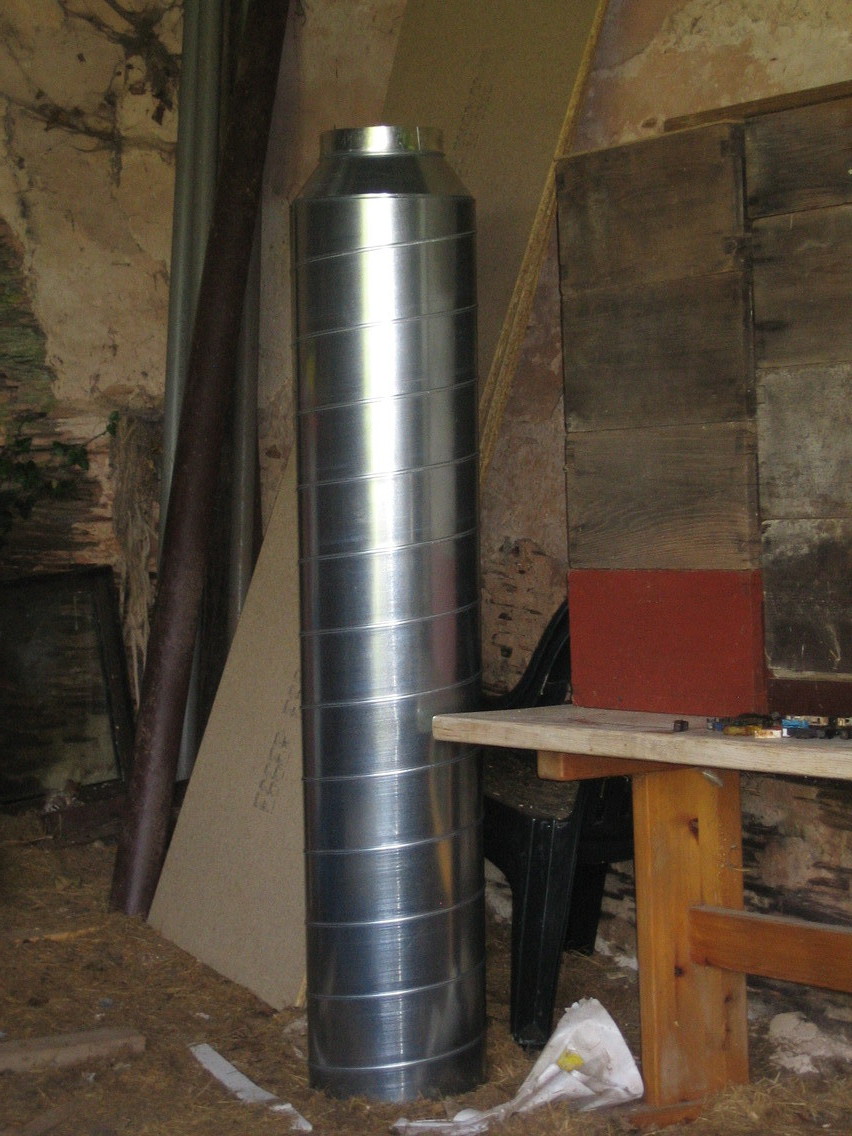
The reducer is a small amount shorter than I thought — only about 120mm, but that’s fine.

I’m now wondering if it wouldn’t be rather neat given that I have lots of room, to run some ducting up the inside before I fill it with concrete to put cables through rather than running them up the outside of the pier. I’ll ponder on that a little longer.
Posted in Astronomy, Observatory, Projects | Tagged , | Leave a comment

Observatory Build. The Big Idea.

Since I’ve had my telescopes I’ve been very tempted to build an observatory. My preferred viewing site is some forty metres from the house which is a long way to carry kit (not to mention to trail power leads if I need power), so the obvious solution is to build an observatory where I can have things set up permanently.

Much as I’d love to build a “rotating dome”, it’s really not practical for the site, not to mention sticking out like a sore thumb, so I’ve decided the best solution is a “roll off roof” design, where the roof runs on wheels in a channel on the tops of the walls and can be pushed to one side when required.

My plan is to have an observing room perhaps ten feet square, with a “warm room” to one side where computers and other equipment can be used. The other major requirement is that the pier should be capable of carrying both SCT and Mak OTA designs where the eyepiece is close to the mount, and large newtonians where the eyepiece is much further away in a position where they can be used comfortably, preferably in a seated position.

That is pretty much my starting point. I’ve looked at quite a number of other people’s builds and intend to plagiarise their work heavily to suit my needs. I’ll document the process as I go along.

Posted in Astronomy, Observatory, Projects | Tagged | Leave a comment

Ditching My Paperwork

I can’t quite believe it’s been six months since I last wrote anything. I guess that’s just how busy I’ve been of late. Time flies like a banana.

Anyhow, thanks to a client who wanted me to sign an NDA by emailing me a scanned image of their NDA form signed by them, to be printed out, signed, scanned and emailed back, I thought it was finally time to address scanning on my Officejet 6500, which I’ve never used before. I discovered that Ubuntu 11.04 had installed “simple scan” on my desktop and that it would quite happily scan documents over the network and not only that, it would scan from the sheet feeder too. It wasn’t too long before I decided that I could scan large amounts of the paperwork that fills my office taking up space to no good purpose and being a fire-hazard into the bargain, and then ditch all the dead trees.

I’ve made a start, and I currently have a pile of unwanted paper (some I’ll recycle for “scribbling whilst thinking and random doodling” purposes) about eight inches high and getting larger all the time, all in exchange for a measly 12GB of disk space. Seems like a bargain.

I did look into gscan2pdf, but it didn’t seem very happy on my machine, being completely unable to tell when it had run out of pages to scan from the sheet feeder. I’m sure that’s something I can sort from the saved image files later though if I decide it would be useful.

In fact, that little “bing-bong” has just sounded to tell me that my latest scan has completed, so I’d best go and save all the files…

Posted in Computing | Leave a comment

Observation Report catchup

It has, IMNSHO, been a rubbish summer. Sunny days have been few and far between and according to the reports this August was the coldest for seventeen years. September isn’t turning out to be anything of an improvement either.

So, given the dearth of cloud-free nights much of my observing has been odd hours snatched here and there between the clouds and I’ve failed to get much decent observing time in at all. I was very much hoping to spend some time learning my way around the Summer constellations, but it seems the major skill required this Summer has been the ability to recognise a constellation from the minimum number of stars possible.

The lack of reliability of the weather forecast has meant that the ST120 on the AZ3 mount has been the tool of choice, being quick to get in and out of the house and not needing too much time to cool down. I’d quite like to have had the 127 Mak out once or twice, but it’s a touch on the heavy side for the AZ3 and the EQ3-2 mount I usually use it on is a lot more work to move about when the weather isn’t playing ball.

Since I last got out in mid-August I’ve had one further night’s observing, during which I managed to view both M56 in Lyra and M71 in Sagitta, both nice targets to find. Unfortunately that’s pretty much been it. There have been teasing glimpses of clear sky (including tonight, though the moon is now very close to full and washing out just about everything), but no good continuous periods of decent observing weather.

I did have a further attempt at view Jupiter, but again it was too low in the sky for clear viewing. There was a small positive note on that occasion though. I’ve seen quite a few streaks across the sky that I’ve attributed to the Perseid meteor shower, but as I was just getting settled with Jupiter in the eyepiece a flash shot across the field of view. I looked up but could see nothing in the sky, so imagined it was just my eyes. As soon as I looked back in the eyepiece there was a second. Again not visible to the naked eye when I moved. I have to assume they were both meteors, but just too faint to see unaided.

In my idle moments (hah! 🙂 I’ve started on a project to build an observatory which should allow me to make the most of short periods of clear skies, but more of that another time.

Posted in Astronomy | Tagged , , | Leave a comment

Observation Report, 19/8/2011

We’ve had the occasional clear night since May, but mostly when the moon was very close to full, leaving little to observe except the moon itself, but last night was the first time I’ve been able to spent a significant amount of time looking at DSOs for more than three months.

Unfortunately my wife was out and I was looking after the kids so I had to stay near the door which meant that I couldn’t look for some of the Messier objects low on the southern horizon as I’d hoped because of the trees, but I did at least have time to spend hunting for those slightly higher in the sky in Ophiucus, the higher part of Sagittarius and Scutum.

Ophiucus was up first, and my lack of practice showed as I too about fifteen minutes to find M10 and a further five to realise that it was actually M12 It wasn’t all bad though as I estimated the position of M14 based on a couple of stars (“hmm, it looks about 2/5 of the way between these two…”), put the red dot on the spot and there it was, bang in the middle of the EP.

The bad news is, I’m afraid, that M107 has disappeared. I star-hopped down from zeta Ophi and found a little “arrow” asterism that has M107 hanging off the bottom end of the arrow head. Only it just wasn’t there. I tried all sorts of magnifications, averted vision, nudging the scope, but I just couldn’t find it. It’s gone.

Moving around I quickly found M26, but “star” (as it were) of the night was the Wild Duck Cluster. I spent ages looking at it trying to see more detail and it seemed to take magnification well. As impressive in its own way as, say, M13, I thought.

The moon was washing out a fair bit of the sky by this time, so I fought with the AZ3 until it would hold the ST120 roughly vertical in a steady position and found M29 in Cygnus, but the view wasn’t great so I’ll come back to that another time.

Since it was there and as I’ve actually had very little opportunity to look at it when it’s been anything other than full, I spent a good three quarters of an hour exploring the moon and finding a few more of the Lunar 100. Once there are some shadows it really is amazing how much detail it’s possible to see. I can kind of understand why people think you should be able to see the stuff left behind by the moon landings. At 100+ magnification it just feels like you could reach out and touch it. I had to keep reminding myself that those features that look really tiny and can only just be made out are actually very large. It’s easy to lose all sense of scale.

I rounded off the night by having a quick look at Jupiter, but perhaps there was some light cloud low on the eastern horizon as it appeared very mushy. Having had such a good evening thus far I decided there was no point spending further time on it and called it a night.

Here’s hoping it’s not another three months until the next one…

Posted in Astronomy | Tagged , , , | Leave a comment

Honey Harvest 2011

This year I took on four hives belonging to a local farmer in addition to the hives in my home apiary. There have been beehives on his farm as long as anyone can remember and he was keen to keep the tradition going, but the previous bee-keeper was trying to cut back on his workload and wanted to give them up.

The bad news when I first visited the hives early in the Spring was that one colony had died out over the winter. There were clear signs of something, probably a woodpecker, having a go at the hive, so it’s possible that’s what caused it. The good news (or further bad news if you’re that way inclined) was that once the weather warmed up thirty-five acres of oilseed rape burst into flower in a field half a mile away. I took around 90lbs of OSR honey off those three hives shortly afterwards.

I can’t imagine anyone will argue much about the summer being very poor and whilst I know of some people who did ok, I also know of people who were having to feed their bees when they should have been harvesting their honey crop, so whilst disappointed I was happy to have approximately 70lbs of honey when I took the harvest in August.

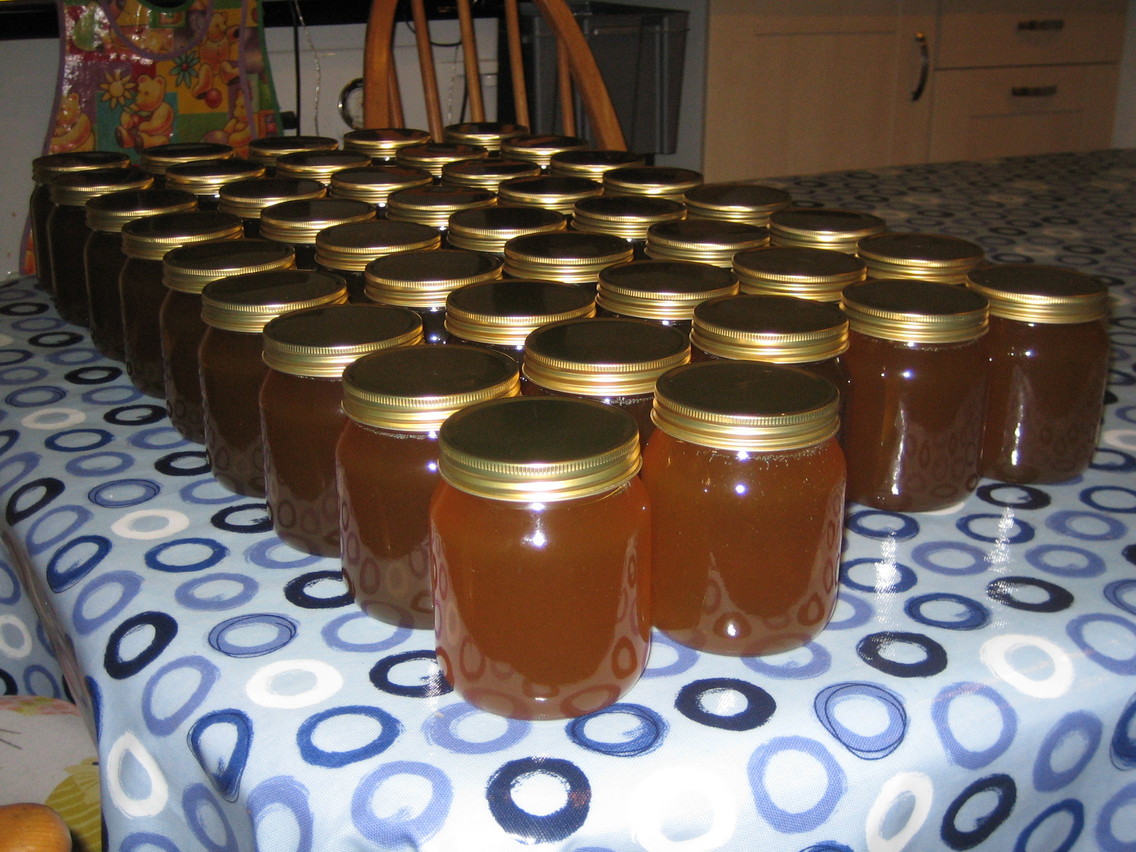
The summer honey is now bottled and sales will begin as soon as my new labels arrive. It doesn’t perhaps have the immediate sweet hit that some other honeys do, but has a very creamy feel on the tongue and to borrow a few wine-tasting terms, has very good “length”, with a little touch of spicy heat. The OSR honey I plan to make into “set” honey once all the additional bits arrive. I’ve never made set honey before, so it’s going to be a bit of an adventure. I’m quite looking forward to it.

Posted in Bee-keeping, Smallholding | Tagged , | Leave a comment

Solar PV Installation

For a long time I’ve been tempted by a solar photovoltaic (PV) installation, but been unable to convince myself that it would be financially worthwhile. A couple of months ago however a friend was telling me about his new installation and I decided to look at the figures again. Our house has a large area of roof that faces south-west and originally being thatched is of steeper pitch than many modern houses, giving the potential for better performance during the winter, so I was quite hopeful.

The current domestic Feed-In Tariff (FIT) payment levels are 43.3p per kWh generated, regardless of whether the power is used on-site or exported, and a further 3.1p/kWh for power exported, though at the moment unless you have an export meter 50% of your production is assumed to be exported, giving an average figure of 44.85p/kWh generated. The payment levels are linked to the RPI and free of income tax for domestic installations generating electricity mainly for use on-site.

I had a rough idea of what a 4kWp installation should cost to install, so set up a spreadsheet to work out payback times based on different changes in the RPI and in the cost of electricity based on sunlight levels at my location (I’m told the government-mandated models use the sunlight levels in Sheffield). The figures actually worked out quite well, paying back the installation cost in around six to seven years and earning in the region of £75,000 over the twenty-five year period, so I decided to get some quotes from local suppliers.

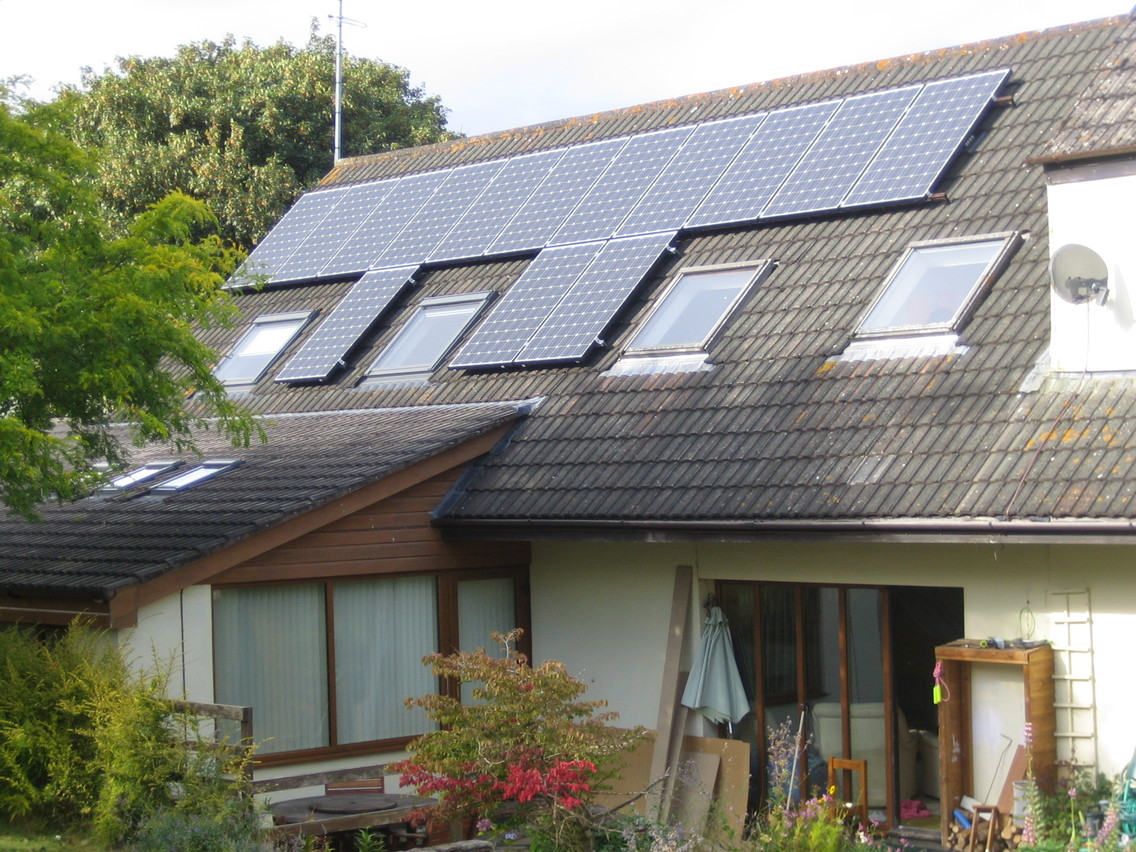
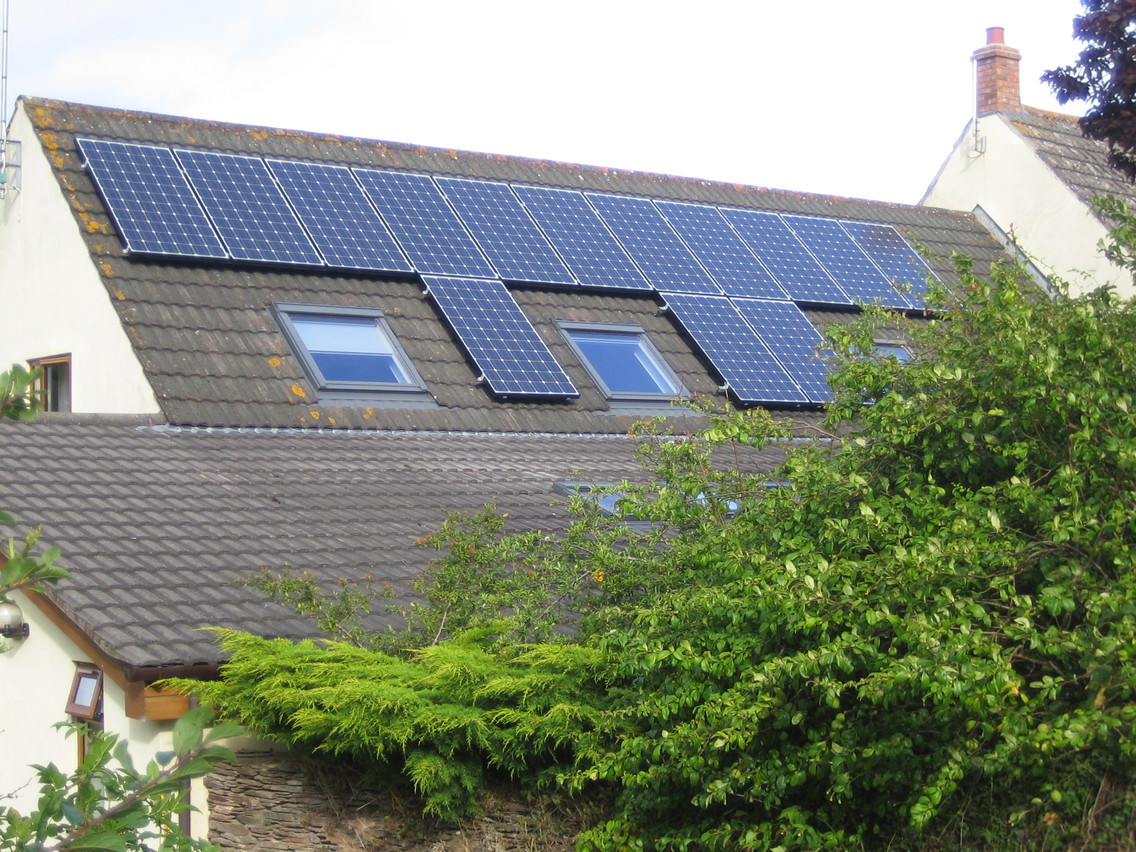
The company that impressed me the most of all of the suppliers who quoted was Somerset Solar Electric, who emailed a number of drawings for different arrangements of panels as well as suggestions for three different sets of panels with a list of pros and cons for each. In the end we went for a system of fourteen Sungrid SG-260 panels which gave us an output close to the maximum Western Power would allow us to feed into the grid on a single phase.

The installation itself took three days from start to commissioning despite being done a little out of the order I was expecting because they were delayed on a previous installation due to bad weather. The electrician arrived first and ran the cabling to connect the inverter in the loft to our incoming supply in the cellar. As luck would have it I had lots of the floor lifted to do some plumbing work, so we took the opportunity to run the cable neatly inside the house rather than on an outside wall. I got the impression the panels were a relatively easy installation, partly because the roof comes down to the first floor ceiling level and partly because it is tiled rather than slated, allowing tiles to be slipped aside to fix the mounting brackets to the rafters. To install the mounting rails and get all the panels in place took just over a day and a half and the system was fully commissioned the same afternoon, on 1st September.

The weather since has been really quite poor in terms of hours of sunshine, but despite that we’re still producing 10kWh per day on average. The inverter we’re using, a Power One Aurora, as an RS232 connector through which I can get actual production figures on an ongoing basis, so once I have that figured out I’ll set some “real-time” graphs up. And get my weather station running again so it’s possible to relate power production to the weather. Given that we’re not far off the Autumn solstice it seems reasonable to use that 10kWh figure as an average daily production figure for the year, in which case my original spreadsheet models have under-estimated production slightly, so I’m happy about that.

For the record, the installation is 3.64kWp, on a roof of approximately 45 degrees pitch, facing south-west.

I’ve now filled in my application forms to sign up for FITs and sent them off to Good Energy. Roll on my first payment…

Finally, a couple of pictures of the installed panels:

Posted in Environment, Projects | Tagged , , | Leave a comment

Observation Report 13/3/2011

This week is apparently the best week this year for observing Mercury. It’s never going to be that high above the horizon once the sun sets, but now is about as good as it gets. I’ve never seen Mercury before, so didn’t know what to expect when I went out at around 6:45pm, but sure enough just to the right of Jupiter there was another “star”, not quite as bright as Jupiter, which had a clearly defined disc when viewed through binoculars. If the skies stay clear this week I’ll try to get another look at it with the Mak.

The moon being around half full it’s fairly bright now and whilst the sky was clear the transparency was poor, but I did also manage to find one more Messier object in Virgo, M49, (my fiftieth) with the ST102. Despite being 8.4 magnitude it was very difficult to pick out. I gave up trying to find M61 and M104. Darker skies are required, I think.

Posted in Astronomy | Tagged , | Leave a comment

Observation Report 7/3/2011

It’s the 7th March. I received my first telescope — the ST80, for Christmas 2010. And tonight is the first really pin-sharp night sky we’ve had. I still haven’t sorted out the mount for the 127 Mak, so the ST102 is out again.

I’d planned to spend some time looking at multiple stars tonight following some of the suggestions in Turn Left At Orion, but had to have one more go at M106 first. This time I star-hopped over from Chara and within a couple of minutes there it was in the eyepiece. Don’t understand how I’d failed to find it previously. In fact, I recognised the stars around it as being ones I’d spent ages staring at on previous nights whilst completely failing to see the galaxy itself!

My first multiple star target was Castor which I found split very nicely giving two sharp star images with a diffraction ring around them. I think I also found the third star, but wasn’t able to match the positions of the stars I could see with Stellarium so need to visit this one again.

Next on the list were ι-Cancri and Struve 1266. ι-Cancri I found fairly easily and could split, but I’m unconvinced that I found Struve 1266 and will have to try that again another time. After these two I moved on to Cor Caroli and γ-Leonis without any problems.

Despite being still fairly early it was unusually cold and I decided I’d have a brief view of Saturn before calling it a night. I’m so glad I did. Even at 125x magnification with my 4mm eyepiece the image of Saturn was very sharp and I could make out three moons that I believe to be Titan, Rhea and Hyperion. Enceladus was in front of the planet at the time according to Stellarium, with Mimas and Tethys on the opposite side close to the rings. Dione should have been visible, but I didn’t see it. Very pleased to have had such a good view of the planet though. I look forward to getting the Mak into service soon.

Posted in Astronomy | Tagged , , , | Leave a comment

Observation Report 6/3/2011

Another clear night, but again with unexceptional transparency. The more I go out the better I am getting at judging the quality of the seeing. I’ll still go out pretty much any night there are stars to be seen nonetheless. The practice at finding objects is well worth the effort, to be able to make the most of those times with the seeing is good.

Back to the ST102 for this evening and on with some hardcore Messier-hunting.

I wanted to revisit a few of the objects I’d first seen with the ST80 having gained a bit more experience finding them, mostly just to confirm my original sightings, so initially I found M1, M35, M42, M43, M44, M48 and M67 in quick succession before moving on to newer things.

As with my previous session the objects in the western sky were too obscured by the haze on the horizon to be worth spending time on. I think I’ll have to wait until the late summer before I can see them. So, the first new target for tonight was M106 and, like last time, another failure. With M88 it was a completely different story though. Working from Stellarium I put the red dot finder in what I thought was roughly the right place and as soon as I put my eye to the eyepiece a galaxy jumped out at me. Unfortunately, given the number of galaxies in this area of Coma Berenices and Virgo I couldn’t be sure which one it was. For the same reason I was able to hunt around, occasionally returning to the first one to find my bearings and pick out two more galaxies and by sketching their relative positions and those of the stars around them and comparing the result to what I could see in Stellarium I decided I’d found M87 first of all, followed by M86 and M84.

Given the locations of these three objects I decided I ought to be able to navigate around and find a lot more and was happy to have my deductions confirmed by finding a long list: M88, M91, M98, M99, M100, M58, M59, M60, M89 and M90. The last I visited was M98 which, being edge-on, is unmistakable in shape. I was very pleased to have found all these and to have identified where I was in the first place. I look forward to viewing these again when Virgo is higher in the sky.

To finish off for the night I decided I’d have another go at finding some of the galaxies in Leo that I’d failed on previously. Starting from ρ-Leo I managed to star-hop neatly to M95 and M96 and M105 was then an easy jump. I was surprised to see two fuzzy blobs in the eyepiece once I got to M105 though. According to Stellarium the second would have been NGC3384.

A busy night, but I’m pleased to have found so many objects, taking my total Messier count up to forty-eight. I think my “eye” is definitely improving. If only the seeing would…

Posted in Astronomy | Tagged , | Leave a comment