It’s mid-summer, so where’s the Sun?

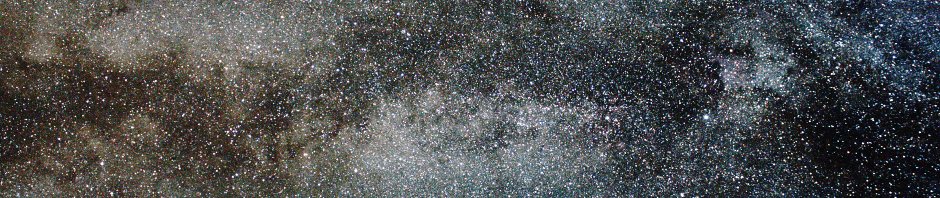
Someone was asking today why the sky is so bright at night at this time of year, so I had to have a think about where the Sun actually goes…

So we’re clear what I’m talking about, let’s say you’re standing outside around midsummer in the northern hemisphere, facing south.  Take a flask; you’re going to be there a while.  The sun rises behind your left shoulder to the north-east, travels across the sky until noon when it’s high, but to the south of you, and then drops back down over your right shoulder to the north-west, passing around “behind” the earth to the north before coming up again in the north-east.  Unless you’re in the tropics the sun never travels around the earth “under your feet”, just as it never goes directly above your head.

The Earth is currently inclined at about 23.5 degrees from the vertical, northern hemisphere towards the sun during the day.  After scribbling on a bit of paper I think I’m correct in saying that as the sun passes in front of you to the south then at its highest it will reach an altitude of ( 90 – latitude + 23.5 ), so 62.5 degrees above the horizon for me at 51N.  At night as it passes behind your head and the planet to the north it will be at most ( 90 – latitude – 23.5 ) below the horizon, so 15.5 degrees for me.  As “astronomical darkness” is defined as “when the sun is 18 degrees or more below the horizon” it’s not going to be that dark here.  And I’m fairly well south for the UK.  If you’re at 59N in the Orkneys the sun won’t drop more than seven degrees below the northern horizon and I imagine it’s pretty light all the time.

Posted in Astronomy | Tagged | Leave a comment

Observation Report, 19th June 2012

Well, it’s been a full month since I last got out with a telescope thanks to the weather, which has been on the wrong side of depressingly atrocious for all of the last four weeks. Despite feeling fairly tired therefore, I was determined to make it out tonight.

The plan for the evening, which has been sitting on my desk for just as long, was to take out the ST120 and go hunting for the late teen and early twenties Messier objects around Sagittarius, Scutum and Scorpius. As it turned out the remaining cloud drifted away and at half past eleven I was outside setting up under a beautiful sky, the Milky Way clear from the southern horizon all the way over my head, finally disappearing in the lighter sky to the north.

I check the scope and finder were aligned using Saturn and then rearranged the tripod to point it in the general direction of Sagittarius, took a peek in the eyepiece to check I wasn’t just pointed at trees and right there in the middle of the eyepiece was my first DSO of the evening! The next bit is perhaps the most challenging for users of unaligned manual mounts. Which DSO was it? Triangulating off Ophiucus I decided that I must be looking at M22 and I was off and running…

I guickly found M25 and M28 just navigating around the sky using a 32mm eyepiece and then dropped down to M20 and M21. Wow! Even with a 120mm scope under mid-summer skies and with a touch of light pollution as well there is so much nebulosity visible around that group of objects. I could probably have stopped right there for the evening. I did keep coming back to them afterwards.

Moving up I found M23 and then came back eastwards to pick up M25, marvelling at the sheer number of stars visible in some of the clusters. It was like looking into the Total Perspective Vortex. From M25 it’s a short hop up to M18 and then M17. An absolute jaw-dropper. I really just wasn’t expecting it. About this time something appeared on my shoulder and started whispering into my ear “You need more aperture. You need lots more aperture”. Yes, yes, I’m working on it.

I should have hit M16 before M17. It almost seemed an anticlimax the other way around which really isn’t fair as it’s a lovely object in its own right.

Starting to feel a bit tired now I thought I’d have a quick look for M62 which I’d tried before but couldn’t find. I was on such a roll that it popped out of the eyepiece really easily, a small fuzzy ball.

I was on the point of packing up the eyepieces at that point when I found that I just wasn’t ready to stop. I had to try a few more objects. M6 and M8 were easier to find than I expected, but M7 was just in the tree line by this time and I took that as a sign that it really was time to call it a night.

My only “failure” of the evening was M24. I could find where it ought to have been, no problem, but just couldn’t see it. Stellarium lists it as magnitude 11, so perhaps it was just too big a stretch for my ST120 on that night under those skies. Despite this my “Messier Total” has now reached 96. If I can find M24 and M83 I stand a reasonable chance of finishing them all this year.

As I was packing up I had a quick check of the stars in Ursa Minor. The magnitude 5.7 star between ηUMi and ζUMi was definitely visible with direct vision. For the day before the solstice, I can be very happy with that.

People rave about M45, but I reckon the clusters in this area of sky are at least as outstanding, and there are so many of them. Unfortunately they’re visible for such a short time at the worst possible time of year for viewing. I feel quite envious of those who are further south and get a better view for longer.

Posted in Astronomy | Tagged , | Leave a comment

May 2012 FIT Payment

At the end of May we received our second FIT payment, somewhat less than the first as expected. It does mean however that about 4.3% of the installation cost is now covered. Unfortunately the late Spring and early Summer months have proved themselves to be less than optimal for electricity generation so we’re not going to receive as much as predicted for that period when the payment arrives in August. We’re still “ahead of plan” though, so I shan’t be complaining just yet…

Posted in Environment | Tagged , , | Leave a comment

Solar PV Generation Update, June 2012

Well, another awful month weather-wise and they say there’s more to come 🙁

Generation for May was, oddly, exactly the same as for April at 395kWh. I was hoping for anything between 500kWh and 650kWh. You’d think all of those fans they’re building out in the North Sea would blow the cloud away. Anyhow, total generation is now 2,180kWh so far, bringing in about £990 in FIT payments and saving up to £320 in electricity not purchased from the grid.

For reasons I don’t entirely understand, May is supposed to be our best month for generation and the poor output has therefore knocked back predicted output a fair bit, to around 3,680kWh for the year. Surely June can’t get any worse?

Posted in Environment, Projects | Tagged , , | Leave a comment

Solar PV Generation Update, May 2012

Well, for the first time since installation we’ve had a poorer-than-expected month. No great surprises there, given how utterly awful the weather has been.

Output for April came it at a measly 395kWh when based on past performance I was expecting somewhere nearer 580kWh. Hey ho. That’s the way the croissant crumbles. Total generation since installation is now 1,785kWh. On the bright side the tariffs have been increased and we now receive 45.4p per kWh generated and 3.2p per kWh exported. We earned approximately £625 in FIT payments on the previous rate and this month adds about £185 at the new rate taking us up to £810 overall, with up to £270 saved in electricity used from the grid.

This month does knock our predicted output back a fair bit, to around 4,100kWh for the year, but we’re still way over what I’d expect.

Posted in Environment, Projects | Tagged , , | Leave a comment

Solar PV Generation Update, April 2012

Somewhat delayed, this, as I’d lost the piece of paper that I wrote the reading down on. Doh!

Anyhow, output for March was 383kWh, another good month thanks to the unusually good weather. That takes our generation total since installation in September up to 1,390kWh which is about £625 in FIT payments and up to £210 in saved electricity.

As with last month, based on the models I have we’d expect to generate around 31% of our electricity in that period which would put our total expected output for the year up to around 4,500 units. I just don’t believe that will happen (though I’ll be partying if it does 🙂

Posted in Environment, Projects | Tagged , , | Leave a comment

Fan-Cooled Xbox Live Camera for Planetary Imaging

The Xbox Live camera has found something of a following as a cheap planetary/lunar imaging camera since the SPC900 (which is undoubtedly a far better camera) started fetching silly prices. I’ve always found it very noisy however. The camera does get quite warm and it seems reasonable to assume therefore that the noise is partly due to heat. I’d seen someone else mod the camera to fit a fan, so I thought I’d have a go myself. I picked up a 30mm 5V fan from Ebay, cut a suitable hole in the back of the case, wired the fan to the USB 5V and ground lines and it seems to work nicely, at least as far as desktop testing goes. Proper testing will have to wait for a clear night I’ve not had one of those for a month 🙁 Here’s a photo of how it looks, anyhow:

Posted in Astro Equipment, Projects | Leave a comment

50mm Binocular Objective Finder

I wanted a 50mm right-angle finder, but didn’t fancy paying the £90 to £100 they seem to cost, so after someone mentioned it was possible I decided to make my own. I picked up a 50mm binocular objective, cheap diagonal and 25mm eyepiece from Astroboot for about £15 and rummaged through stuff I had lying around for the rest. The mount came from (I think) a dead red dot finder and most of the rest is lengths of various diameters of plastic pipe I had lying about.

This one is very much a “proof of concept” and was useful to make because it brought home just how much of the focal length could be taken up by the diagonal (as much as 60 or 70mm). I intend to make another (though straight through this time, so I can potentially use it as a finder-guider) and will cover the build step-by-step now I know what I’m doing. For the moment however, here are a couple of photos of my completed (but as yet unpainted) finder:

Posted in Astro Equipment, Projects | Leave a comment

Pathetic “10 Best Telescopes” Feature in The Independent

I’m not entirely sure why I find myself so incensed over this particular piece of trash journalism (and I use the word in the loosest possible sense). Perhaps because it aptly demonstrates the utter contempt for their readership endemic in the newspaper industry. Perhaps because if people are going to make the effort to spend time looking through a telescope I’d like them to get as much pleasure from it as I do. Or perhaps it’s just because on the basis of this rubbish, people might go out and spend their hard-earned on something totally unsuitable.

Yesterday the Independent newspaper published an article on the 10 Best Telescopes, clearly targeted towards astronomical use. If you read no further, take this one point away with you: ignore the article. It’s utter bottom-wash. If you are interested in buying a telescope for astronomy the best advice I can give is to decide on a budget and then either visit an observing session held by a local astronomy society, have a look at what they’re using and talk to other astronomers about what is available in your price range. If you can’t find a local society, join an on-line forum such as Stargazers Lounge where you’ll find more knowledgeable and friendly advice than you can shake a hairy stick at.

The Indie feature was cobbled together by Samuel Muston who claims on his twitter page that he “does something at the Independent”. Whatever that something is, it’s clearly not carefully-researched journalism. I don’t know how he managed to get the gig for writing this particular piece, but perhaps the only other person in the office at the time was the cleaner. The cleaner could not have turned in anything worse. Could it be that as a foodie, Mr. Muston spends much of his time staring at the world through glassware and was therefore considered experienced in judging the quality of a lens? When I used to visit Ludgate House, “home of the Daily Express”, many years ago it was clear that the hacks were more interested in an altogether different type of optic. Not that he should bear all the blame. Clearly the editor who allowed such drivel to be published was more interested in filling column inches than actually producing a useful article.

Before getting to the list of “best telescopes” itself, there are a couple of general points that should be made. To be a genuinely useful instrument for astronomical use a telescope must have good quality optics and they just don’t get produced on a budget for the limited size of the astronomy market. There are other components that need to work well too, otherwise you’ll end up wanting to throw the thing across the garden the first time you use it, but to some extent they can be improved with a little work. If you have a poor quality optical train then you might as well drop the telescope in the bin. Not everyone will share my opinion I’m sure, but I’d say that there are almost no telescopes costing less than £100 at the moment that are up to the job and a fair few more expensive ones that aren’t either. If you can’t afford £100 then a pair of binoculars somewhere around the 10×50 size is likely to give far more enjoyment. A cheap telescope may be ok for so-so views of the moon, but that’s about as far as you’ll get with it. The second point is that magnification claims made by manufacturers are irrelevant. What really influences the quality of the view achieved with a telescope is how much light it can capture and that is dependent on the aperture — the diameter or “width” of the telescope. The ability to have high magnification is useful (which is usually changed by swapping eyepieces), particularly for viewing objects in the solar system, but it’s not the be-all and end-all. There’s a general rule that a telescope will only be good for magnification up to twice its diameter in millimetres, but even then it’s rare for UK skies to be clear and still enough for greater than 250 times magnification.

And so to the “10 best telescopes”:

  1. Skyliner 250PX
    Certainly a good telescope and by no means as expensive compared to others as Mr. Muston suggests, but it’s also big and heavy (between 30kg and 35kg, I believe). Telescopes of this size often come up second-hand because people find they’re too awkward to get out to use and to store and prices can be surprisingly low as a result. Not a good choice at all for a beginner.
  2. Olympus EXP SI Binoculars
    Many astronomers have a pair of binoculars as well as a telescope and they’re great to have. If you can’t justify the cost of a telescope then a good pair of binoculars is an excellent alternative. They don’t have to be as expensive as this pair. If you’re interested in going down this route, talk to an astronomer or dealer who is knowledgeable about using binoculars for astronomy. What’s good for terrestrial use may not work well on the night sky.
  3. National Geographic Land & Sky
    Fails the £100 test. A toy. And better as a rounders bat than a toy telescope at that. Avoid it.
  4. Bunkerbound.
    Same again. Even Amazon have it in their “Toys & Games” section.
  5. EVOSTAR-102 (EQ3-2) Refractor.
    A decent telescope on a fairly competent mount. It’s more biased towards viewing objects in the solar system rather than galaxies and nebulae. The mount will be awkward to get the hang of and perhaps even frustrating as a beginner. The advantage is that if it’s properly aligned it can easily track objects as they appear to move across the sky, and (at extra cost) it can be motorised.
  6. Vario-Finder 10×60 with Astro Lens
    Baader make some good quality astronomy kit, but this really isn’t designed to be an astronomical telescope and for the money you could get something much more satisfying. Avoid it.
  7. Celestron Astromaster
    There are a number of different models in the Astromaster range, but I’ll assume from the price that it’s the 130EQ that’s being discussed here. It’s nearer the budget end of the market to be honest, but it is still a perfectly acceptable beginner’s telescope and will give far better views of galaxies and nebulae than most of the telescopes Mr Muston recommends, although they’ll still mostly be fuzzy grey blobs. Not really ideal if your interest is with objects in the solar system however.
  8. Explorer-130p Supatrak Auto
    Another perfectly acceptable telescope. Once you’ve found an object it will track it across the sky. The same comments apply as for the Astromaster.
  9. The Celestron Travel Scope
    I assume from the brand that this will be optically ok. 70mm of aperture isn’t really going to satisfy anyone for very long though, and if the compelling reason to buy for Mr. Muston is that it comes with its own bag, well, I’m sure it’s not beyond the wit of most astronomers to find a suitable bag or case to transport a telescope in. Failing that, get some binoculars.
  10. Infinity 76P 3″ Reflector
    Cute, but I think it’s really just Skywatcher’s Heritage 76 model wrapped up to look like a toy. It is a proper reflecting telescope however, with a parabolic mirror. I think Mr Muston made up “aspherical technology”. It is a very small aperture though and going to be limited as a result. Some of the brighter nebulae and galaxies would be visible, as would some of the planets, but you’d not see any real detail. I’d buy the Heritage 76 in preference, but a pair of binoculars might be better than either.

So ignoring the binoculars, of the list of “10 Best” we end up with perhaps three that are “ok” for beginners but far from “the best” and one that an experienced astronomer might choose if their interest lay in that direction.

Shame on you, Samuel Muston. You give your profession a bad name (as if it wasn’t already going to take a special dispensation to get it into the bottom-most pit of Hell) and do nothing but damage your limited credibility. Next time you get asked to write about something you have no experience of, have the balls to admit you can’t do it, or at least do some proper research rather than copying out a quick few hundred words from the brochures between courses of a boozy lunch.

Posted in Astronomy | 1 Comment

Lifecam Saturn Montage

I spent some time last weekend capturing images of Saturn with my modded Lifecam using different SharpCap settings. This is a very different camera to use compared with the SPC900. There’s no direct control of gain, and the pixel size is almost half that of the SPC900. That didn’t actually lead to more detail being captured as to get sufficient light onto the sensor to get the camera working well enough I had to do without a barlow of any kind. Here’s a montage of the results. The first image is one taken three weeks ago with the SPC900. The others are all taken with the Lifecam with different saturation and brightness settings.

I’m really not sure I can consider myself at all happy with the performance of the Lifecam as yet. I think I need to wait until Jupiter is back in the sky later this year to do a good comparative test of the two cameras side-by-side. Otherwise, I think I’m done with planetary imaging for a while. Time for a break to do some DSO hunting and catch up on other astro jobs.

Posted in Astroimaging, Astronomy | Tagged | Leave a comment