8GB Memory Upgrade for HP Proliant Microserver

I decided to upgrade the server to 8GB RAM (its default configuration is 1GB). The motherboard has two RAM sockets, so I purchased a pair of 4GB RAM sticks to put in. It’s not a difficult job, only taking ten to fifteen minutes, but it helps to have small fingers.

To fit the RAM it’s necessary to remove the motherboard. It slides out from the bottom of the unit, but it’s a bit fiddly. First thing is to undo the two blue-headed bolts at the front of the board using the key clipped inside the door to allow the board to slide forward a little:
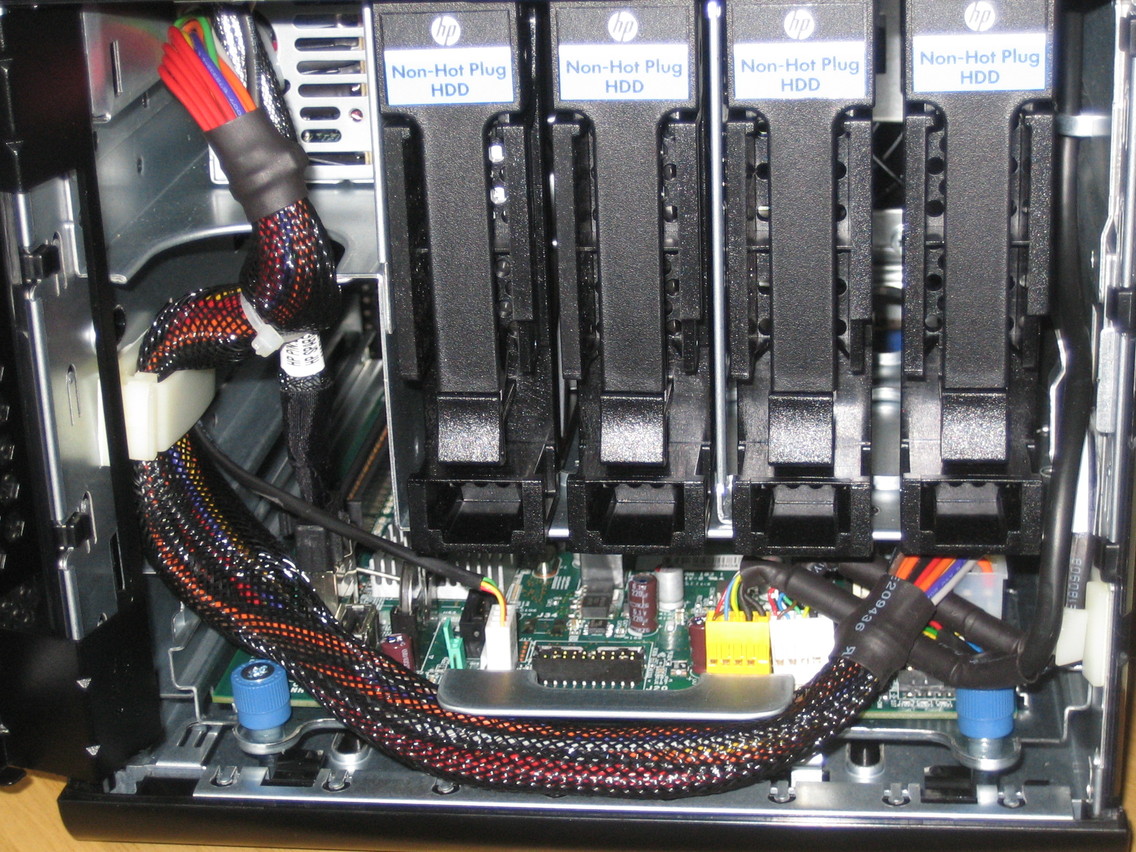
That done it’s possible to remove the two cables routed down the left hand side, including the connector for the disk array (which is awkward if you have large fingers) and the three on the right hand side — two USB headers and the switch/LED connector block:
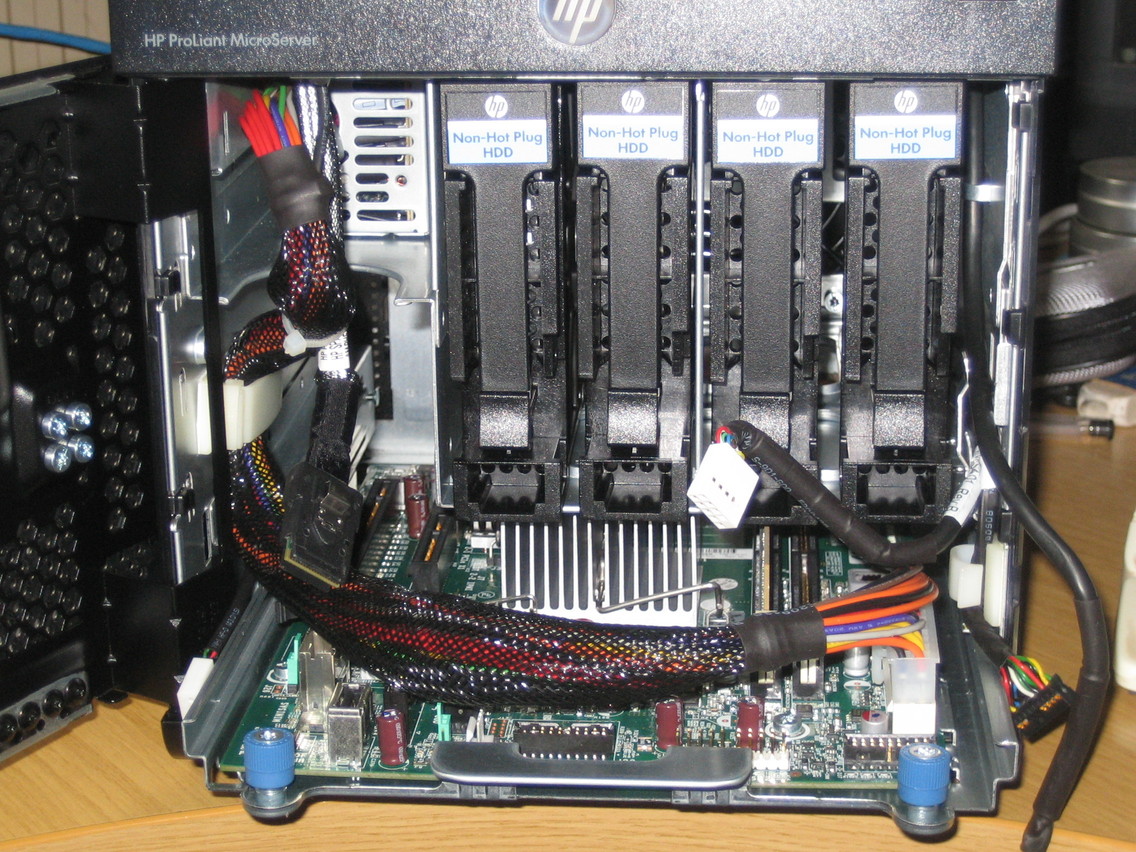
With those removed the board will slide out a little further allowing the power connector to be removed, and then it will come out completely:
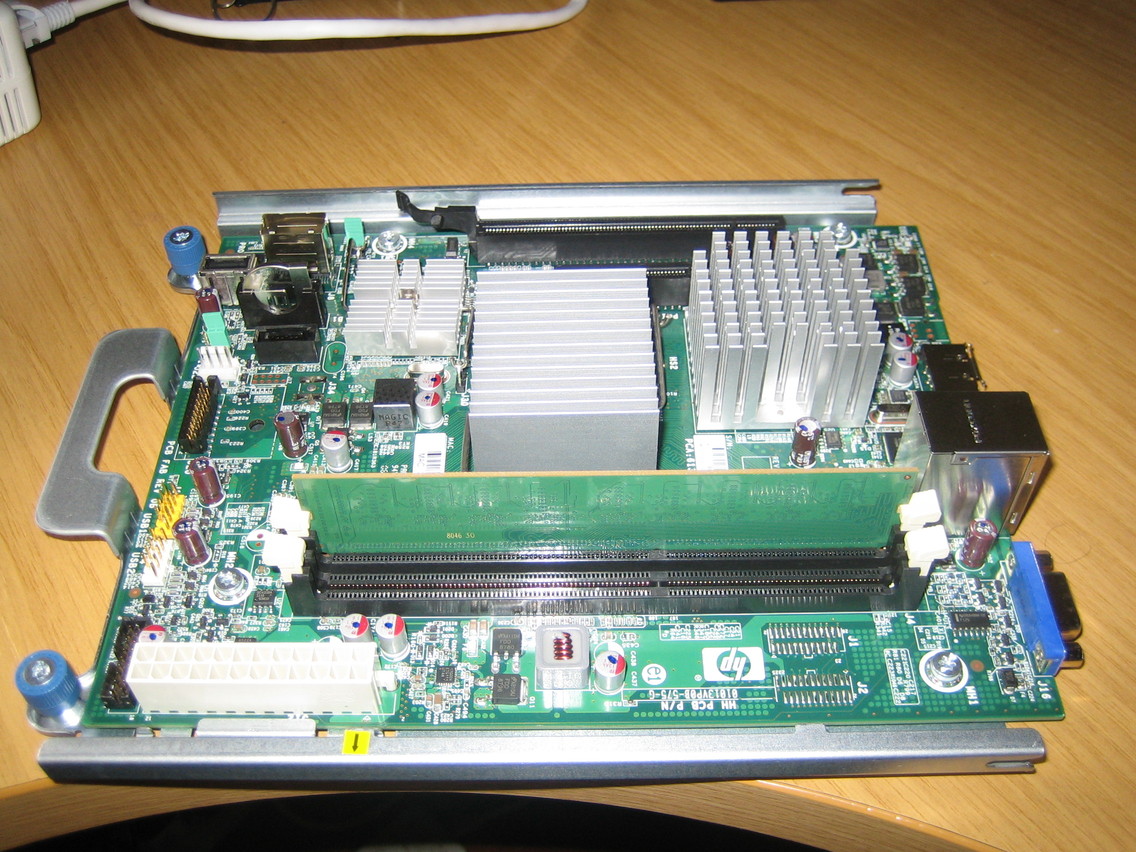
Removal of the old DIMM and replacement with the new ones is straightforward:
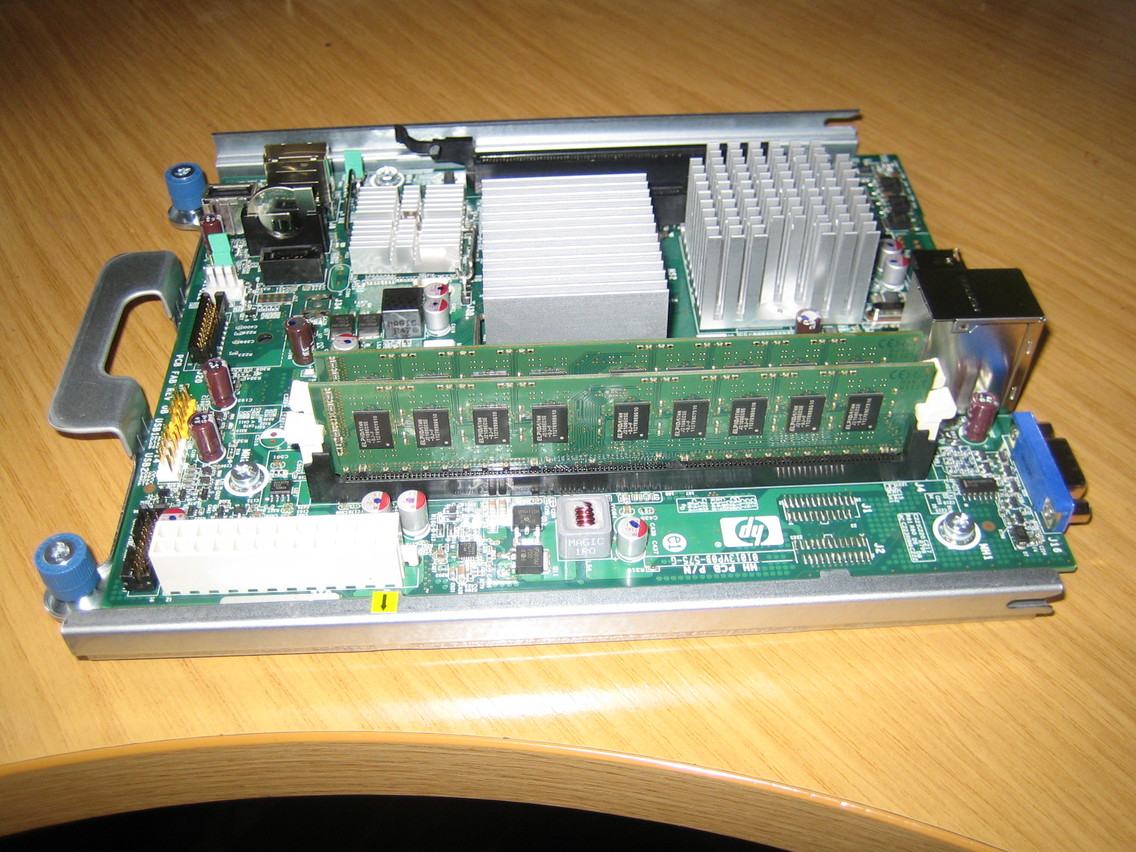
And then as it says in all the good Haynes manuals, “reassembly is the reverse of removal”. First slide the board back in and replace the power connector:
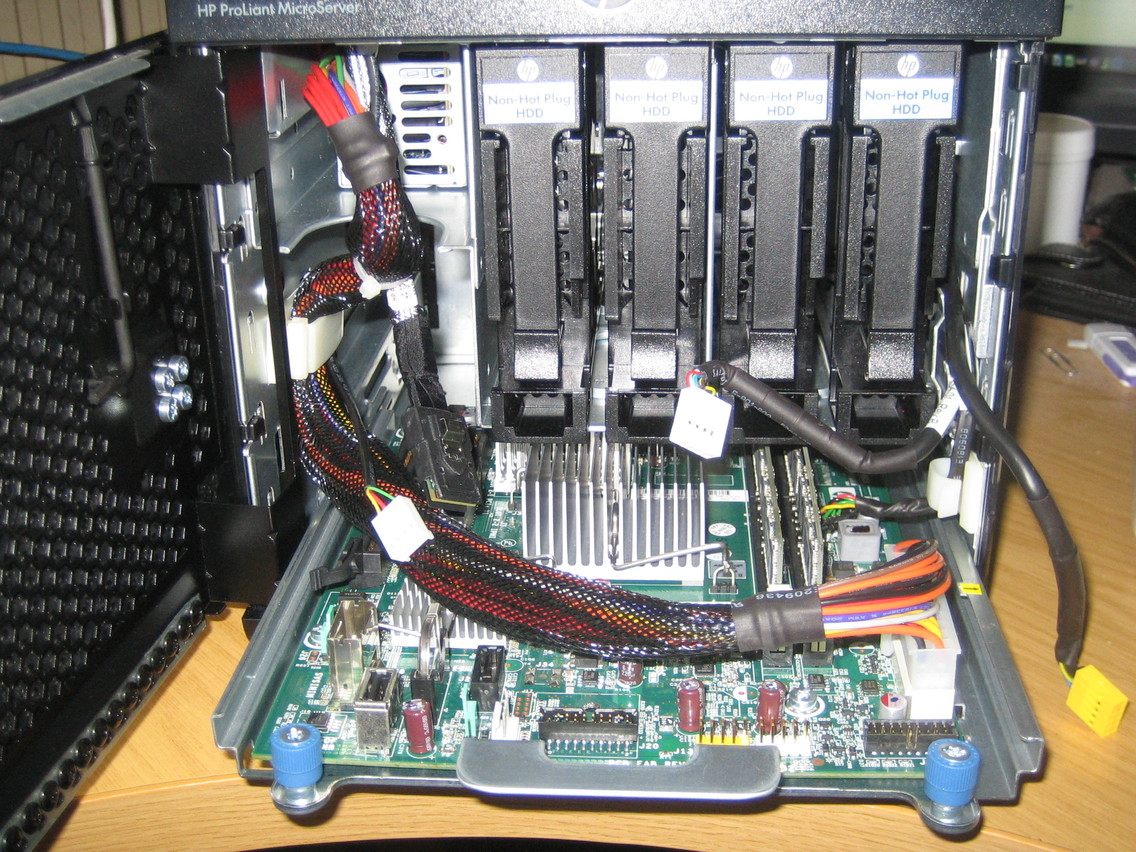
Then slide the board in far enough to reconnect all the other cables:
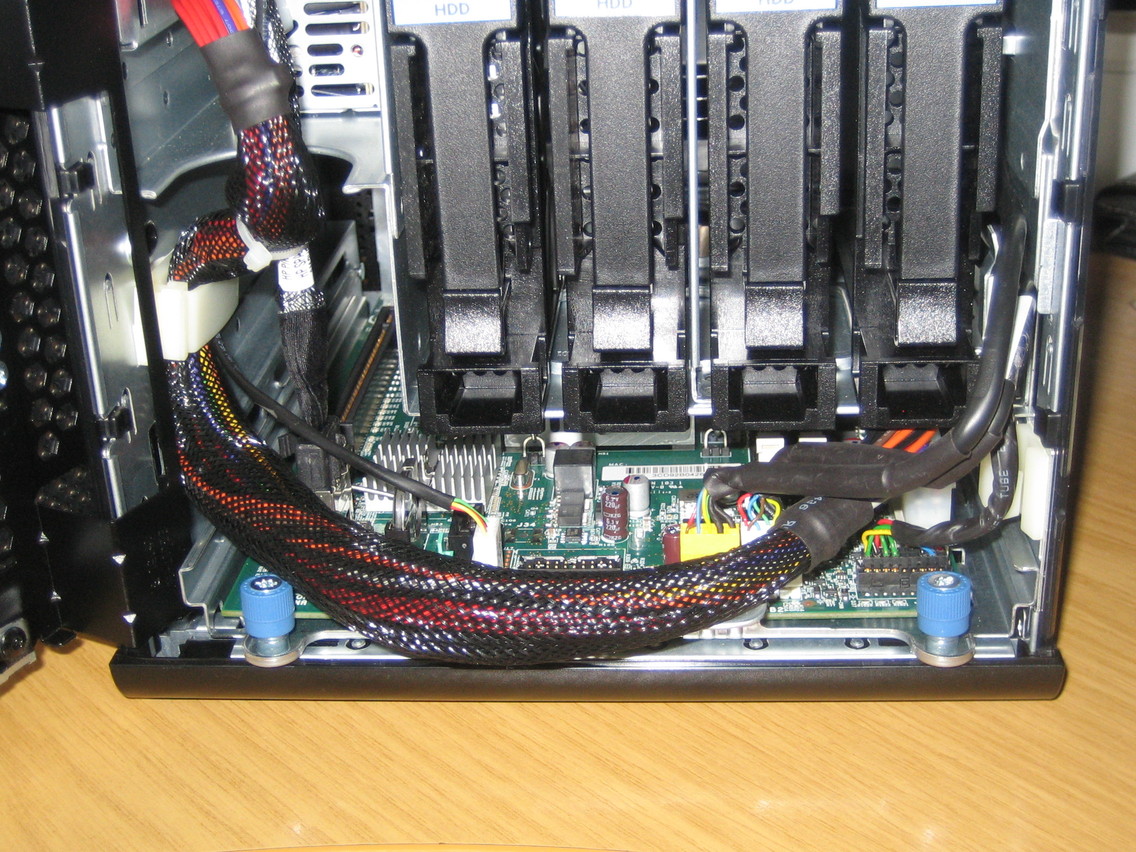
And finally push the board home, do up the blue bolts again, re-seat the cables in the clips and route the power connector cable under the motherboard “handle”:
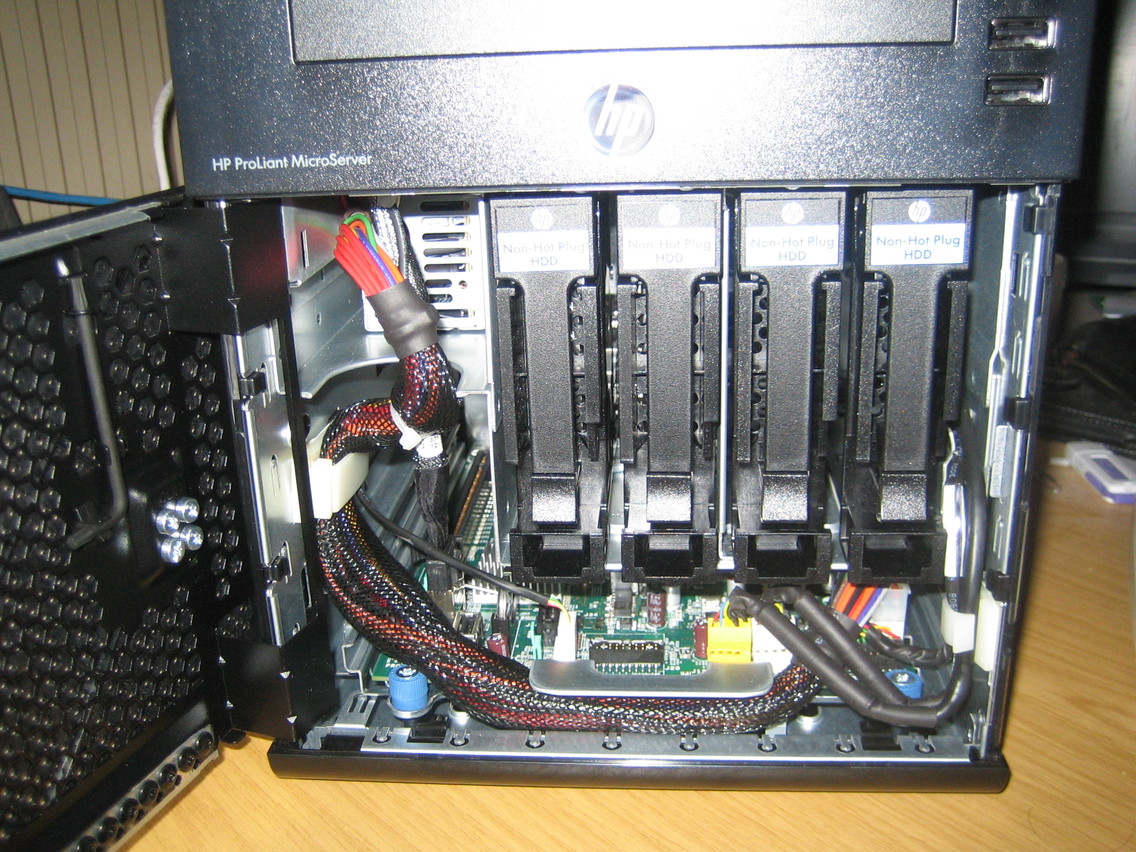
Boot up the server once more and you’re sorted:

$ ssh root@gamay head /proc/meminfo
root@gamay's password: 
MemTotal:        8051332 kB
MemFree:         7845936 kB
Buffers:           11612 kB
Cached:            64960 kB
SwapCached:            0 kB
Posted in Computing | 2 Comments

Clearer Boards

Back in the Spring when I wanted to take the OSR honey off some hives I had a real problem getting the bees to vacate the supers. Up until now I’ve always used a crown board fitted with Porter bee escapes, but despite having cleaned and adjusted them the bees just weren’t interested in leaving the supers. I also tried a friend’s clearer board which used cones at the centre and each corner, but that didn’t work well either.

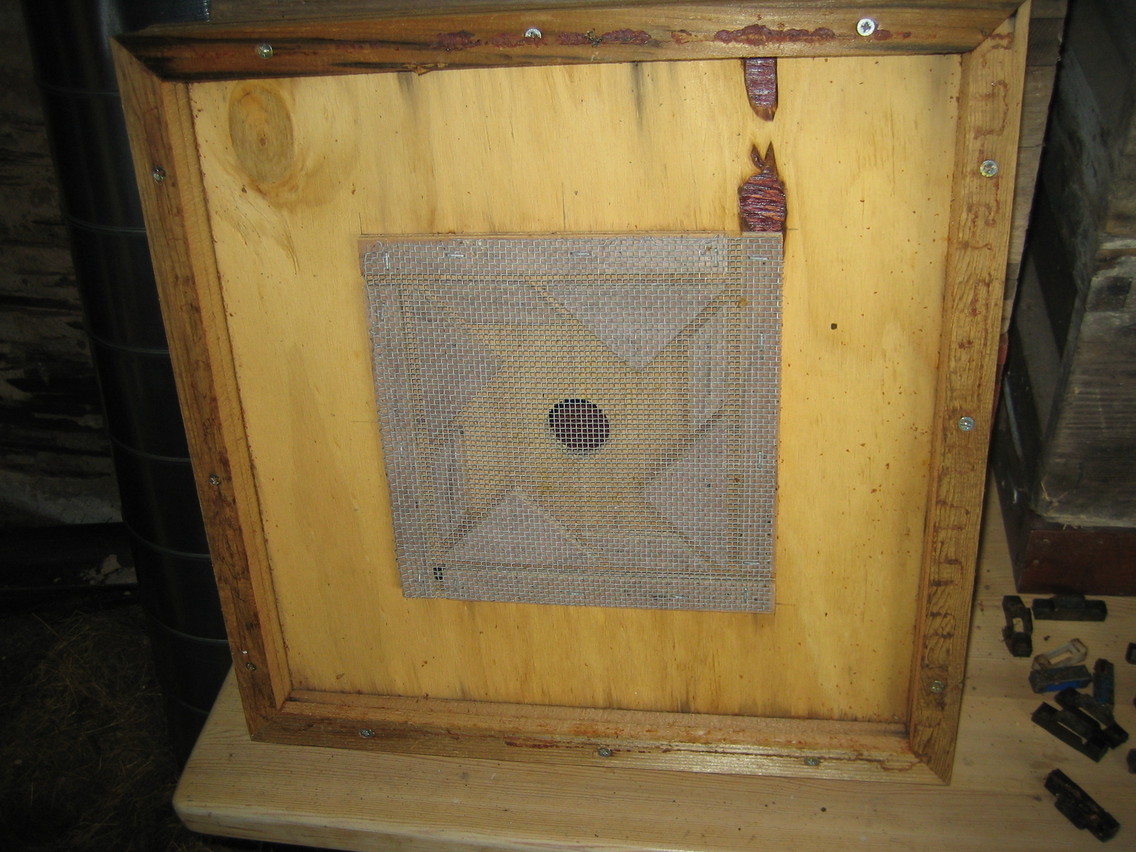
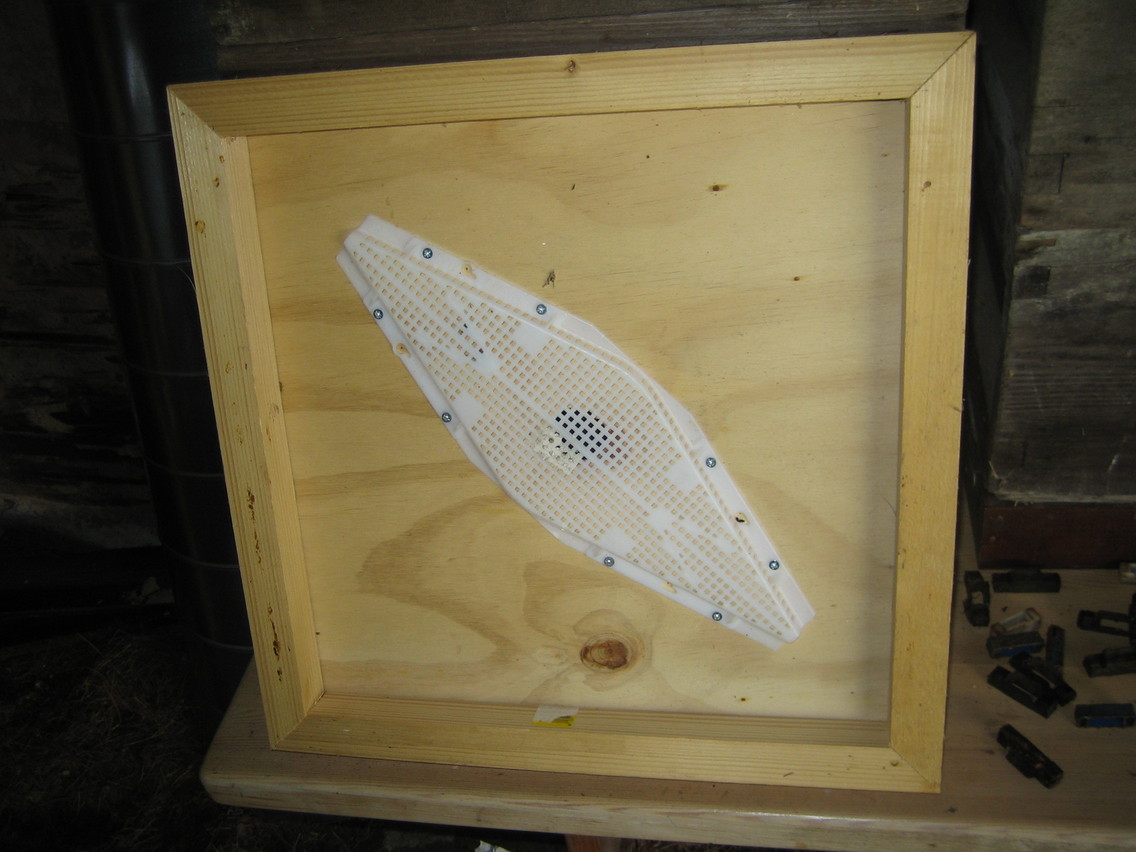
So, for taking this Summer’s harvest I decided I’d try some other designs of clearer out. I bought a few of the rhombus clearers from Thorne and made up a board to suit:

The board is a piece of 18″ square 12mm ply, with 25mm “walls” on the bottom to give the bees a bit more space underneath and 12mm on the top. The hole in the middle is 38mm, purely because I happened to have a hole saw that size.

These worked quite well, the only problem being one where the supers turned out not to be entirely bee-tight. I’ll certainly give them a go again next year. I’d only bought three rhombus escapes and needed four new boards, so I also took a look around Dave Cushman’s beekeeping equipment plans and decided to have a go at making a square vortex-style escape:

Again the main board is 12mm ply with 25mm walls below and 12mm above, and the “vortex” is made from 6mm ply spaced so that a standard hexagonal section pencil would just rotate in the gaps. The 6mm ply was nailed and glued to the base. Once in place, I cut down a piece of mesh to fit over the top and fixed it in place using a staple gun. Again the central hole is 38mm.

This turned out to work exceptionally well and I’m very impressed with it. I shall definitely make up some more for next year and give up on the crown board/Porter escape combination altogether.

Posted in Bee-keeping, Projects | Tagged , , | Leave a comment

Google Sketchup on Ubuntu 11.04

For designing the observatory I really needed something a bit more “touchy-feely” than pencil and paper — my usual method of designing bits and pieces I build. A few people had mentioned Google Sketchup, but it’s only available for Windows and Mac and I don’t do either of those as a rule. I’m a UNIX/Linux user of twenty-five years or thereabouts and I just can’t get on with Windows.

The obvious solution was to try installing the Windows version under WINE. A fair bit of mucking about later and I was no further forward, but eventually I discovered “Winetricks” and it’s own installer for Sketchup. Another few minutes and I was up and running.

The learning curve is fairly steep, but Google’s video tutorials are very helpful at leading you through the basics. It’s entirely possible that attempting to design an observatory as my first project was excessively ambitious, but if what I wanted were that much simpler I’d never have bothered anyhow.
Thus far it’s been an excellent tool for visualising what I have in my head and making sure it stands a chance of working in real life. So much so that I’ve already started using it for other projects such as my ongoing bathroom build. I highly recommend it, but don’t expect to be able to use it as a CAD tool. That’s really not what it’s about.

Visit the 3D Warehouse to see what other people have got up to with it. I downloaded a number of things from that site to help out with and incorporate into my own designs.

I’ll post some images of what I’ve been doing with it shortly.

Posted in Computing, Observatory | Tagged , , , | Leave a comment

Crystal Balls

I was amused (or perhaps bemused) by a piece on the BBC News website today covering the inflation rate rising once again. One economist is quoted as saying:

“However, inflation should start to fall by the end of the year, and drop significantly next year as those factors which have driven the rate up this year, such as January’s hike in VAT from 17.5% to 20%, high oil and food prices and the depreciation of sterling all move into reverse.”

I can’t help wondering how the crystal ball appears to be functioning so well now, given that it’s past record would struggle to reach the dizzy heights of “chequered”. If it had been working a few years ago perhaps we’d not be in this mess now. Ahhh, but of course! As they keep telling us, “Past performance is no guarantee of future results”.

Any suggestion that they might not have a clue what they’re talking about, or that they’re just trying to talk up the economy so they can afford this year’s new Ferrari will be treated with the derision it deserves.

Posted in Random | Tagged , | Leave a comment

Backup Server

Now I’m moving as much of my paperwork as possible to electronic format and given that we have lots of photos and video footage of the children in electronic form I decided it might well be sensible to have some sort of backup copy.

We don’t have sufficient bandwidth out here — it’s a long walk even to get as far as the middle of nowhere, so a local solution is necessary. To that ends I’ve just purchased an HP ProLiant micro server from Box Limited. It’s a 1.3GHz Athlon with space for four SATA disks, and a mere £235 with the offer of a further £99.99 cashback from HP. I’m going to put four or five 2TB+ disks in it in a RAID5 configuration (no spare, given that this is only for backups and I should therefore always be able to regenerate the data if I lose everything) giving a good chunk of disk space.

The server arrived today and appeared to accept a CentOS 5 installation happily so Linux is clearly going to play nicely. Now I just need to get the disks ordered and to decide what OS I’m actually going to install.

Posted in Computing | Leave a comment

Pier Tube Deliberations

Before construction on the main structure of the observatory can start, I need to get the pier in place because this will be set into a concrete block in the ground under the floor. As I’ve said before, my aim is to be able to put my 127 Mak or C9.25 scope on the pier and have the eyepiece height suitable for viewing from a seated postiion (even if that has to be a slightly raised seat), but also to allow the use of my 200P Newtonian scope on the same mount, where the eyepiece is way above the top of the mount by some distance when viewing objects close to the zenith. The other consideration is that I don’t want the walls of the observatory to come too far above the horizon.

I’ve not had the chance to measure accurately, but I’ve assumed that I’d prefer the eyepiece height with the 200P to be no more than six feet (1800mm) above floor level and that generally the eyepiece will be no more than 425mm above the mount saddle. The OTA is just over 90cm long, but the eyepiece isn’t right at the end and I’m assuming the scope will be mounted somewhere close to the middle of the tube. That may turn out to be an optimistic assumption given the weight of the mirror, but if it turns out to be a few tens of millimetres on the low side I can handle that. For using my other scopes I assumed that I wanted the saddle height to be about the same as the wall height which I’ve decided should be a minimum of 4’6″ or 1380mm (for a pitched roof design) to allow me to walk around inside. The saddle-to-base height of the NEQ6 looks to be about 410mm, leaving me with an overall pier height of 965mm (1800 – 425 – 410) above the floor level. On an office chair at my desk, my eye height is about 1.2 to 1.3m, so with the SCT, Mak or a ‘frac on the mount I should be just below the level of the mount saddle (1375mm). I’ll have some height adjustment at the top of the pier anyhow, and I plan to make an adjustable chair in the fullness of time anyhow.

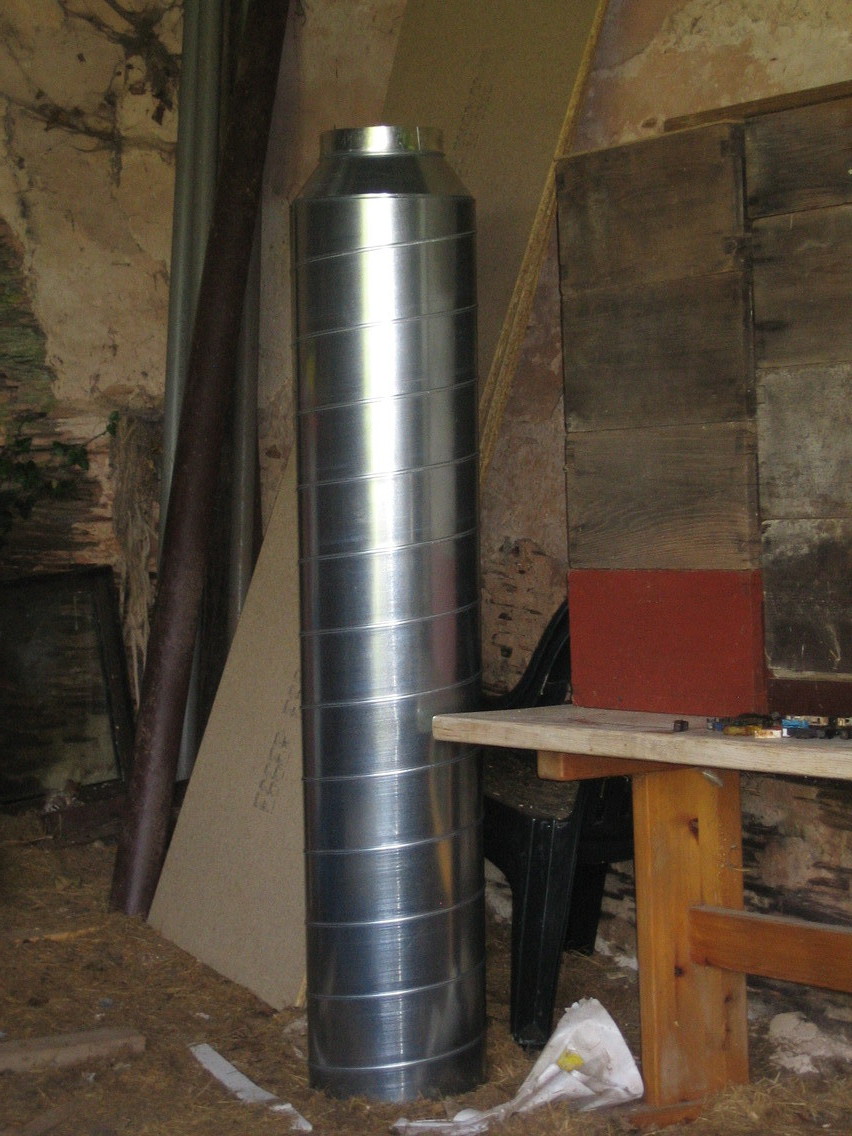
Dimensions fixed, after a great deal of deliberation I decided that some air conditioning type ducting would make a good for the pier. Hunting around online led me to ebay as a source for reasonably-priced 1.5m lengths of galvanised spiral ducting. I dithered over diameter (200mm and 300mm were both options) for a while and finally plumped for a 300mm diameter tube with a 300mm to 200mm reducer on top, to give a bit more clearance for the scope around the top of the pier. From the images the reducer appeared to give perhaps another 150mm of height as well, which would mean a reasonable length could be buried in the block in the ground.

The ducting has now arrived, and here it is (next to some stacks of beehives):

The reducer is a small amount shorter than I thought — only about 120mm, but that’s fine.

I’m now wondering if it wouldn’t be rather neat given that I have lots of room, to run some ducting up the inside before I fill it with concrete to put cables through rather than running them up the outside of the pier. I’ll ponder on that a little longer.

Posted in Astronomy, Observatory, Projects | Tagged , | Leave a comment

Observatory Build. The Big Idea.

Since I’ve had my telescopes I’ve been very tempted to build an observatory. My preferred viewing site is some forty metres from the house which is a long way to carry kit (not to mention to trail power leads if I need power), so the obvious solution is to build an observatory where I can have things set up permanently.

Much as I’d love to build a “rotating dome”, it’s really not practical for the site, not to mention sticking out like a sore thumb, so I’ve decided the best solution is a “roll off roof” design, where the roof runs on wheels in a channel on the tops of the walls and can be pushed to one side when required.

My plan is to have an observing room perhaps ten feet square, with a “warm room” to one side where computers and other equipment can be used. The other major requirement is that the pier should be capable of carrying both SCT and Mak OTA designs where the eyepiece is close to the mount, and large newtonians where the eyepiece is much further away in a position where they can be used comfortably, preferably in a seated position.

That is pretty much my starting point. I’ve looked at quite a number of other people’s builds and intend to plagiarise their work heavily to suit my needs. I’ll document the process as I go along.

Posted in Astronomy, Observatory, Projects | Tagged | Leave a comment

Ditching My Paperwork

I can’t quite believe it’s been six months since I last wrote anything. I guess that’s just how busy I’ve been of late. Time flies like a banana.

Anyhow, thanks to a client who wanted me to sign an NDA by emailing me a scanned image of their NDA form signed by them, to be printed out, signed, scanned and emailed back, I thought it was finally time to address scanning on my Officejet 6500, which I’ve never used before. I discovered that Ubuntu 11.04 had installed “simple scan” on my desktop and that it would quite happily scan documents over the network and not only that, it would scan from the sheet feeder too. It wasn’t too long before I decided that I could scan large amounts of the paperwork that fills my office taking up space to no good purpose and being a fire-hazard into the bargain, and then ditch all the dead trees.

I’ve made a start, and I currently have a pile of unwanted paper (some I’ll recycle for “scribbling whilst thinking and random doodling” purposes) about eight inches high and getting larger all the time, all in exchange for a measly 12GB of disk space. Seems like a bargain.

I did look into gscan2pdf, but it didn’t seem very happy on my machine, being completely unable to tell when it had run out of pages to scan from the sheet feeder. I’m sure that’s something I can sort from the saved image files later though if I decide it would be useful.

In fact, that little “bing-bong” has just sounded to tell me that my latest scan has completed, so I’d best go and save all the files…

Posted in Computing | Leave a comment

Observation Report catchup

It has, IMNSHO, been a rubbish summer. Sunny days have been few and far between and according to the reports this August was the coldest for seventeen years. September isn’t turning out to be anything of an improvement either.

So, given the dearth of cloud-free nights much of my observing has been odd hours snatched here and there between the clouds and I’ve failed to get much decent observing time in at all. I was very much hoping to spend some time learning my way around the Summer constellations, but it seems the major skill required this Summer has been the ability to recognise a constellation from the minimum number of stars possible.

The lack of reliability of the weather forecast has meant that the ST120 on the AZ3 mount has been the tool of choice, being quick to get in and out of the house and not needing too much time to cool down. I’d quite like to have had the 127 Mak out once or twice, but it’s a touch on the heavy side for the AZ3 and the EQ3-2 mount I usually use it on is a lot more work to move about when the weather isn’t playing ball.

Since I last got out in mid-August I’ve had one further night’s observing, during which I managed to view both M56 in Lyra and M71 in Sagitta, both nice targets to find. Unfortunately that’s pretty much been it. There have been teasing glimpses of clear sky (including tonight, though the moon is now very close to full and washing out just about everything), but no good continuous periods of decent observing weather.

I did have a further attempt at view Jupiter, but again it was too low in the sky for clear viewing. There was a small positive note on that occasion though. I’ve seen quite a few streaks across the sky that I’ve attributed to the Perseid meteor shower, but as I was just getting settled with Jupiter in the eyepiece a flash shot across the field of view. I looked up but could see nothing in the sky, so imagined it was just my eyes. As soon as I looked back in the eyepiece there was a second. Again not visible to the naked eye when I moved. I have to assume they were both meteors, but just too faint to see unaided.

In my idle moments (hah! 🙂 I’ve started on a project to build an observatory which should allow me to make the most of short periods of clear skies, but more of that another time.

Posted in Astronomy | Tagged , , | Leave a comment

Observation Report, 19/8/2011

We’ve had the occasional clear night since May, but mostly when the moon was very close to full, leaving little to observe except the moon itself, but last night was the first time I’ve been able to spent a significant amount of time looking at DSOs for more than three months.

Unfortunately my wife was out and I was looking after the kids so I had to stay near the door which meant that I couldn’t look for some of the Messier objects low on the southern horizon as I’d hoped because of the trees, but I did at least have time to spend hunting for those slightly higher in the sky in Ophiucus, the higher part of Sagittarius and Scutum.

Ophiucus was up first, and my lack of practice showed as I too about fifteen minutes to find M10 and a further five to realise that it was actually M12 It wasn’t all bad though as I estimated the position of M14 based on a couple of stars (“hmm, it looks about 2/5 of the way between these two…”), put the red dot on the spot and there it was, bang in the middle of the EP.

The bad news is, I’m afraid, that M107 has disappeared. I star-hopped down from zeta Ophi and found a little “arrow” asterism that has M107 hanging off the bottom end of the arrow head. Only it just wasn’t there. I tried all sorts of magnifications, averted vision, nudging the scope, but I just couldn’t find it. It’s gone.

Moving around I quickly found M26, but “star” (as it were) of the night was the Wild Duck Cluster. I spent ages looking at it trying to see more detail and it seemed to take magnification well. As impressive in its own way as, say, M13, I thought.

The moon was washing out a fair bit of the sky by this time, so I fought with the AZ3 until it would hold the ST120 roughly vertical in a steady position and found M29 in Cygnus, but the view wasn’t great so I’ll come back to that another time.

Since it was there and as I’ve actually had very little opportunity to look at it when it’s been anything other than full, I spent a good three quarters of an hour exploring the moon and finding a few more of the Lunar 100. Once there are some shadows it really is amazing how much detail it’s possible to see. I can kind of understand why people think you should be able to see the stuff left behind by the moon landings. At 100+ magnification it just feels like you could reach out and touch it. I had to keep reminding myself that those features that look really tiny and can only just be made out are actually very large. It’s easy to lose all sense of scale.

I rounded off the night by having a quick look at Jupiter, but perhaps there was some light cloud low on the eastern horizon as it appeared very mushy. Having had such a good evening thus far I decided there was no point spending further time on it and called it a night.

Here’s hoping it’s not another three months until the next one…

Posted in Astronomy | Tagged , , , | Leave a comment