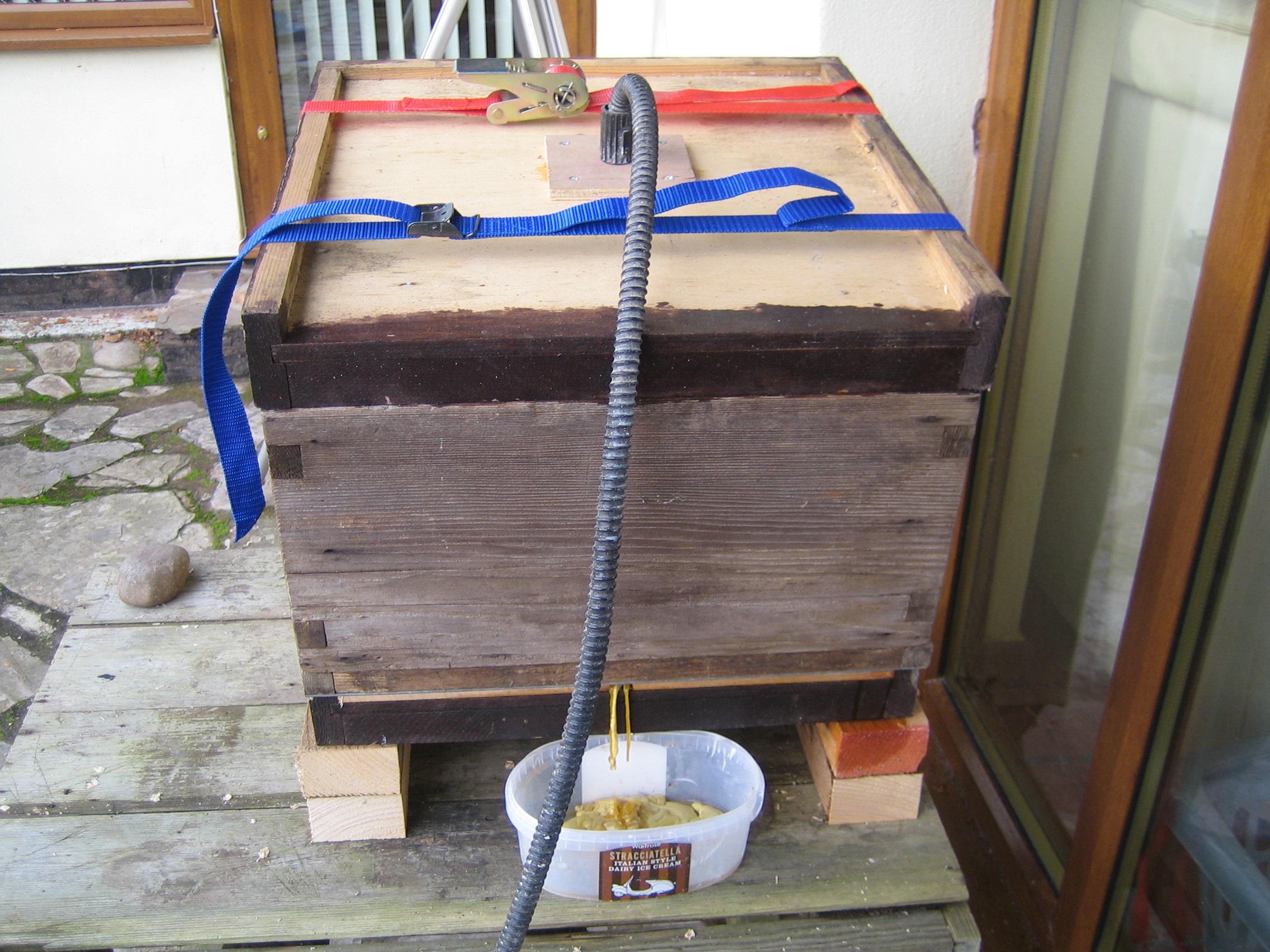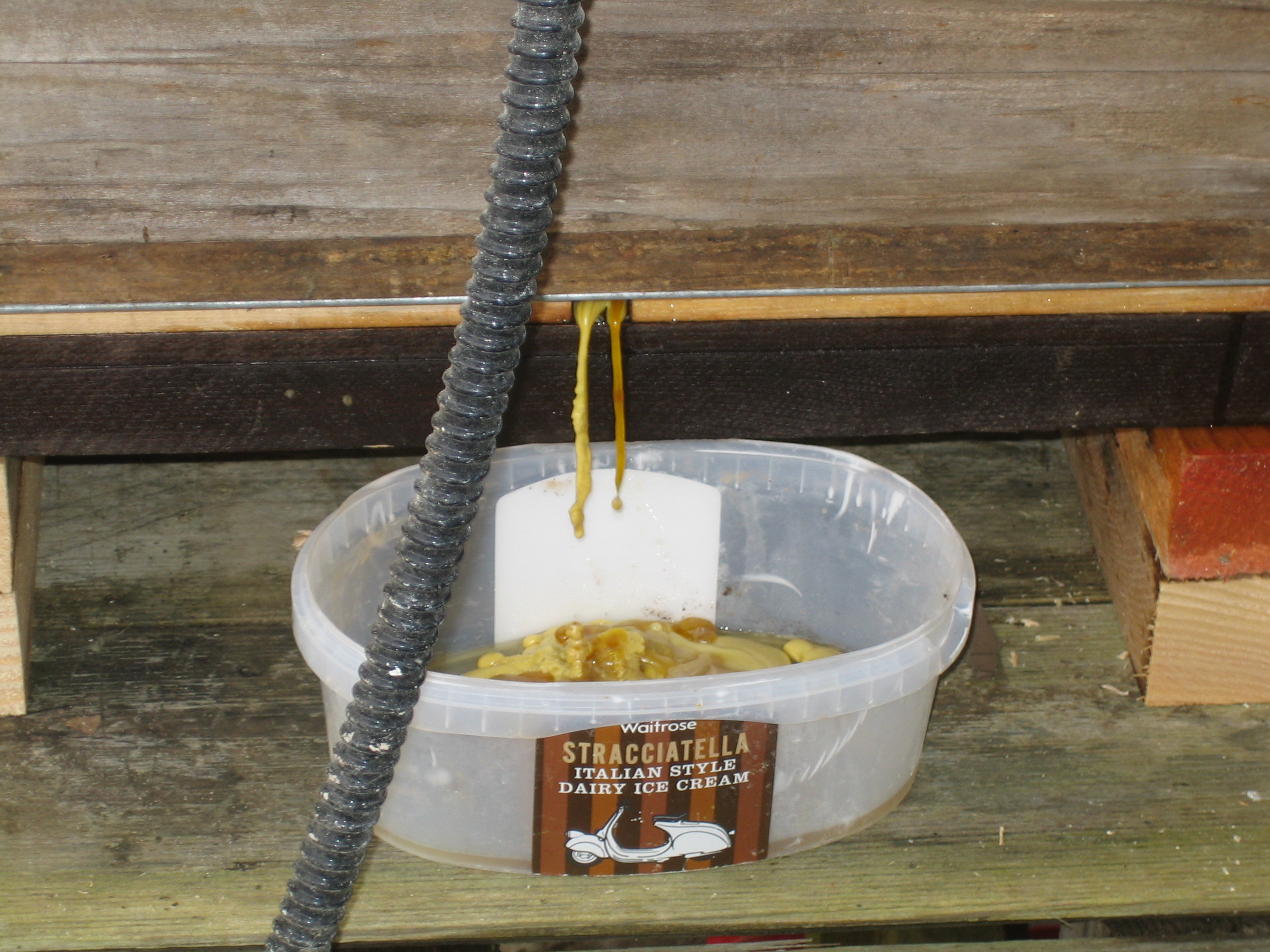
A home-made steam wax extractor

In those years where we have a proper summer (not since about 2006 now), I put “waste” beeswax and old combs into my solar extractor to melt down the wax. In 2011 we didn’t really get that much decent wax-melting weather though, so I ended the year with about fifty frames of comb I wanted to melt down. Some bee equipment vendors sell steam-powered extractors, but want far more beer tokens than I am prepared to pay. Hunting around the interwebs I found a few ideas and here’s what I ended up with. It uses an old steam wallpaper stripper to make the steam. The “head” of the stripper was removable, so I could use just the heater unit and the flexible hose.
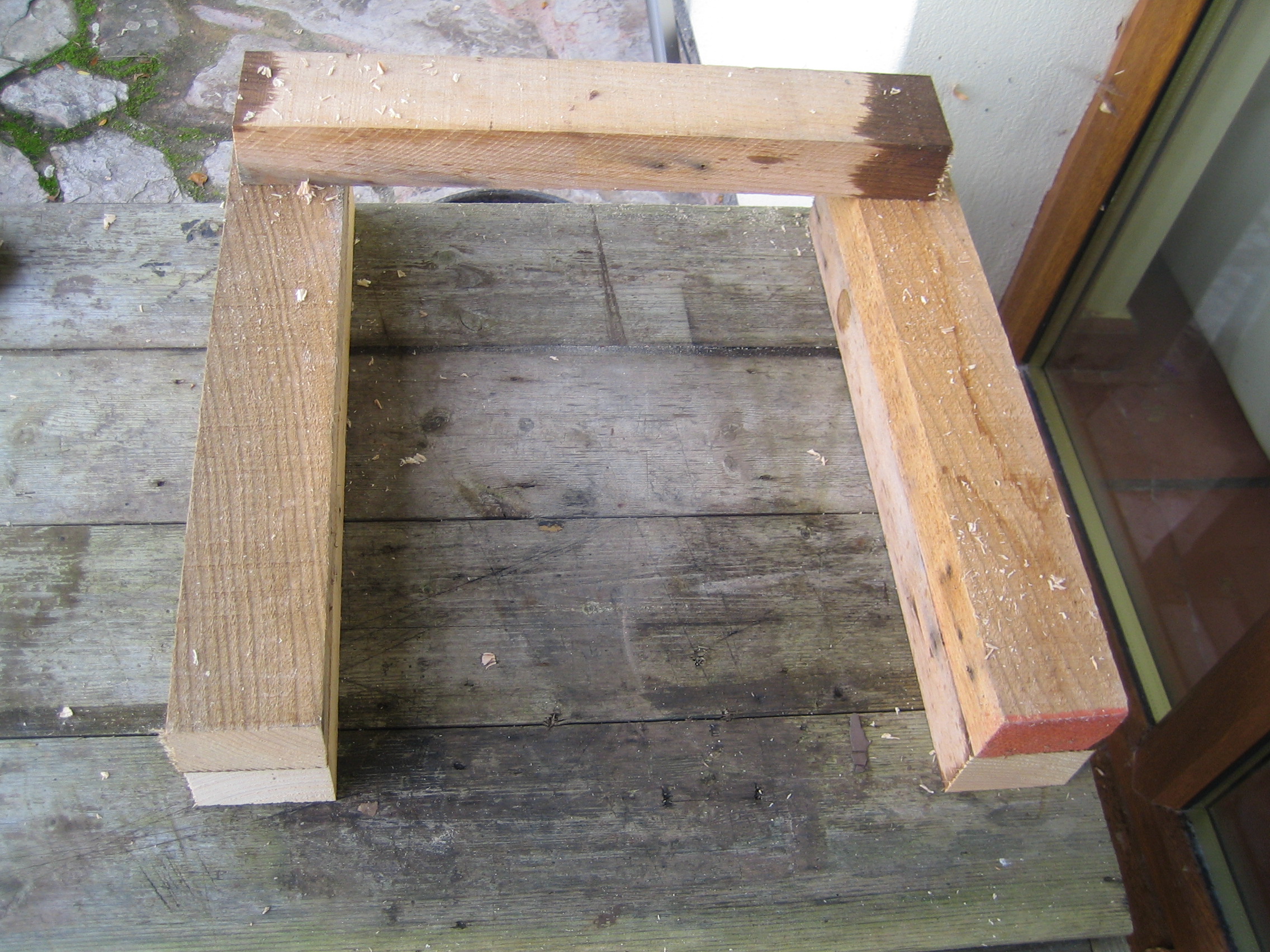
I started with an old “bench” — actually a table that I believe my dad built for putting motorcycle engines on whilst he was working on them. On that I built a “Jenga”-style base of timbers about 50cm long so everything on top would be tilted forward.
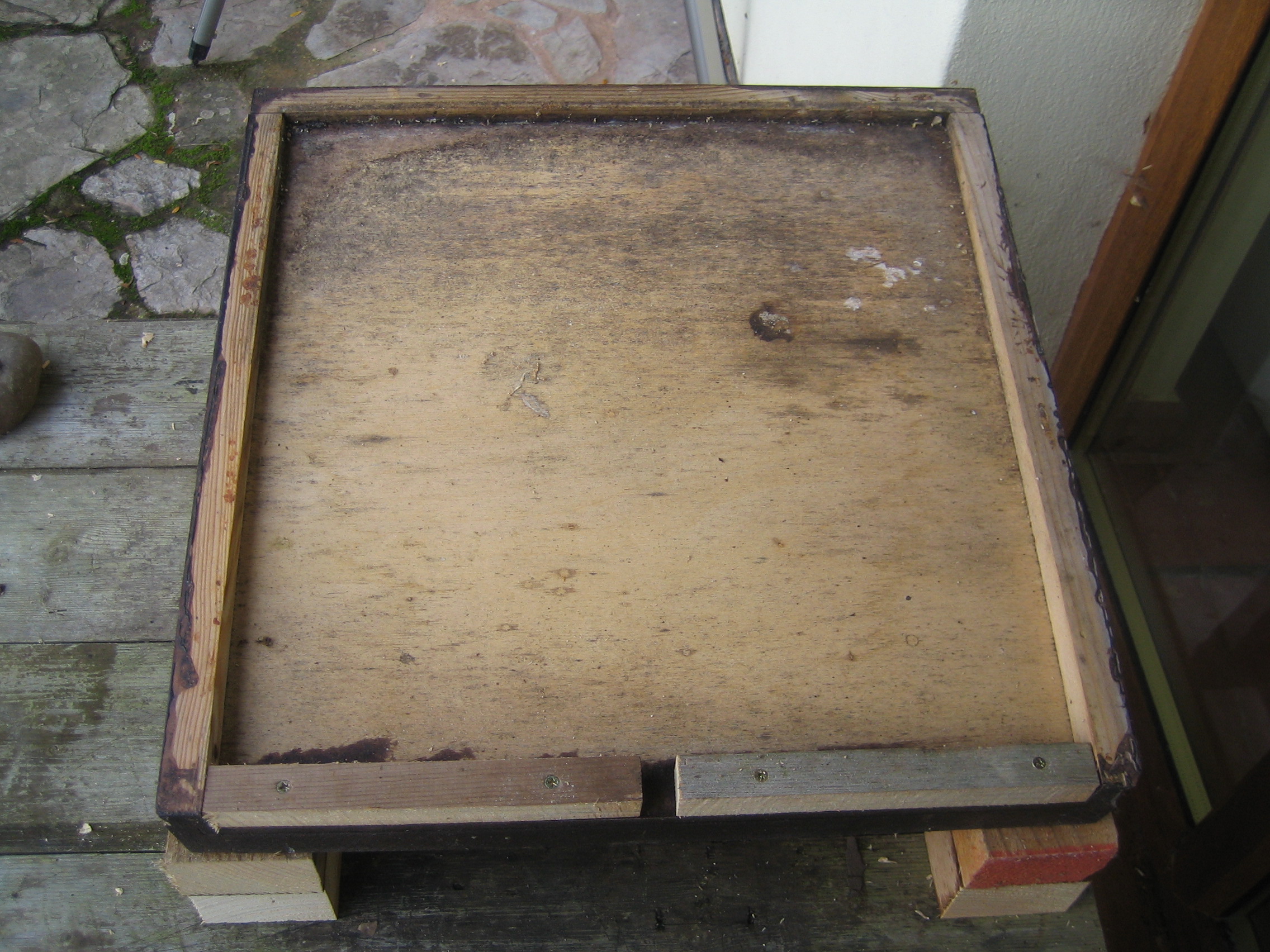


I have a number of old solid floors that I no longer use and was willing to sacrifice to the project, so one of those went on next. Where the entrance block would normally go I screwed two blocks of wood to leave a gap about 20mm wide in the middle of that edge of the floor.
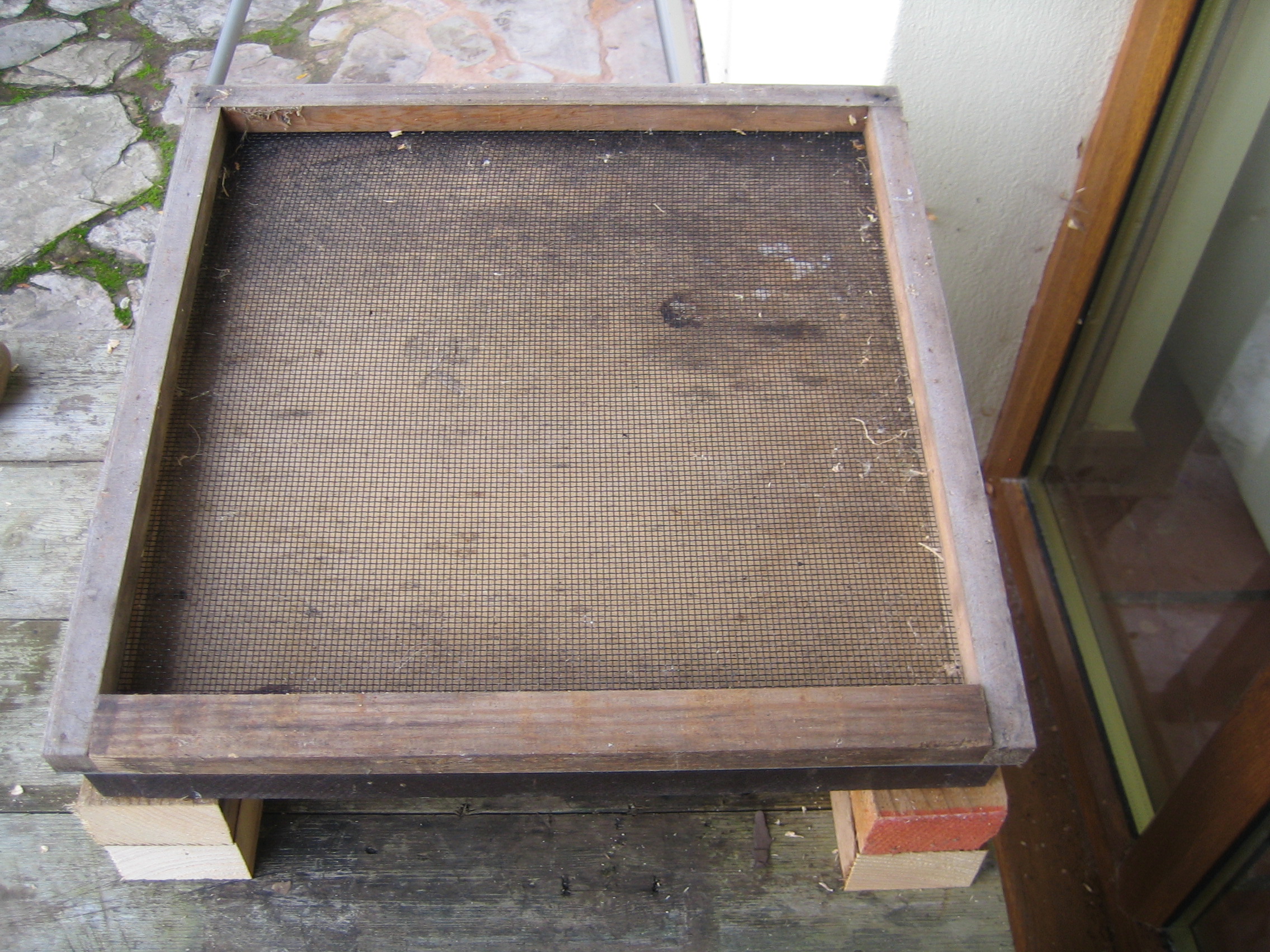


On top of the solid floor goes a mesh floor. This one had its entire front edge open for an entrance block, so I closed the entire length with another block of wood. This floor stops rubbish from falling onto the solid floor and blocking up the hole (that the molten wax will eventually run from).
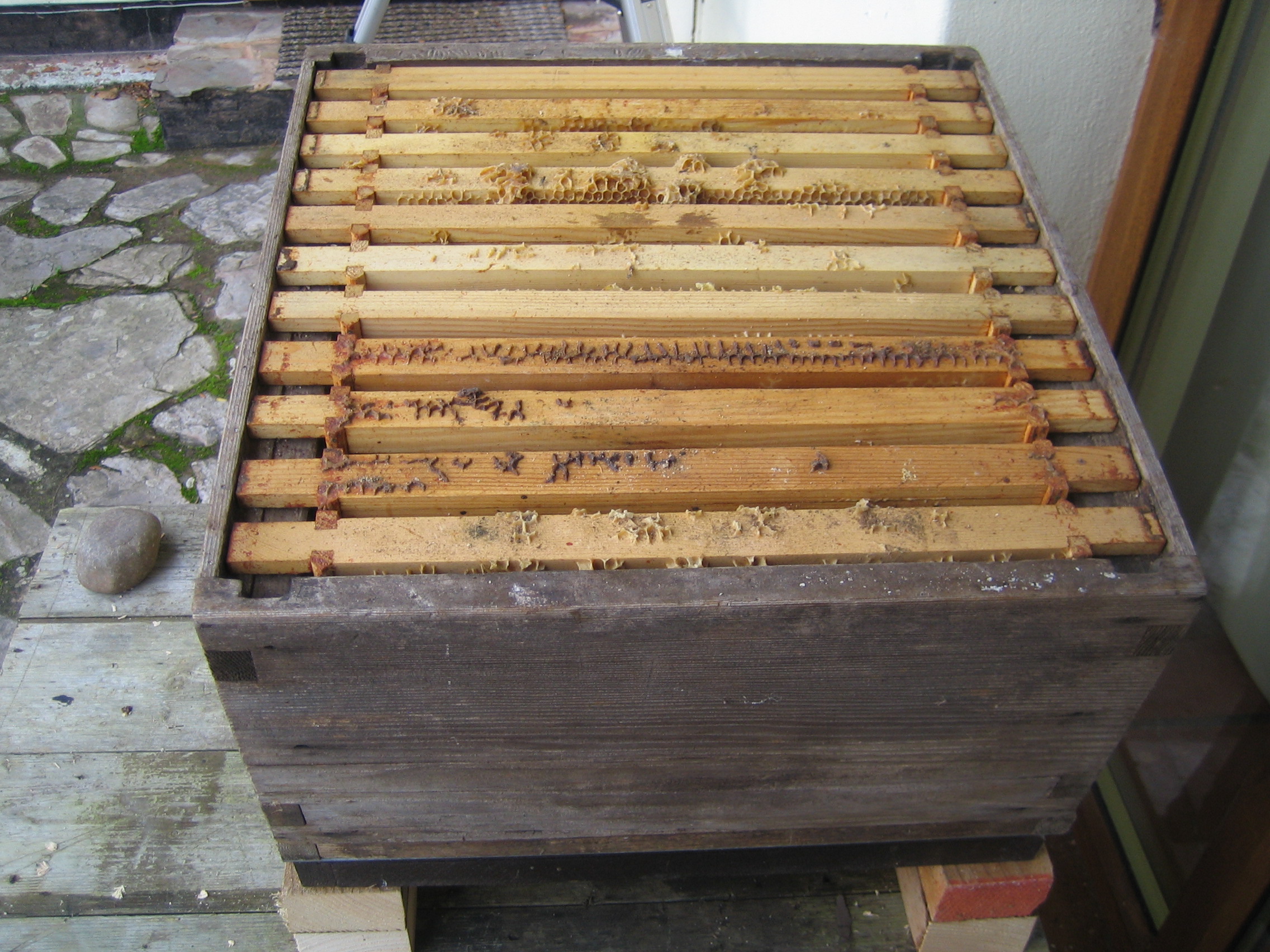


On top of the mesh floor goes the box of frames to be melted down. I was prepared to sacrifice this brood box because it doesn’t have space for frame runners and was in need of some repair work, but actually it doesn’t seem to have come to any harm despite being repeatedly filled with steam.
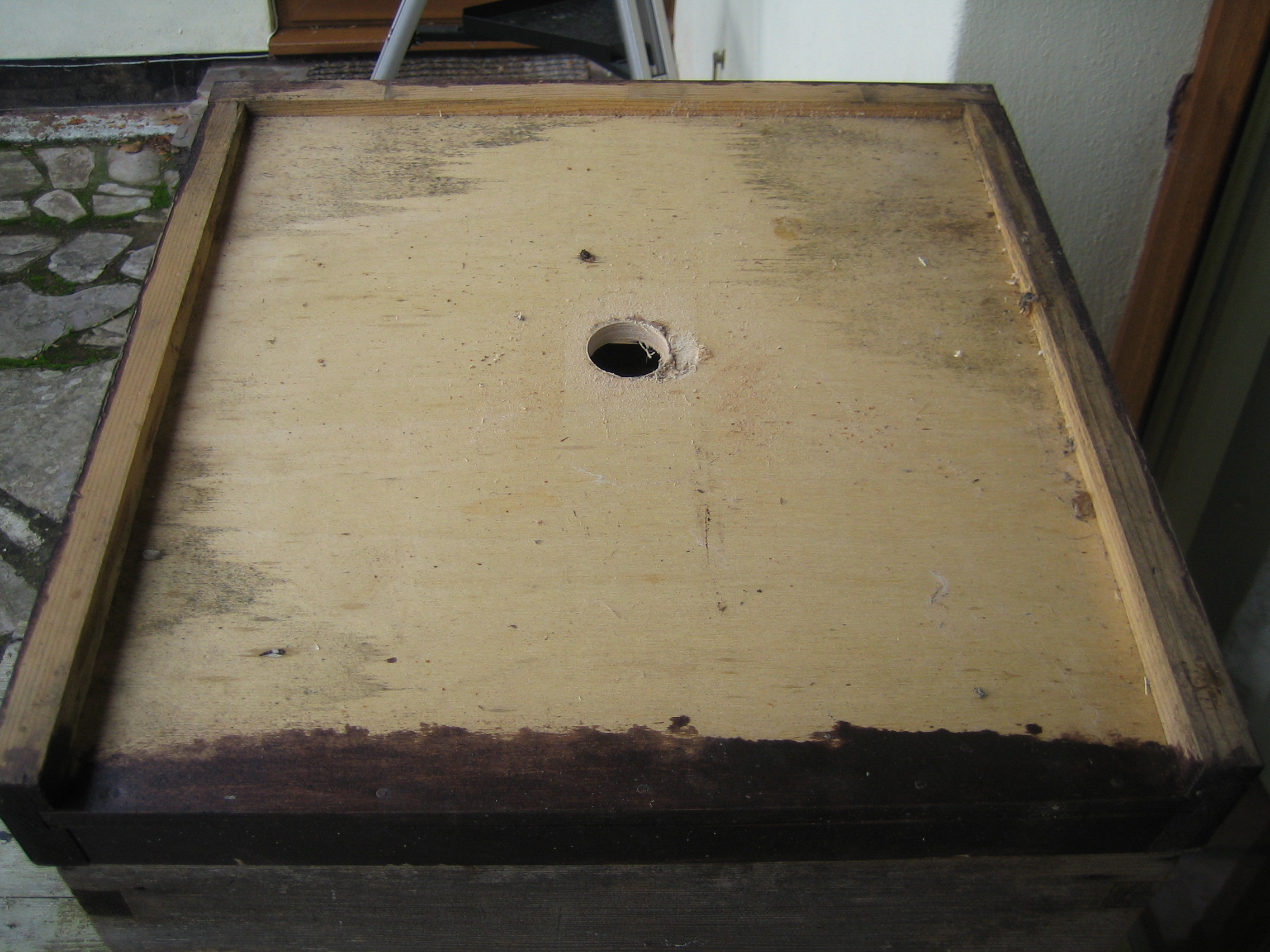


I needed a “lid”, and a second solid floor did the job. I cut a small hole in the top for feeding the steam in. I can’t recall the exact diameter of the hole, but I believe it’s around 40mm to 50mm.
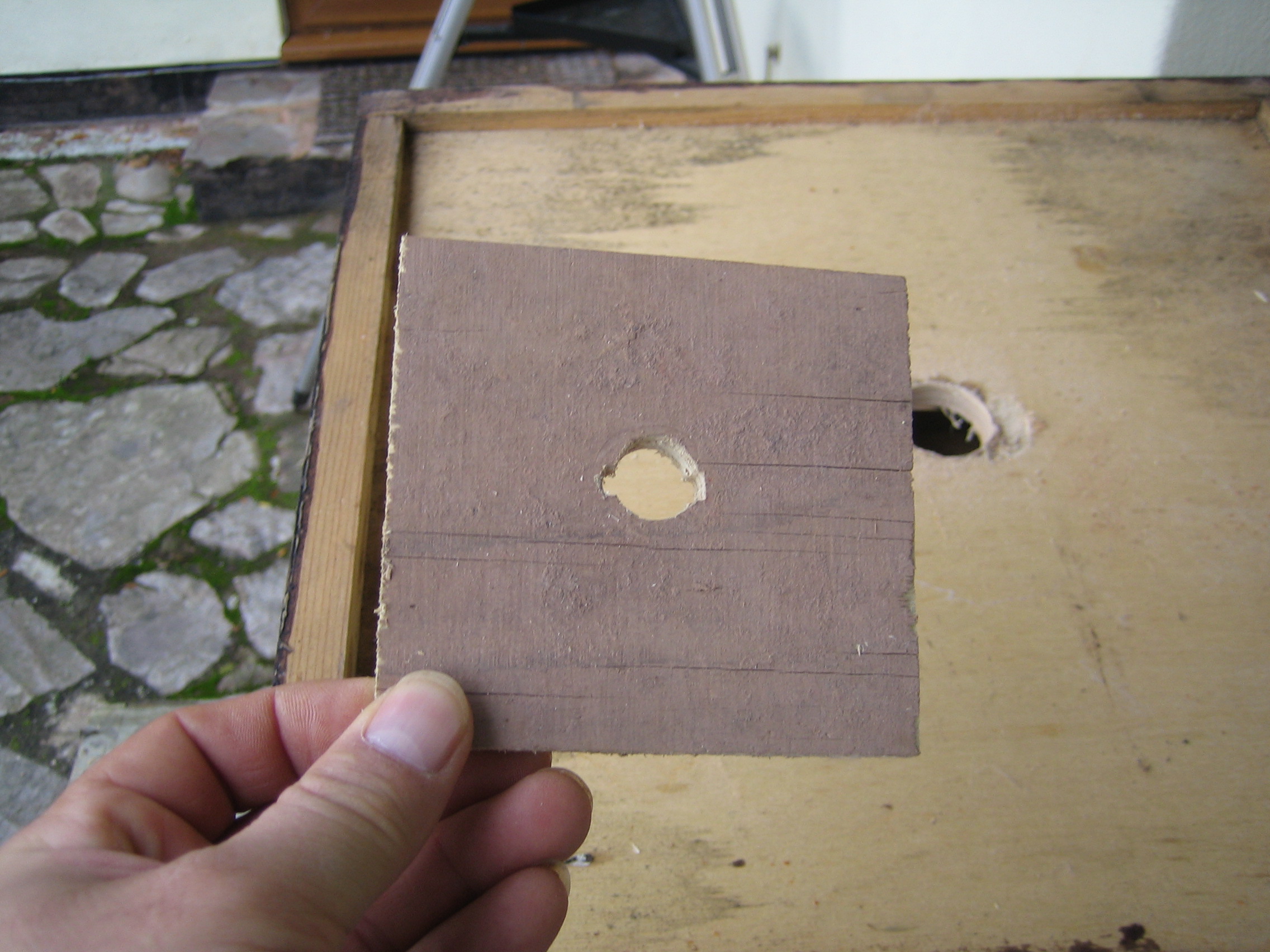


The end of the wallpaper stripper hose had two lugs to lock it into the head. To allow the same mechanism to work for my melter I cut a small piece of ply to take the hose with some cut-outs for the lugs. The hose can thus be pushed through ply and turned to hold it in place.
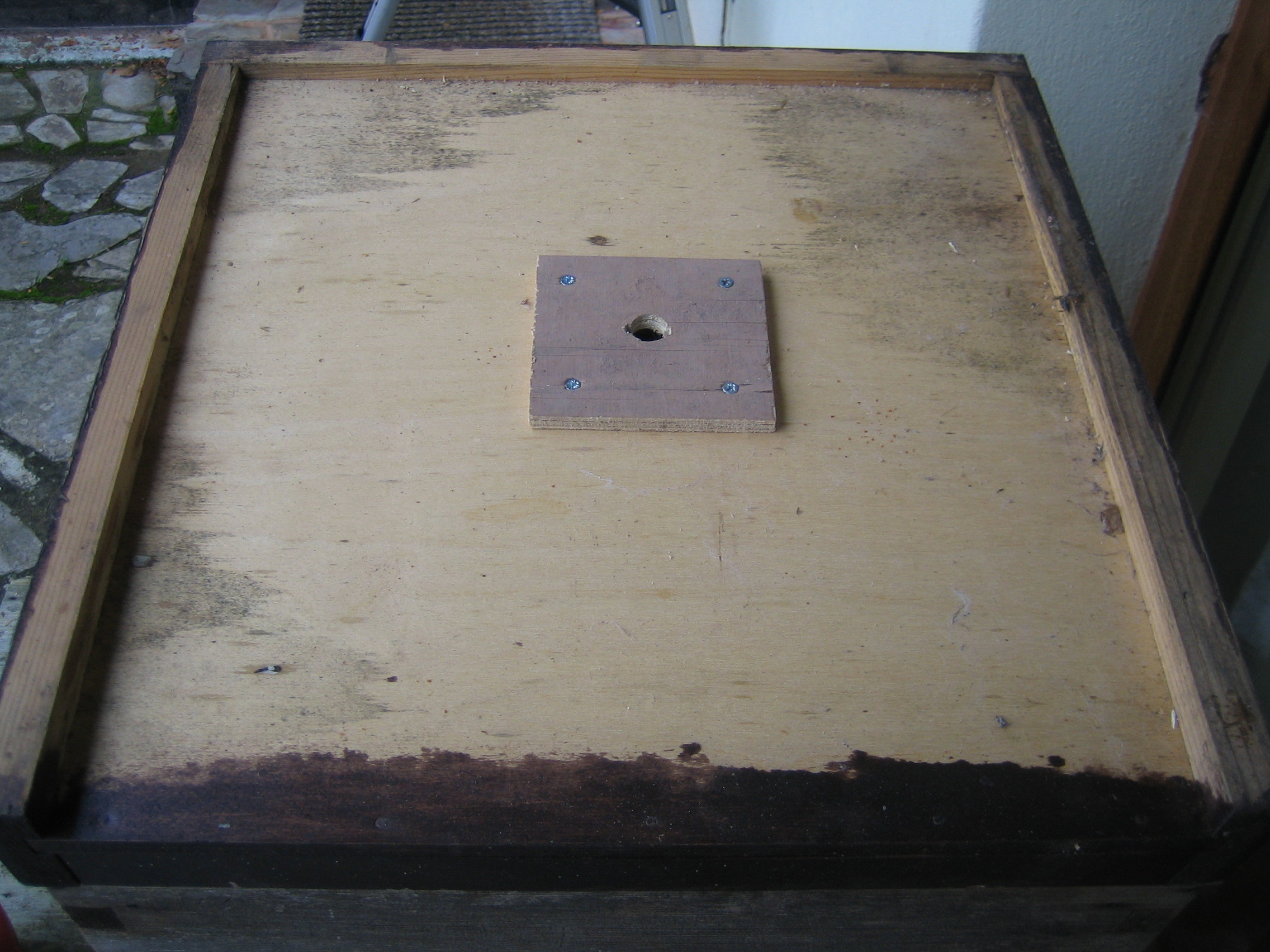


There’s the hose “socket” fixed in place. The hole in the floor is large enough that the lugs on the hose won’t foul.
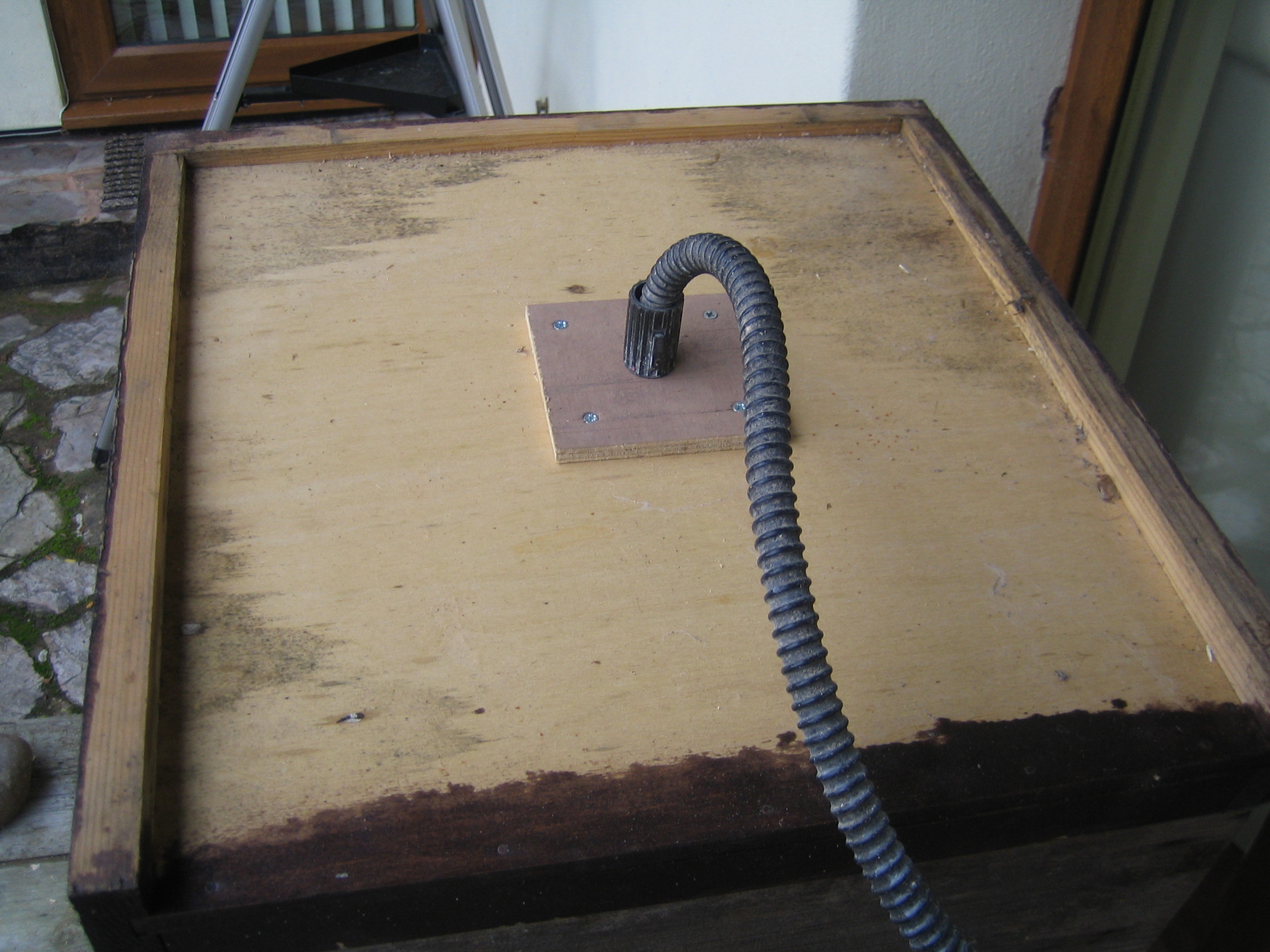


The hose in situ.


Finally, a couple of photos of the extractor in action. To help seal the box so steam can’t escape from the joins I use a couple of ratchet straps to pull it together firmly. I fill up the stripper reservoir and leave it to run for about half an hour, which is usually enough to melt all of the wax from the combs.
Once the wax is melted I allow the box to cool and remove the lid. The frames clean up fairly easily and should be sterile for re-use if necessary (old frames I don’t want get used as kindling for our wood-burner). Even propolis scraps off without too much trouble. Extracted brood frames tend to collapse leaving blackened cocoons on the mesh floor. I remove those and put them on the compost heap.

This autumn I melted down my entire pile of waste wax and old frames, ending up with about 6kg of wax, some of which I’ll probably exchange for foundation and some I’ll make into candles.

The only real negative side of the extractor is that wasps and bees find it irresistable. It’s probably a process that’s best saved for the winter months, or done somewhere well out of the way of other people.
Posted in Bee-keeping, Projects, Smallholding | 1 Comment

Polytunnel Chiles

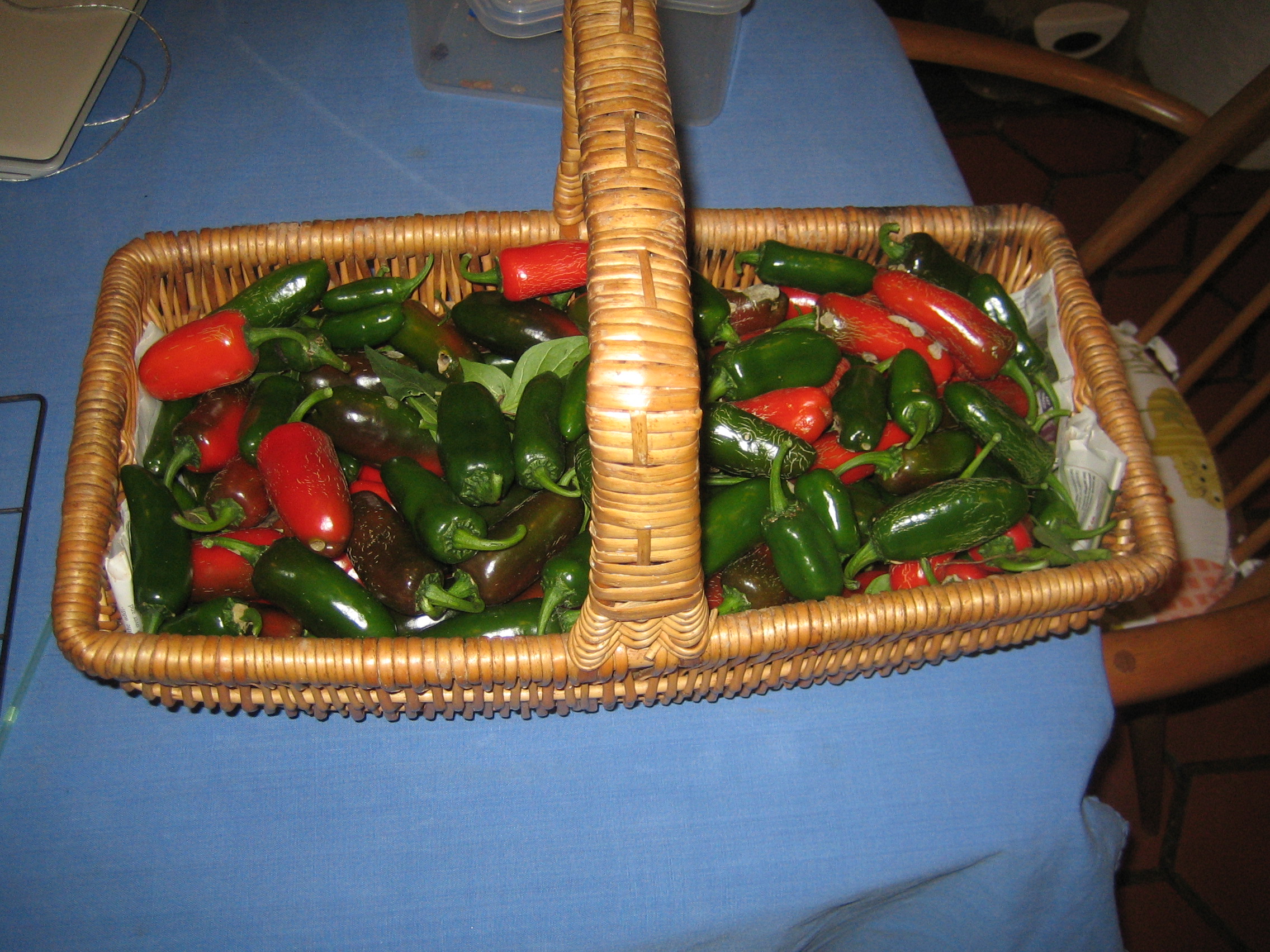
Most years I try to grow a few different varieties of chile in the polytunnel. Jalapenos are always on the list so we can pickle them for use on pizzas, in fajitas and tacos and suchlike. 2011 hasn’t exactly been the best year for vegetables because of the odd weather, but my Jalapenos seem to have done ok (despite the odd bit of munching by slugs or snails):

I’ve left the plants in the polytunnel and unless the winter turns considerably colder through January and February it’s entirely possible the plants will make it through to the spring to start growing again. I look forward to that happening, but I think I’ll be starting off some new plants in the propagator around the start of February, just in case…

Posted in Polytunnel, Smallholding | Leave a comment

Harlequin ladybirds by the thousand

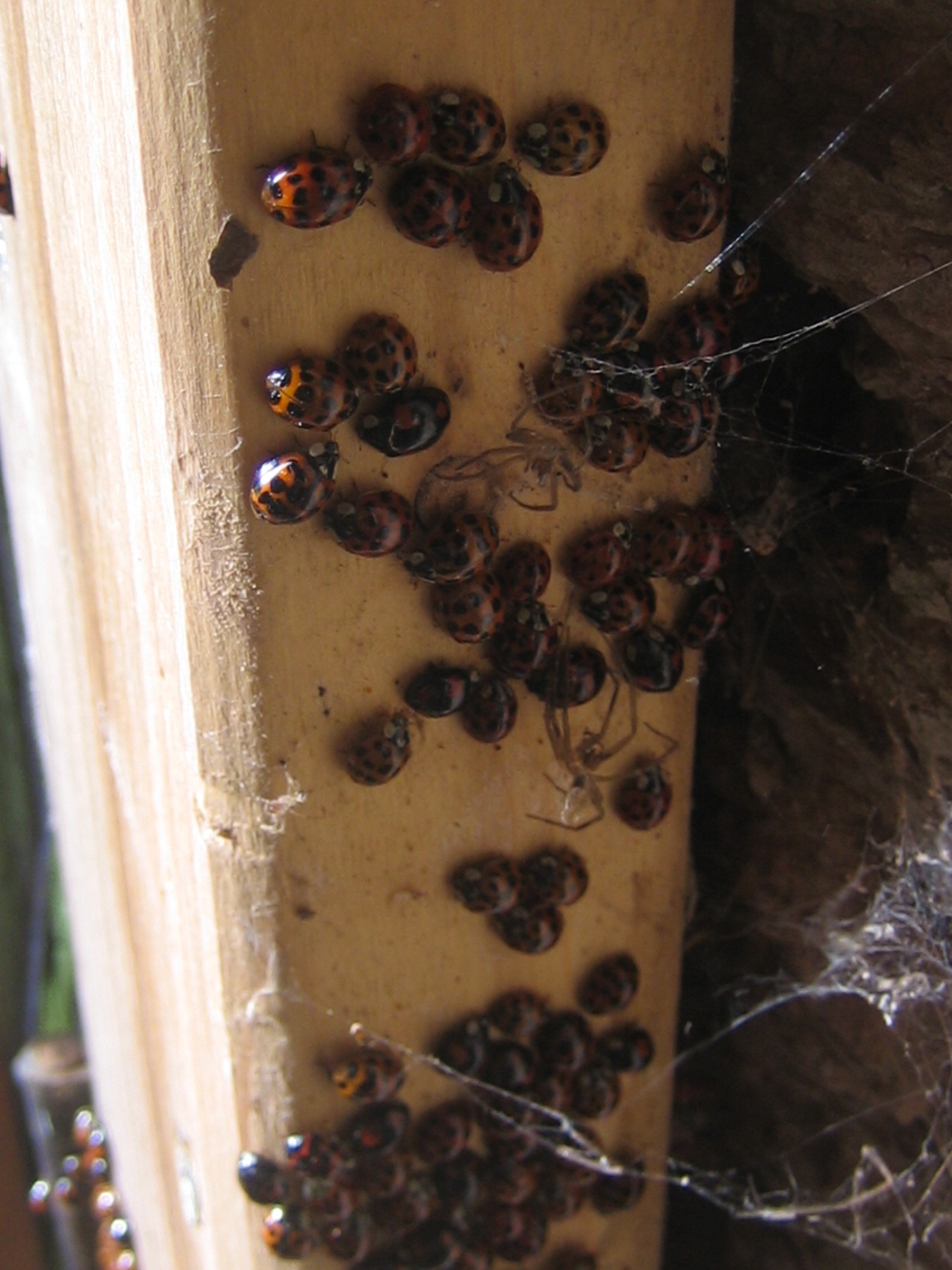
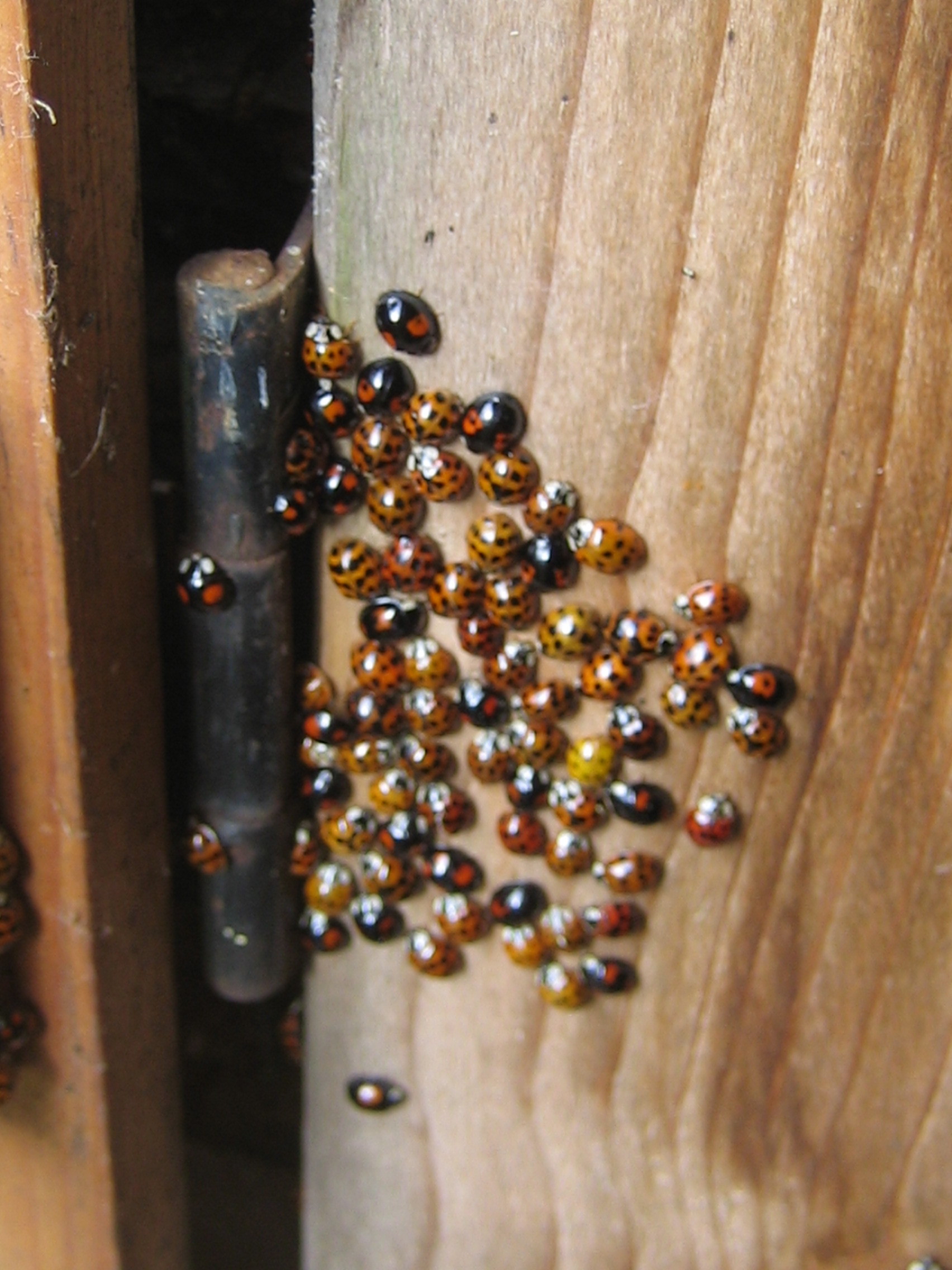
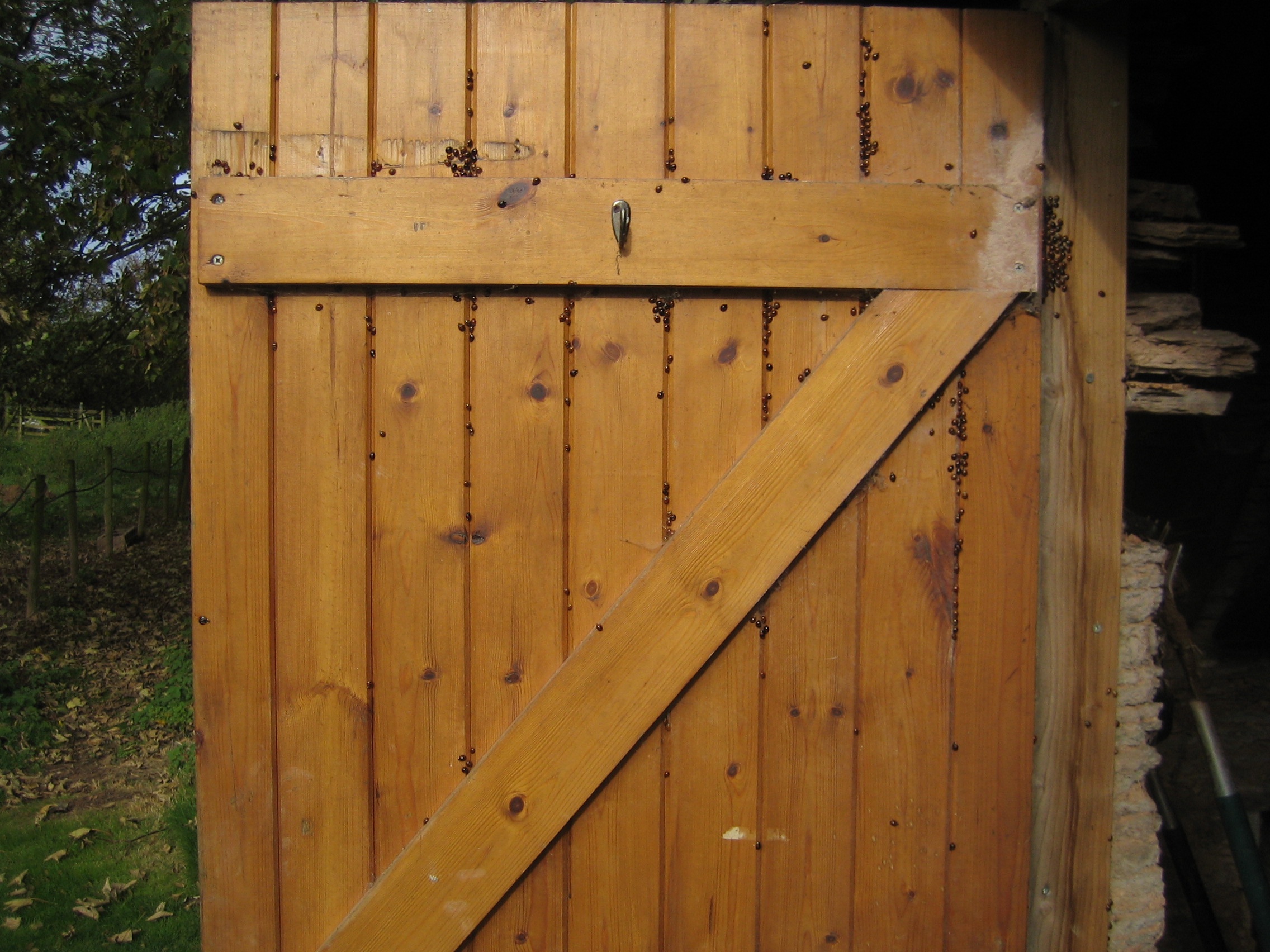
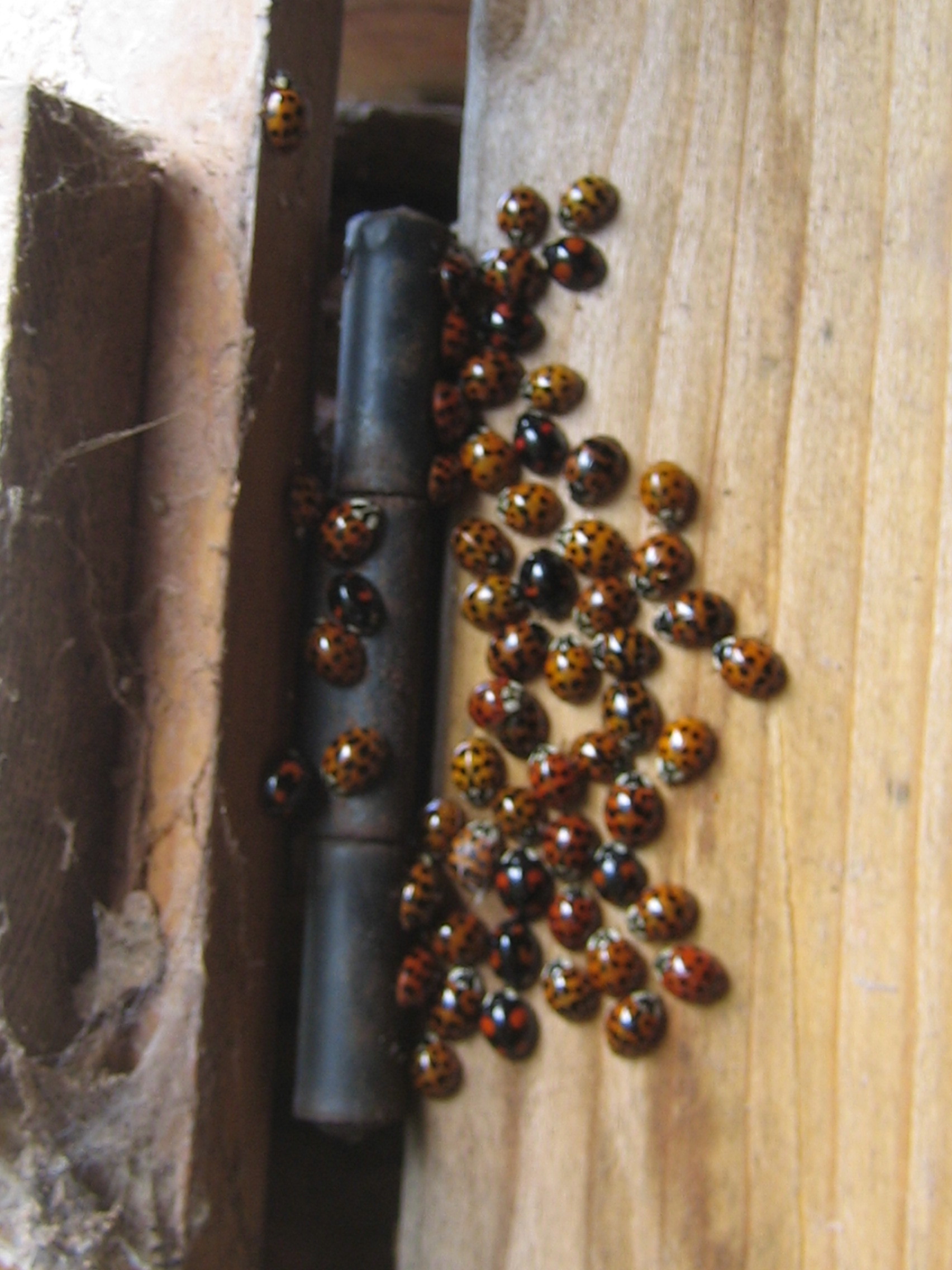
The Harlequin ladybird appears to be moving into the south west of the UK in huge numbers now, having been fairly rare only five years ago. As the summer ends the adult ladybirds find somewhere to overwinter and apparently produce a pheromone that others Harlequins will follow to join them.

I opened up the door of our tool shed in the autumn and saw all of these (apologies for the poor focus):


Interesting that there are quite so many of the black variety. I hadn’t understood that they were so common.

However, I have to admit that I find myself in something of a dilemma. I know these ladybirds are a pest and our out-competing our own native ladybird species. On the other hand they have a voracious appetite for bugs and other bests that I really don’t want on my vegetables. I don’t like killing animals purely for doing what comes naturally (killing them to eat is another matter), but would it be a positive contribution to the welfare of our native species if I did just that? (And no, I’m not about to start eating ladybirds 🙂

Posted in Smallholding, Veg plot | Leave a comment

Odd cloud effect

I looked out of my office window the other day and saw this:

No idea what caused it. Looks like an aircraft contrail in reverse. Not something I’ve ever noticed before.

Posted in Random | 4 Comments

Google Completely Loses the Plot

Over the last couple of days I’ve been receiving frequent emails containing the tedious witterings of someone I’m barely acquainted with, courtesy of Google+.

I have never told Google I wish to receive email from Google+, so at what point did it become acceptable to allow someone to add my email address to a list of recipients who subsequently receive all their random dribblings every few minutes? And then insist that if I want it to stop, I have to go to their website to get myself off a list I never asked to be on in the first place?

Since Google got so big not to have to care, I guess 🙁

Amazingly, Google seem to think this is The Next Big Thing and that I will be desperate to add my name to their tens of subscribers. Not a chance. I’d rather claw my own eyes out with a rusty fork.

Posted in Computing, Random | Tagged , | Leave a comment

MythTV/FFmpeg: Part 3

Well, I finally realised that there’s a 0.24 fixes tree for nuvexport that isn’t part of the main MythTV 0.24 fixes tree, so I downloaded that having read on the mailing list that it should work with the MythTV 0.24 fixes FFmpeg.

But no. It doesn’t. 0.24 fixes nuvexport attempts to use options for padding and cropping that are no longer supported by 0.24 fixes FFmpeg.

I was on the point of abandoning FFmpeg and going back to using the transcode option until I discovered that it is no longer supported, so I just had to give things one more try. I installed FFmpeg 0.8.4, ignoring the MythTV version, symlinked it to “mythffmpeg” and installed the latest version of nuvexport from github, ignoring the 0.24 fixes release.

So far that appears to be working.

Posted in Computing, MythTV | Tagged | Leave a comment

MythTV/FFmpeg: Part 2

Enabling mp3 encoding in the bundled version of ffmpeg was merely a case of adding

--enable-libmp3lame

to the configure command for the entire package. nuvexport-xvid now runs to completion.

Unfortunately the output looks all wrong, so I’m back to the drawing board. I suspect my aspect ratio fix.

Posted in Computing, MythTV | Tagged | Leave a comment

Trials and Tribulations with MythTV and FFmpeg

I’m running MythTV 0.24.1 at the moment with quite a few MythBuntu and other front ends. I’m running out of disk for recordings and decided to archive a few off to release some space which I’ve done with previous versions of MythTV fairly regularly. Unfortunately I discovered fairly quickly that asking nuvexport to transcode recordings to my preferred format (XviD) using ffmpeg was badly broken.

MythTV now includes its own copy of ffmpeg in the distribution to try to control some of the rapid changes of command line parameters the ffmpeg team seem to inflict on us with monotonous regularity. I discovered that it didn’t support libxvid out of the box for some reason (perhaps I didn’t have the necessary libraries installed at the time I built it). So, first step was to reconfigure it and rebuild. Only it won’t. The ffmpeg shipped with 0.24.1 looks like it just won’t link when libxvid is enabled.

So, I downloaded the latest git release and tried that. ffmpeg would now build, but doesn’t like that the libraries aren’t quite the same as the 0.24.1 versions, so I ended up rebuilding the entire package from the source, discovering in the process that libxvid wasn’t enabled again…

Eventually it dawned on my that I needed to add the command line switches:

--enable-libxvid --enable-gpl

on the mythTV configure command and this time all was well.

After reinstalling I kicked off nuvexport once more only to discover that it failed yet again, but this time because ffmpeg was being called with a parameter:

setsar=1

which the MythTV version of ffmpeg doesn’t support — it’s a later change to the code. I discovered that the older version of the parameter is:

aspect=1

So I edited /usr/local/share/nuvexport/export/ffmpeg.pm around line 335 to change:

push @filters, "setsar=1";

to

push @filters, "aspect=1";

This fixed the problem entirely and I got a full first encoding pass from nuvexport. Now it just falls over because ffmpeg doesn’t support the mp3 codec. That’s something to look at tomorrow.

Posted in Computing, MythTV | Tagged | Leave a comment

Jupiter and Moons

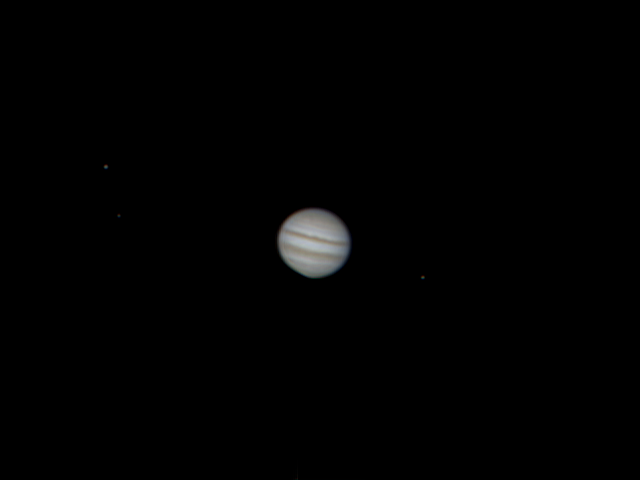
Since Jupiter is returning to our skies now I thought I’d take advantage of last Thursday’s clear-ish skies to do some imaging practice with my 127 Mak and SPC900. I’ve not been through all the clips I took with my Ultima barlow yet, but this one was the first sequence I took. It’s not a great image, but I like it because during processing I discovered I’d caught three of the Jovian moons as well — Io, Callisto and Europa (Europa is on its own on the right).

Not sure why the bottom left of the planet has been “ground off”. I think it’s a processing artefact. I’ll have another look some time.

Image details:

127 Mak on an EQ3-2, SPC900, 1200 of 2400 frames stacked in Registax 6.

Posted in Astroimaging, Astronomy | Tagged | Leave a comment

New Life…

Our chickens are kept in large fenced runs (to keep out the foxes) in the orchard with the trees providing some shade from the fierce heat of the British Summer. The birds are rotated around the pens giving them fresh grass on an irregular basis (ie. when the fierce heat of the British Summer means that the runs currently in use are a complete mudbath).

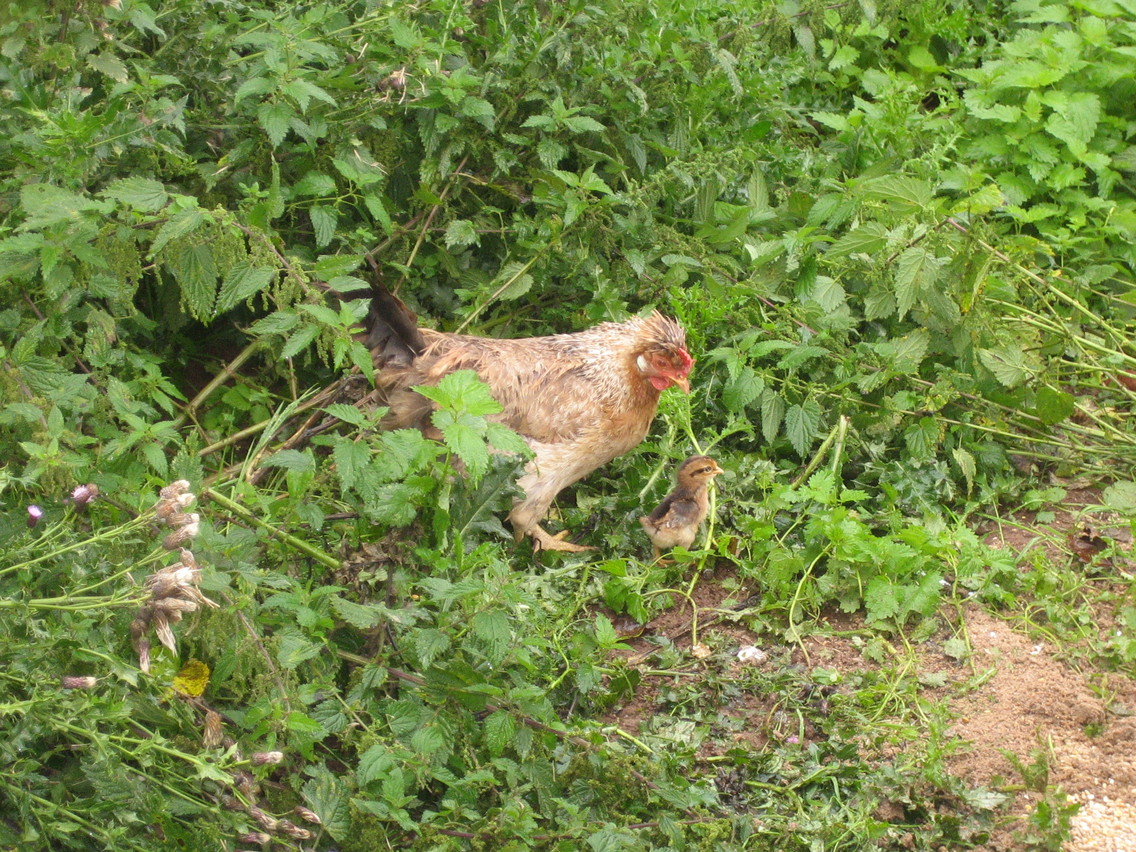
Almost a month ago one of the hens disappeared. I was forced to assume that she’d roosted high enough in a tree to allow her to fly outside the fence in the morning and had become breakfast for a local fox family. A couple of mornings ago however I found her hiding in the undergrowth. She’d got into one of the unused runs and laid a number of eggs that she’d been sitting on for the last three weeks. Here’s how I found her:

Sadly only two of the eggs had hatched and I assume that one of the chicks didn’t make the trip as I could only find the one, but perhaps given the time of year that’s not such a bad thing. The new one is going to have its work cut out surviving as it is. It probably won’t even be fully feathered and able to keep itself warm until the end of October.

I’m keeping an eye on them and hoping that the next few weeks are mild enough for the chick to survive.

Posted in Chickens, Smallholding | Leave a comment