Seven years of solar PV

Seven years ago I blogged about us having a 3.64kW solar PV system installed on our roof. I thought it was about time I went through the figures to see how it has performed from the figures I submit each quarter for our FITS payment. This is how it works out:

I’m surprised by the huge difference between the winter quarters and the summer quarters, all except for the last few quarters which are fairly odd-looking, the last quarter of 2017 being far better than any in previous years and the second quarter of 2018 being quite poor. I’ll have to submit the next quarter figure shortly and I expect those to be back over 1,400kWh.

Average generation per year is somewhere around 3,500kWh, well above the estimated figure of 2,900kWh we were given when the survey was done before we decided to go ahead and higher than the national average household annual consumption figure, I believe. The total generated over the seven years will probably come in at somewhere just over 24,600kWh.

With hindsight I think I’d probably consider having more panels installed, but as Western Power don’t appear to be keen to allow domestic installations to feed more than 4kW back onto the grid I’d probably have to find some way to store the power purely for use on-site.

Posted in Environment, Projects | Tagged , , | Leave a comment

3d printing project for this weekend

My 3D printer kit came with a PSU, power connector socket and power switch, but there’s nowhere on the frame to attach them even if I wanted to and nothing else is provided to stop you getting a “tingly finger surprise” when switching it on and off. I made this to fit the switch and socket with the end of the PSU that has all the connectors on resting on a ledge along one wall above them. Estimated print time was eleven hours but it worked out nearer thirteen for some reason.

I’m pleased with how this has worked out. The supports for the holes came out very easily and the holes themselves were a near perfect size for the switch and socket. All the cabling tucks inside neatly and I no longer need to worry about electrocuting myself when I’m switching the printer on and off.

Posted in 3D Printing | Tagged , | Leave a comment

DeWalt D28710 first impressions

Having just posted that I cut up a pile of steel tube today I realised that I’ve not said anything about the saw itself. It’s a DeWalt D28710 that I purchased specifically for my observatory project though it will see use in the future for other things. I probably wouldn’t buy DeWalt tools normally, but this was in a sale and only a small amount more than what I’d probably have bought otherwise, so I went for it (though in fact the other saw came with a blade and the DeWalt didn’t).

I’ve fitted the saw to a stand I picked up from Lidl for just under £40 (see an earlier post). It won’t bold directly to the stand, but that was easily sorted with a few angle brackets and self-tapping screws into the base of the saw, which hold it plenty steady enough for the work I was doing.

First impressions are that the horizontal handle makes it very easy and comfortable to use, the adjustable spark guard does indeed shift the majority of the sparks away from the user and the quick release clamp makes life very easy. The saw has plenty of power for the job I’m trying to do, too. It’s also nice that there’s a place to keep the allen key for adjusting the clamp so hopefully I won’t ever need to go looking for one. Putting a cutting wheel in was a doddle.

Things I wasn’t so happy with are that the angle markings for the clamp aren’t particularly accurate. I cut a test piece and measured it rather than trust the markings. The plastic section of the blade cover is also a bit naff and already wearing a bit where it rubs on the base as the blade descends.

Overall though, I’m pretty happy with it, though I need to work out how I’m going to make some 30 degree cuts which are outside the range of the clamp.

Sadly I don’t have the same opinion of the cutting discs. I bought two Clarke abrasive metal cutting discs from the same vendor and I’m quite unimpressed with them. The one I have in the saw makes quite hard work of cutting and clearly doesn’t run perfectly true. Initially it also seems to have a tendency to try to “bounce off” the workpiece. I will not be buying these again.

Posted in Workshop | Tagged | Leave a comment

Building an observatory. Construction #14

The steel for my rolling roof finally arrived this week: sixteen three metre lengths of 25mm square section tube with a 2.5mm wall. The wait has allowed me to change the roof design several times 😀

This morning I wrote a cutting list and this afternoon set to with the cut-off saw, reducing all but four of the sixteen lengths to correctly-sized pieces ready for welding.

I do still have a few cuts to make, mostly where I’d like to get the main structure assembled to allow me to cut the extra pieces to fit. The remainder are the horizontal braces for the “rafters” which need a 30 degree cut on the end. My cut-off saw won’t do that without some modification. I’ll work that out this week or decide that it’s just easier to put a metal-cutting blade in the angle grinder and cut them that way.

Posted in Astronomy, Observatory, Projects | Leave a comment

A new mount clutch lever

On my EQ3-2 mount I wanted to mess around with the shape of the DEC clutch lever a little to give more clearance for hardware on the mount. I don’t want to damage the supplied (metal) lever however, so I removed it and redesigned something as close as I could get in OpenSCAD. It’s not a perfect copy, but this should allow me to experiment to see if what I want is even possible.

The hole in the centre didn’t come out quite as neatly as I’d have liked because the taper was unsupported underneath, but that will all be covered up by a screw so I shan’t fuss about it too much.

Posted in 3D Printing, Astro Equipment, Astronomy | Tagged | Leave a comment

My first 3d-printed object revisited

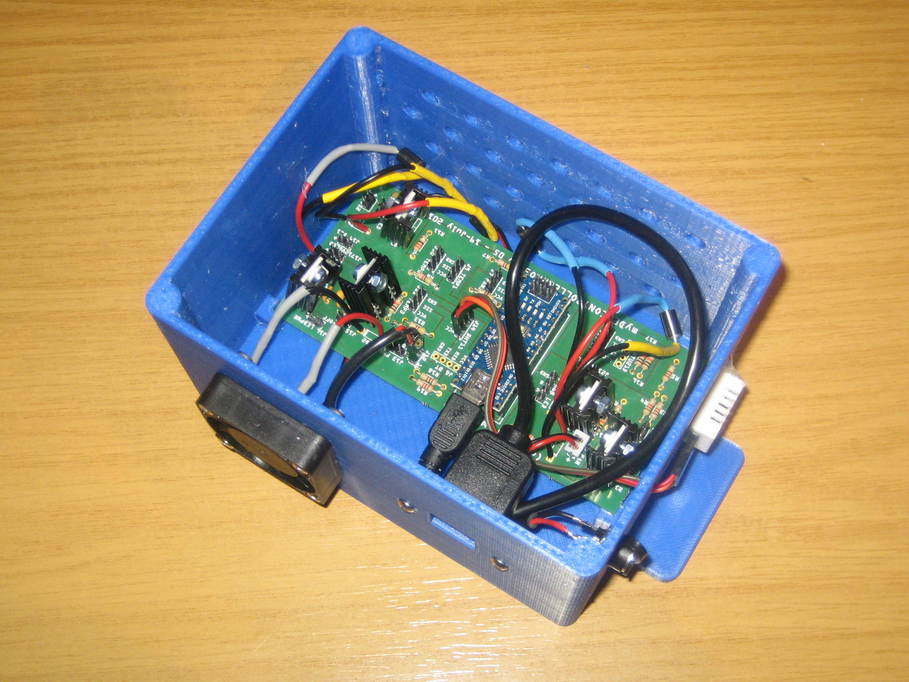
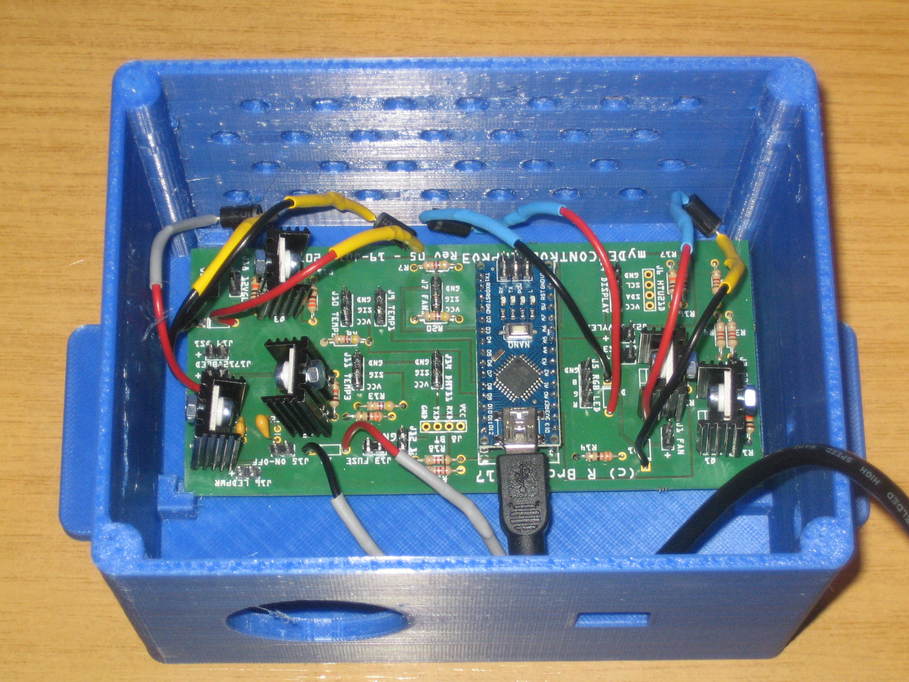
When it came to assembling the case I’d printed it became obvious that the pillars supporting the circuit board really weren’t strong enough to withstand cables being inserted into and removed from the sockets on board the PCB. I decided therefore to print another version, this time with larger square pillars.

(I got bored of red, so this one is blue 🙂

This has worked much better and the PCB is now firmly supported against the forces placed on it via the sockets.

The design for the top was basically the same as the base, but with cut-outs for the sockets and a lip around the inside edge to fit into the base. It is a lovely snug fit which was a pleasant surprise. So snug in fact that I haven’t bothered putting in screws to hold the two halves of the case together.

Posted in 3D Printing, Projects | Tagged | Leave a comment

3D printer filament spool holder

I decided at the weekend that I should have a proper support for the filament spool for the printer that would allow the filament to be pulled into the extruder without needing to negotiate any bends. The printer came with a stand for the spool, but there’s nowhere to fix it on the printer and in fact I really don’t want to stick over a kilogram on top of the printer potentially wobbling it about.

I hunted around in my pile of scrap metal and found some parts from a dismantled wardrobe and a broken step ladder and put them together with the existing stand to make this:

It’s perhaps not quite as strong as I’d like — the back can twist a little as filament is pulled from it, but it seems to do the job nicely.

Posted in 3D Printing, Projects | Leave a comment

Printing my first self-designed object

It’s probably been time to bite the bullet for a while, so I finally decided to get on with designing something of my own to print out on the 3d printer. This is actually a case for the PCB of the PTR unit for occultation recording using oacapture. It’s sat on my desk for some time now in an ill-fitting box, so it’s time to fix that.

I’ve never done CAD work before, but I am familiar with Sketchup. Unfortunately Sketchup doesn’t really like to run under WINE on my Linux desktop, so after searching about for a while I came across OpenSCAD. To my way of thinking this shares a lot of ideas with Sketchup, but the work is done by writing code for all the objects rather than dragging them around the screen. Given that I’m used to coding this works well for me, though it might not be to everyone’s taste.

I decided to make the case in two halves, the lower one being the less complex. Fifty lines or so of code in OpenSCAD resulted in this:

and after exporting it to STL and waiting a couple of hours for the printer to finish I ended up with this:

Whilst I’m not unhappy with this, it’s not perfect. I had an issue with the first layer not printing out nicely which I’ll come to in another post, but the other thing I really wasn’t happy with was the posts. The pins to locate the PCB are fine, but the posts themselves are a bit of a mess. I think perhaps I should have made them bigger and the printer would then have made a better job of them. If I were to print it again I think I’d make them larger diameter, or perhaps square.

Posted in 3D Printing, Projects | Tagged | Leave a comment

Building an observatory: new toys

As the frame for the sliding roof of my observatory is going to be welded up from mild steel I decided I’d take advantage of an offer from one of the online tool vendors to buy a cut-off saw at a discount. My father-in-law then told me that LIDL were selling stands for the princely sum of £40 (a few pence less, actually) so I decided to risk one of those to put the saw on.

As it happens, it’s not bad at all. Very sturdy welded construction and holds the saw nicely. My only criticism might be that it’s two or three inches too shorter than I’d ideally want. That’s easily fixed however, so I shan’t be complaining.

Posted in Observatory | Tagged | Leave a comment

Reducing stringing in my 3d prints

I tried printing a couple of 3d printer torture tests (for example, this one and found quite a bit of stringing between the smaller elements that I really wasn’t happy with.

To try to address that I found a quicker test to run and printed it. It’s tricky to see from this photo (would have been far more sensible to print it in another colour), but the back edges of all the cubes are joined by a very thin layer made from the stringing as the printer jumps between the cubes.

Printing a new test each time I reduced the print temperature in jumps of ten degrees until I had no stringing between the cubes, but at that point I was down to 180C and the printed surface was looking quite poor, so I then started stepping up the temperature again, increasing the retraction distance by 0.5mm each time until I achieved a surface I was happy with and no (or minimal) stringing. That was at 200C with 1.5mm retraction. I could perhaps have gone to 2mm and might still do so.

Another print of the initial test showed significantly reduced stringing and a much better print overall, though the stringing does still exist where the thickness of the print gets down to the same sort of size as the nozzle. I think the better solution there would be a smaller nozzle.

Posted in 3D Printing | Tagged , | Leave a comment