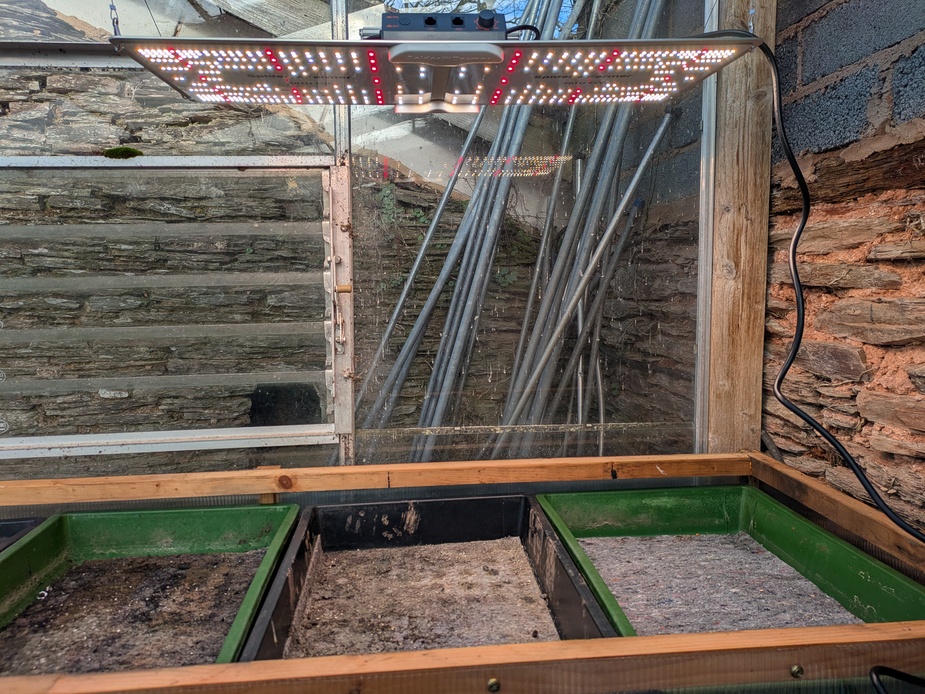
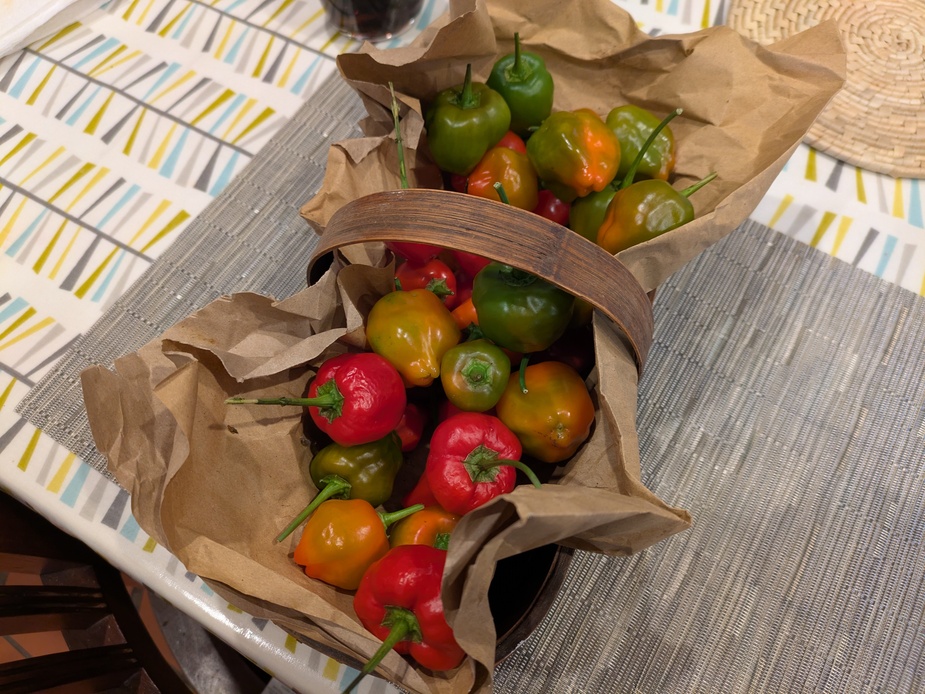
I had a few spare tomato and pepper plants in pots, so I thought I might as well put them in the greenhouse where they’d hopefully provide more fruit despite the lateness of the season. The greenhouse was otherwise empty, so why not put it to use?


I had a few spare tomato and pepper plants in pots, so I thought I might as well put them in the greenhouse where they’d hopefully provide more fruit despite the lateness of the season. The greenhouse was otherwise empty, so why not put it to use?


As I had a number of brood boxes to make up, today I decided to make a jig that holds them square and aligns the frame rails at the correct height. Only when it came to making the parts for that last job, I discovered that the supplied boxes and parts weren’t the same as the published dimensions. I’m guessing that’s partly down to the original boxes being specified in inches whereas everything is now done in millimetres and people sometimes round up and sometimes round down when converting between the two. I think I need to do a bit more research before comitting myself.
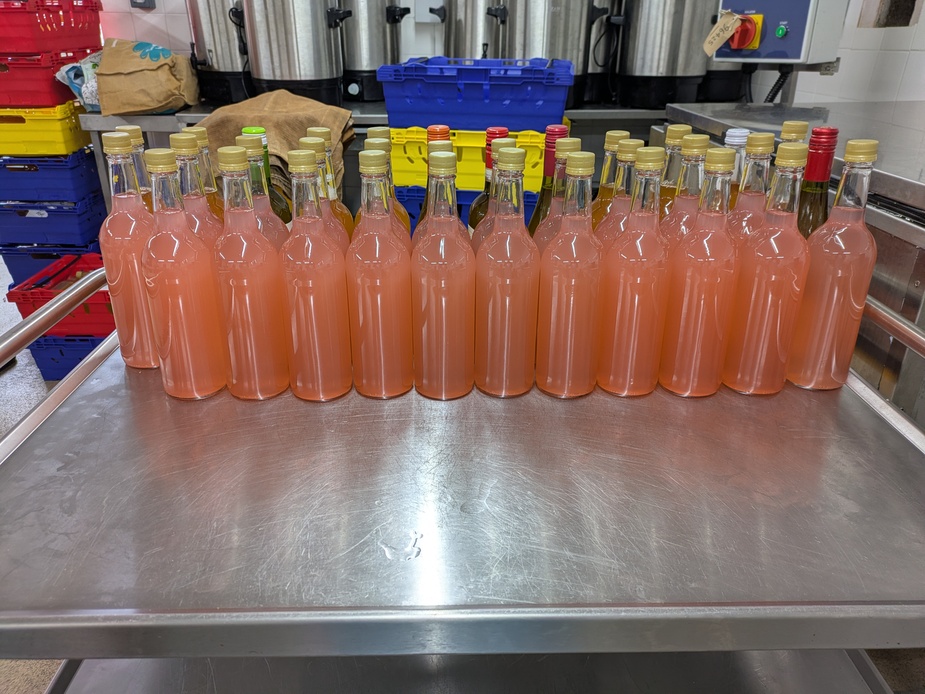
I saved the honey from the cappings when I extracted my supers last year and recently I found some forgotten bottles of apple juice in the cellar that were still perfectly drinkable having been pasteurised at the time, so making cyser (fermented honey and apple juice) seemed like the logical thing to do.
With the yeast added, it’s now bubbling away nicely…

I don’t know if it’s down to the mild winter or something else entirely, but we seem to have so many queen hornets around at the moment.
Whilst I was spreading compost in Frankenstein’s greenhouse I was joined by one, which couldn’t then find it’s way out again. There’s still one in the bee shed, though I’ve just knocked down her nest. We’ll see if that makes her move one. And whilst I was doing that having seen her leave, another flew past me from the other direction.
Shortly afterwards my father-in-law evicted a dead one from the bedroom. Whether that was one I’d already seen or another I have no idea.
Having spent yesterday composting new beds, I decided today was the day that I should catch up with the greenhouses. There’s garlic in part of the bed in one and nothing in the other but potted strawberries, so neither was a major problem to get done.
Just the polytunnel to go now. That will be very soon. There’s pretty much nothing left eating in there and I think at least some of the tomatoes could go in now.
I desperately need to start planting more out, but the weather has just been so rubbish…


I’ve been wondering if I could extract honey from brood frames with my existing extractor and without buying any extra (and expensive) parts. I reckon it might be possible. Only three at a time, but then with screens I’d only be able to do three at a time as well. And I’d have to turn them around to extract each side.

Why do I want to extract brood frames? Well, if I’m using a Demaree as a swarm control method, I may well end up with more than I need to feed nucs and suchlike, so extracting them seems sensible.
Since I now have the concrete pad removed from the veggie plot I can at last finish the new beds that I started back in February. I extended them to line up with the rest of the beds (although they run at right angles) and got the compost and woodchip paths all down. I’m now completely out of woodchip until I make some more. I also ended up adding some small beds at either end of the raspberries. Those will be for new fruit bushes this coming Winter I think. For this year I might use them for outdoor tomatoes.


A few candid shots when this one turned up in the field behind our house today. I assume it must have come down off Exmoor looking for food. It’s quite rare to see them here.


Having taken the sides off the old strawberry bed, the problem remained of what to do with the soil it contained — probably about half a tonne. The bed was next to a concrete pad with a dwarf wall of concrete blocks around it. I think it used to be the base for a large dog kennel. I put an old garden table on the pad and used to use it for standing plants on, but the table succumbed to terminal rot and is now on the bonfire.
I decided that life would be much easier from the point of view of maintaining the veggie plot and accessing the compost area with the tractor if I got rid of the pad altogether. I almost wish I hadn’t 😀
The blocks forming the dwarf wall were buried about a third of their height in the ground. I had to dig around the outside of many of them so I could dislodge them, and being old “proper” concrete blocks, they were very heavy. Eventually I had removed enough of them to discover that the pad was concrete laid on brick rubble and about 5″/125mm deep. I couldn’t break it with a sledgehammer as it was.
Eventually I noticed a crack in the pad and managed to free a corner and drag it away. That spurred me on to see if I could somehow break some more. I ended up with a couple of very large pieces that I used the digger to lift by the edge and lay back down on top of some of the removed blocks. That allowed the sledgehammer to be used to rather better effect and after much effort I managed to break the rest into pieces I could pick up.
After clearing the area I started to drag the soil from the bed back over the top of the hole I’d made, at which point I found absolutely loads of bindweed. I did my best to get it out. I reckon I had several kilos of roots by the end of it.

That done, a little “smoothing” of the soil and in a few weeks no-one will ever know there was ever anything there…