Observation report 15/2/2011

After almost a full day of pouring rain, the skies cleared in the late evening and the seeing was excellent. The moon was bright enough to cast crisp shadows and to illuminate the smoke from one of our chimneys as it rose straight upwards.

Given the brightness of the moon there seemed little point spending time attempting to view anything else so I decided to attempt a few features on the Lunar 100 list. First up was the Copernicus crater, easily found but perhaps would have been better a couple of days early when the illumination was more oblique. It wasn’t as bad as some of the features towards the eastern limb though, where most detail was lost in the brightness. A short hop north-west took me to another crater, Aristarchus, and then back over to the east to see the impact rays across Mare Crisium from Proclus.

At 50x magnification the fractured floor of the Gassendi crater was just about visible, but needed observing for some time for the details to resolve. Sinus Iriuum with its missing south-eastern rim was easy to see.

I spent some time trying to find the straight wall running south from about 18°S 8°W, but couldn’t see it at all, again probably due to the angle of lighting and whilst I could see the Petavius crater, it’s floor features weren’t visible to me for the same reason.

I upped the magnification to around 80x and was rewarded with a fantastic view of Schroter’s Valley and of the different surface textures in Mare Serenitatis after which I went looking for the Alpine Valley leading up to Mare Frigoris. It took some time to pick that out and then once I’d seen it I couldn’t believe it had been so difficult to find. It’s described as a “graben”; I had to look up what that means. The best description I can come up with is something like a rift valley.

Posidonius and Fracastorius were very clear as was the Aristarchus Plateau, but after some searching I was unable to identify Pico to my satisfaction. It also took me some time to find the Hyginus Rille before I realised I’d been staring right at it for several minutes.

With time getting on I decided I couldn’t stay out much longer, so finished by finding the Archimedes crater and the oblique impact features at Messier, Messier A and Schiller. Just on the bright side of the terminator and still partially in shadow, Schiller stood out strongly, looking very impressive.

By this time Saturn was about 25° above the horizon and I couldn’t really call it a night without a quick viewing. It was time well-spent as the image was far sharper than a few nights previously. I tried pushing the magnification up to 250x using a barlow, but couldn’t achieve focus. It’s probably asking too much of the ST102 anyhow and the barlow is only the cheap and nasty one that was supplied with my ST80, so I wasn’t expecting much. I do have a much better one arriving shortly, so I’ll try again at around 170x next time the seeing is good.
Posted in Astronomy | Tagged , , | Leave a comment

Focus motor drive for Startravel 80 & 102 Review

One of the problems with the ST80 and ST102 on the EQ1 mount is the amount of “wobble” when changing focus, which not only takes a while to settle down afterwards, but makes it more difficult than it need to be actually determine when the scope is in focus in the first place. I put up with the problem for a while, but when someone mentioned in passing that Skywatcher have a motorised focus drive, I thought I’d give it a try. I bought mine from First Light Optics, but they’re available from many different suppliers, often misleadingly called an “autofocuser”.

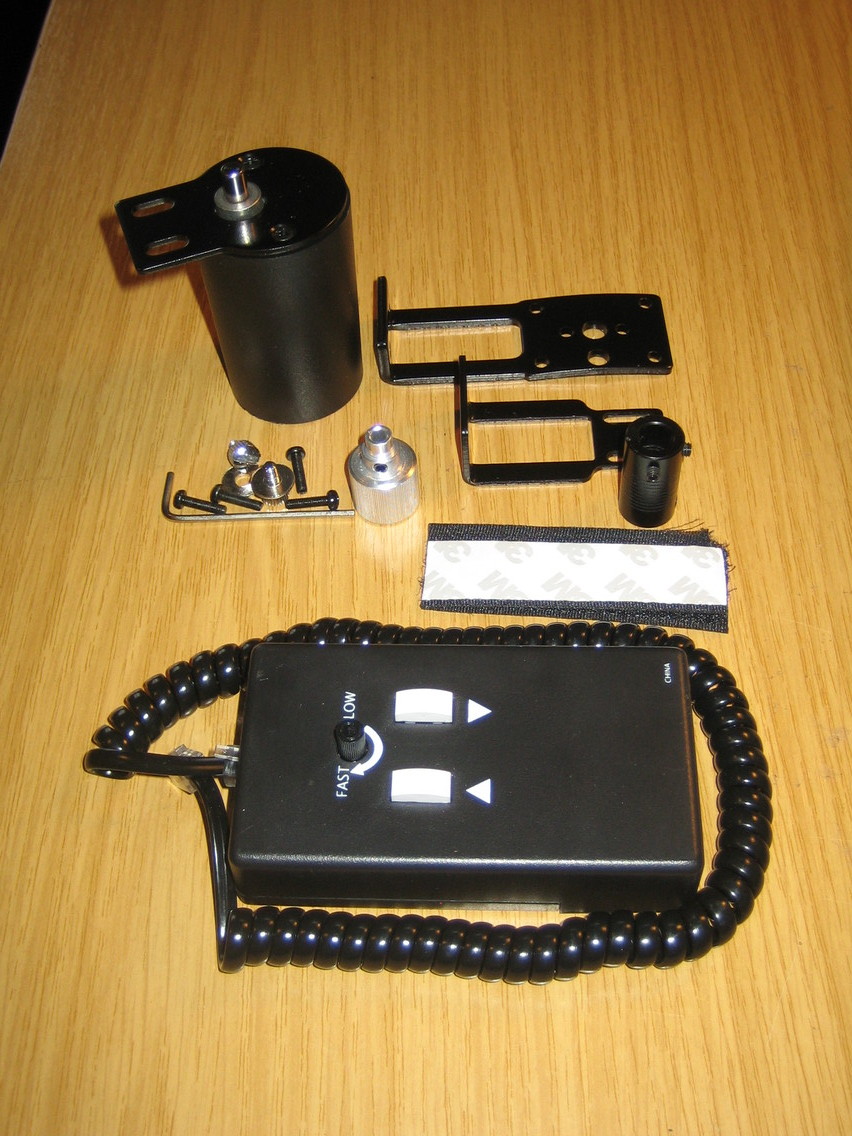
The drive arrived as a kit of parts, some of which weren’t necessary for my scope(s), including the motor, controller, battery, cable, two mounting brackets, four screws for retaining the mounting plate, two knurled and slotted screws for attaching the motor to the mounting plate, a plastic “universal joint” type drive connector, an Allen key, a length of self-adhesive velcro and a metal connector which appears to have an O-ring in the open end that was already fitted to the motor output shaft. This clearly wasn’t intended to fit anything I was going to use it for, so I had to remove it (with some difficulty — it was quite stiff even after I’d removed the retaining grub screw completely). Oh, and an A4 sheet of instructions which, whilst OK, weren’t brilliant. I assume the larger mounting bracket is for some of the other scopes that the kit fits and I didn’t use the four retaining screws because the existing ones held the mounting bracket I used without any problems.

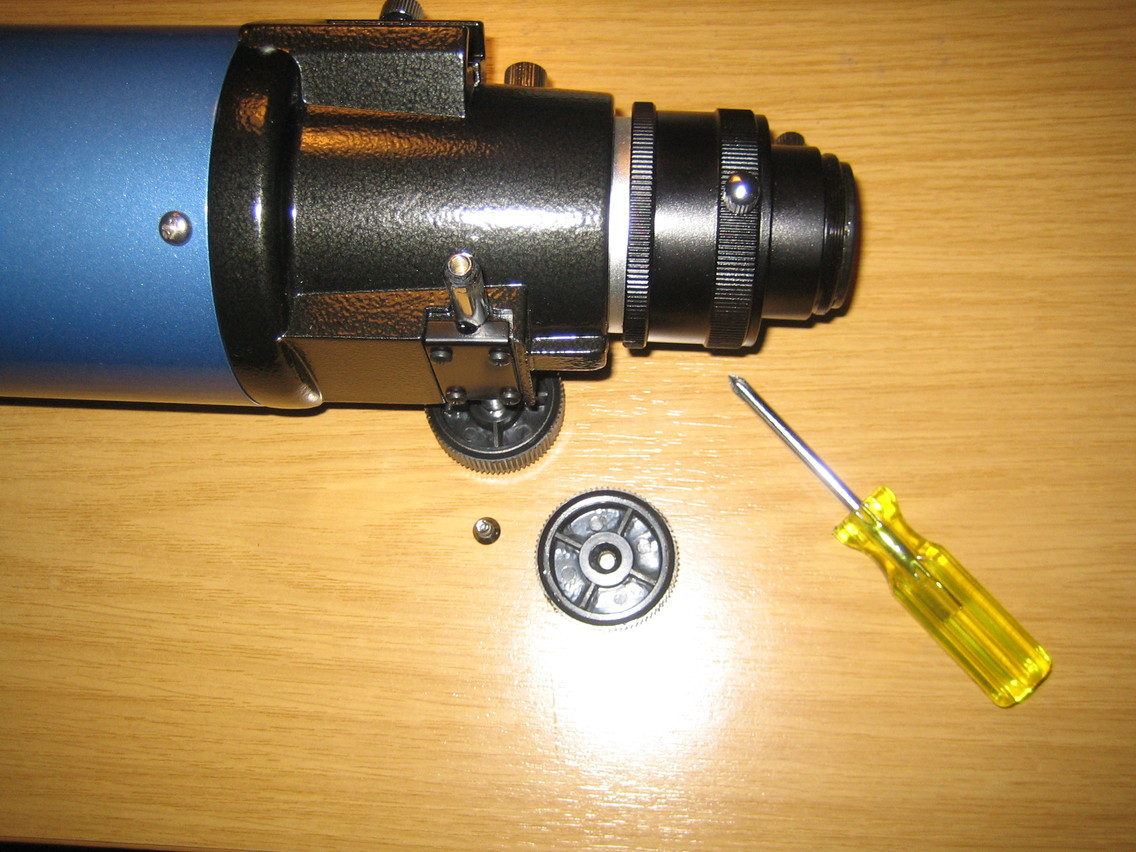
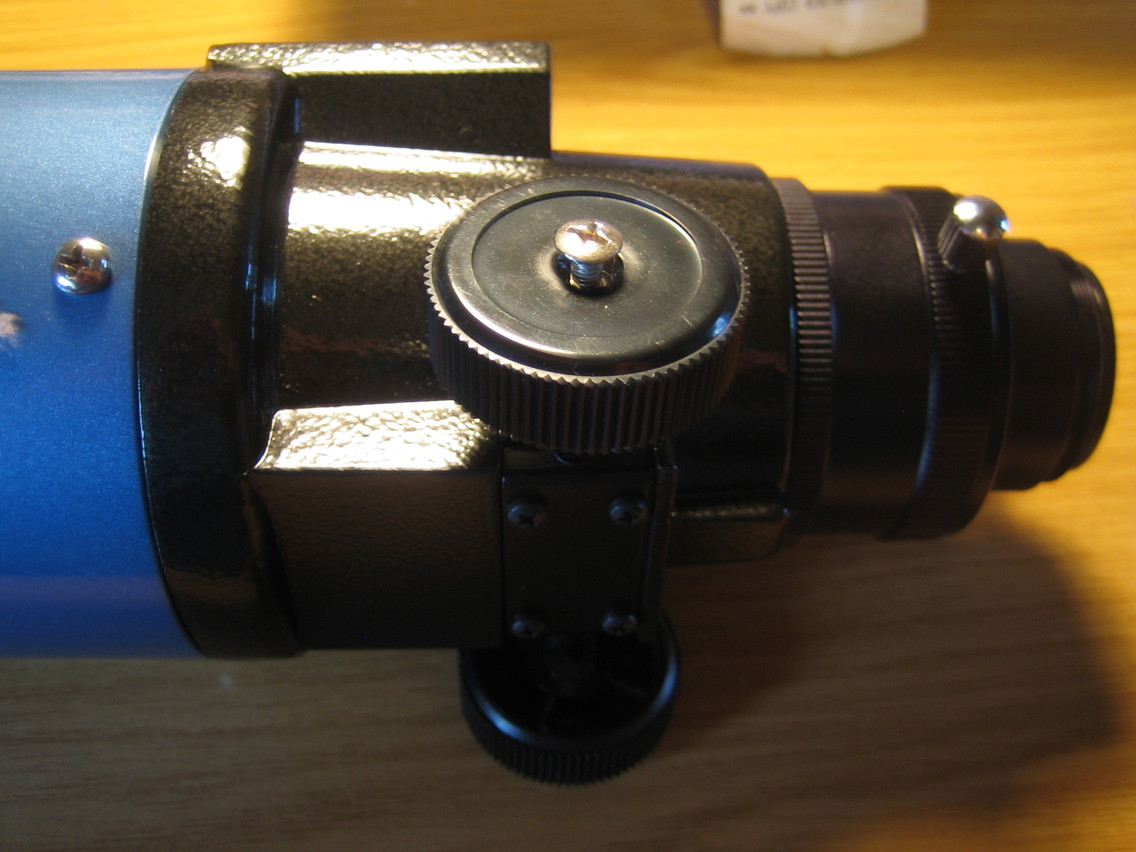
The first job is to remove one of the focusing wheels, by removing the screw in the centre and then just easing it off. I’ve fitted this kit to both my ST80 and ST102 and whilst the ST80 wheel came off easily, the ST102 was very stiff and needed a certain amount of carefully levering to remove it:

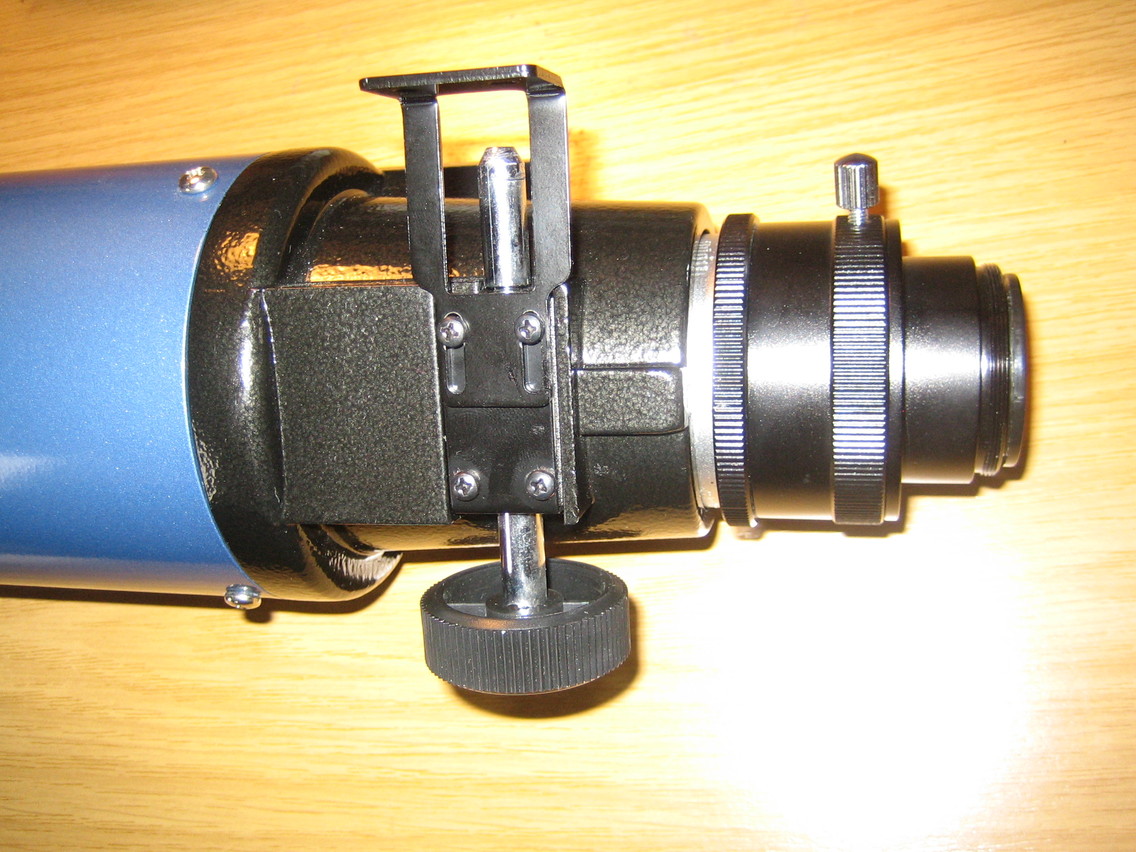
With the wheel removed the two screws nearest that end of the focusing shaft can be removed from the plate covering the pinion wheel and the motor drive mounting bracket refitted with the same screws. I did them up just tight enough to hold the bracket in place without slopping around so I’d be able to move it into the correct position to fit the motor drive:

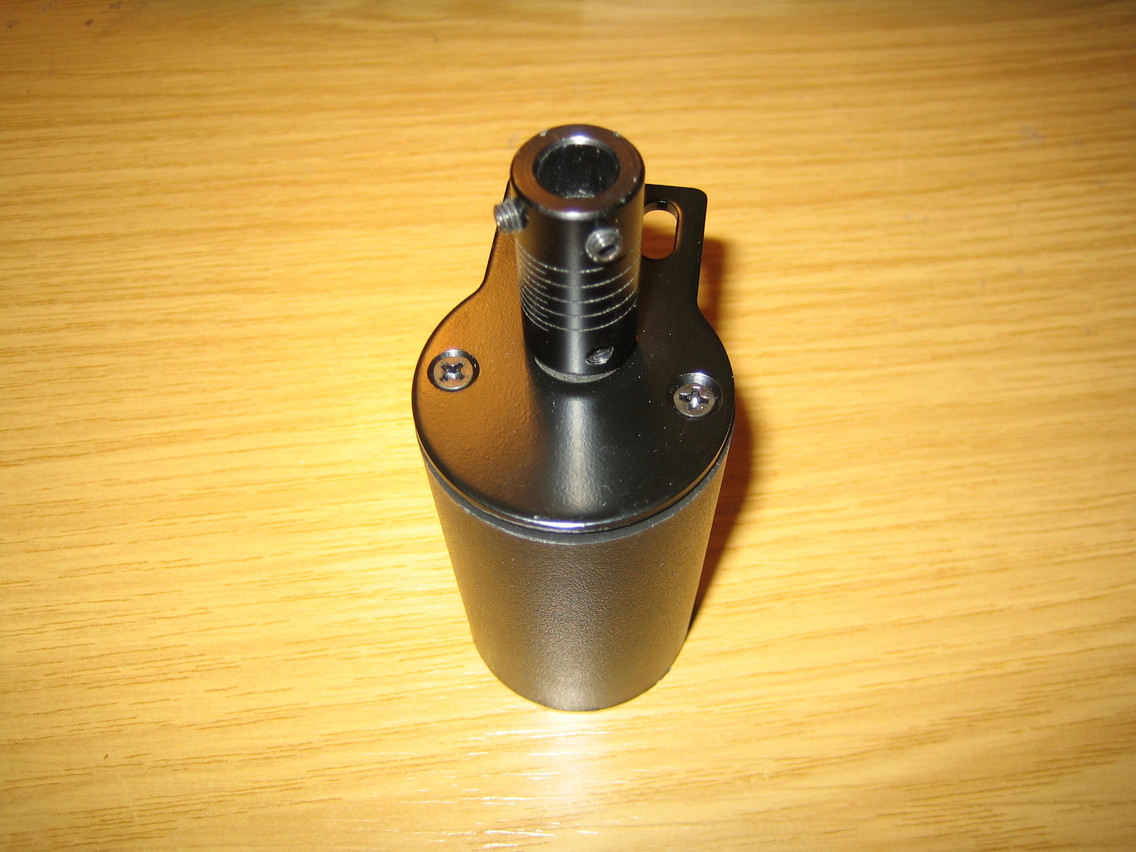
I fitted the plastic connector onto the motor next. The shaft has a flat on it for the grub screw to bear on so orientation matters whereas the focusing shaft doesn’t and the other end of the connector will go on in any orientation. However, it’s worth aligning the connector before putting it over the focusing shaft to allow easy access to the two grub screws for tightening them onto the shaft:

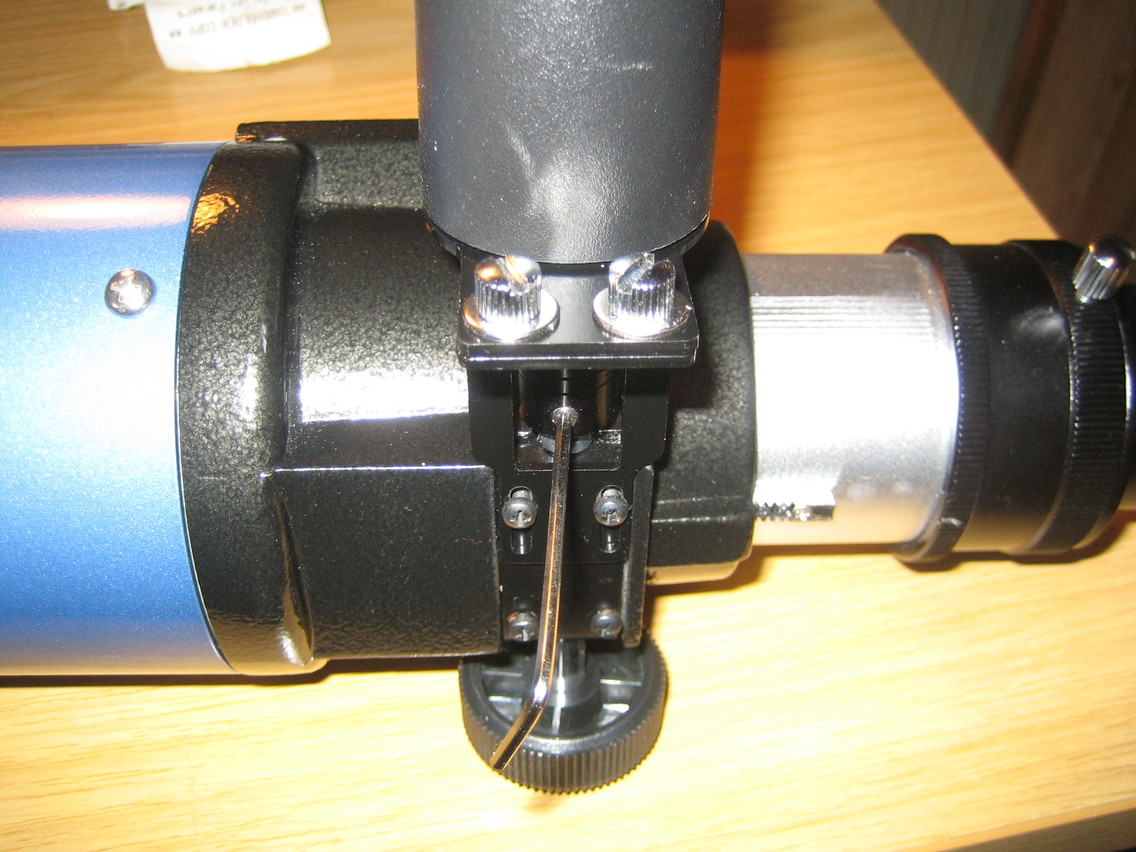
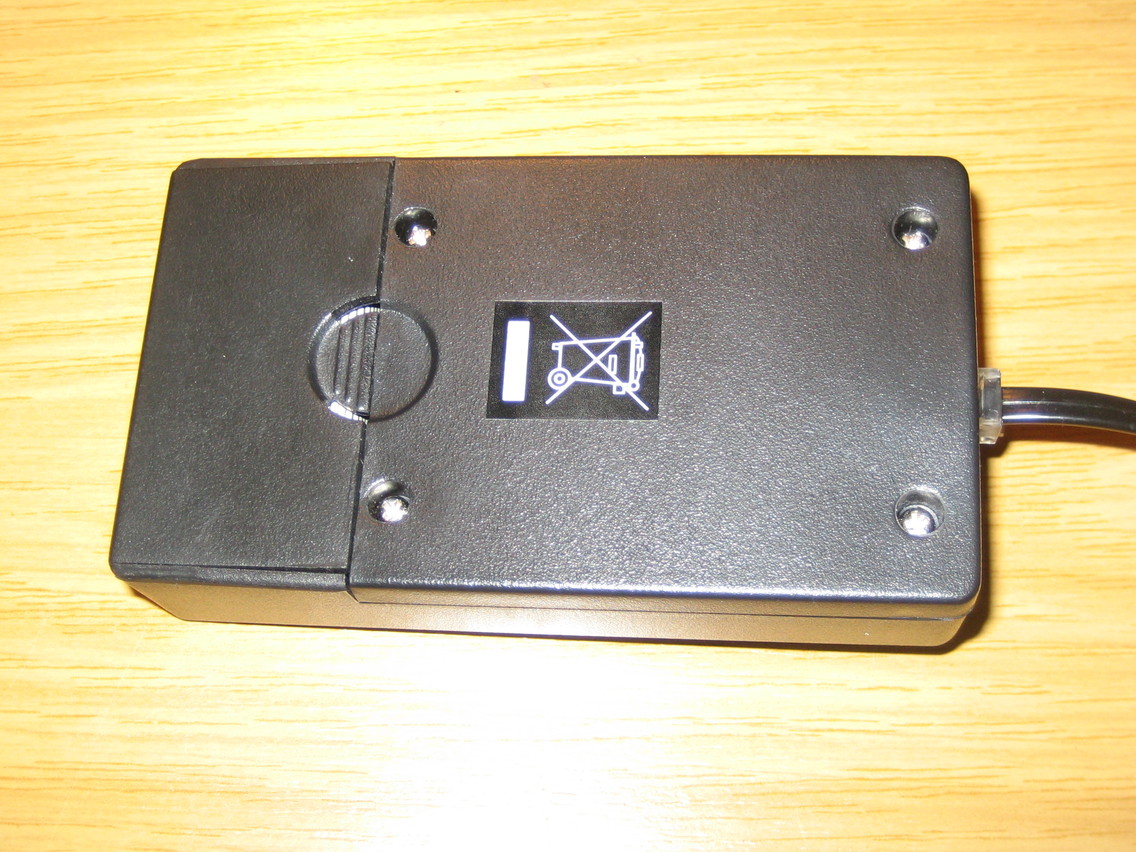
With the motor connected I connected the motor housing to the mounting bracket and tightened up the screws on the bracket itself. Before connecting everything up the battery needs to be fitted into the controller. I found there to be almost no free space around the battery for the connector cables and couldn’t get the battery compartment cover closed with the battery in place, so ended up undoing the four screws on the back of the controller to allow the cover to be put in place, then screwed them back down:


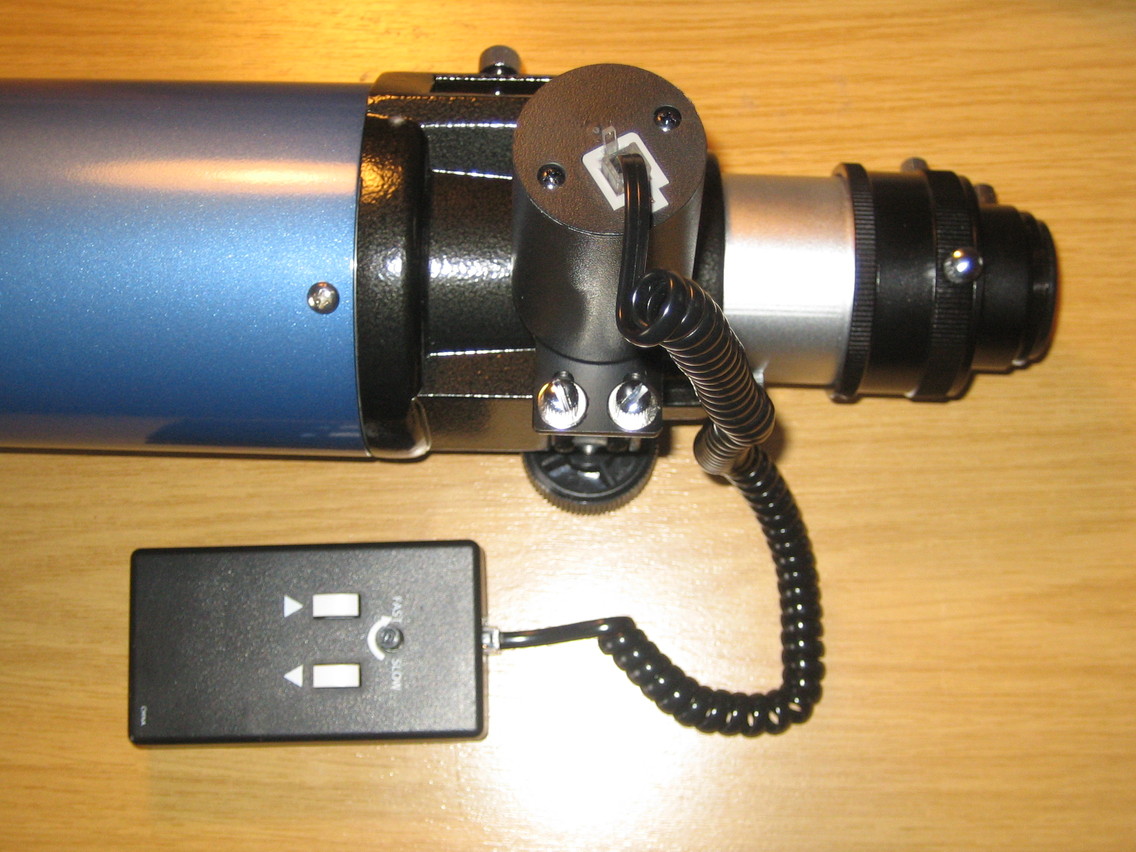
Finally, connect up the cable — either way around seems fine — and test it.

I was concerned that I’d find using the controller to focus the scope rather than the focus knob a nuisance, but actually as long as I keep the controller somewhere it’s easy to find without taking my eye from the eyepiece when I need to, it’s fine, and the entire process of focusing is far easier because the image stays beautifully steady. Learning which button moves the focus in which direction and which way you need to turn the speed controller to make the movement faster or slower takes a while to get the hang of, but it’s no different from getting used to the slow motion controls or the clutch locks on the RA/dec axes. It also helps if the cable is fixed to the scope body somewhere to stop its weight dragging the focuser end of the scope down when the clutch locks are released.

I found one additional problem with the ST80. Without the motor drive the scope would only balance in the rings if it was as far forward as possible, with the screws attaching the scope tube to the focuser housing tight up against the rear scope ring. With the motor fitted the scope wouldn’t quite balance without additional weight at the front of the tube.

All in all I’m very happy with the improvement the motor drive has made. A more rigid mount would also solve the problem, I’m sure, but this is a very acceptable alternative until I can justify spending that kind of money

Posted in Astronomy | Tagged , | Leave a comment

Cider Apple Pressing 2010

Behind our house are a small number of cider apple trees around twenty-five years old. Three of these I have identified as Yarlington Mill, two are Dabinett, four are, I’m fairly sure, Somerset, and the remaining three I have not been able to identify, though they’re definitely Jersey-type apples. Yarlington Mill and Dabinett are pretty good cider varieties. The Somerset trees are prolific, but don’t produce particularly good quality juice.

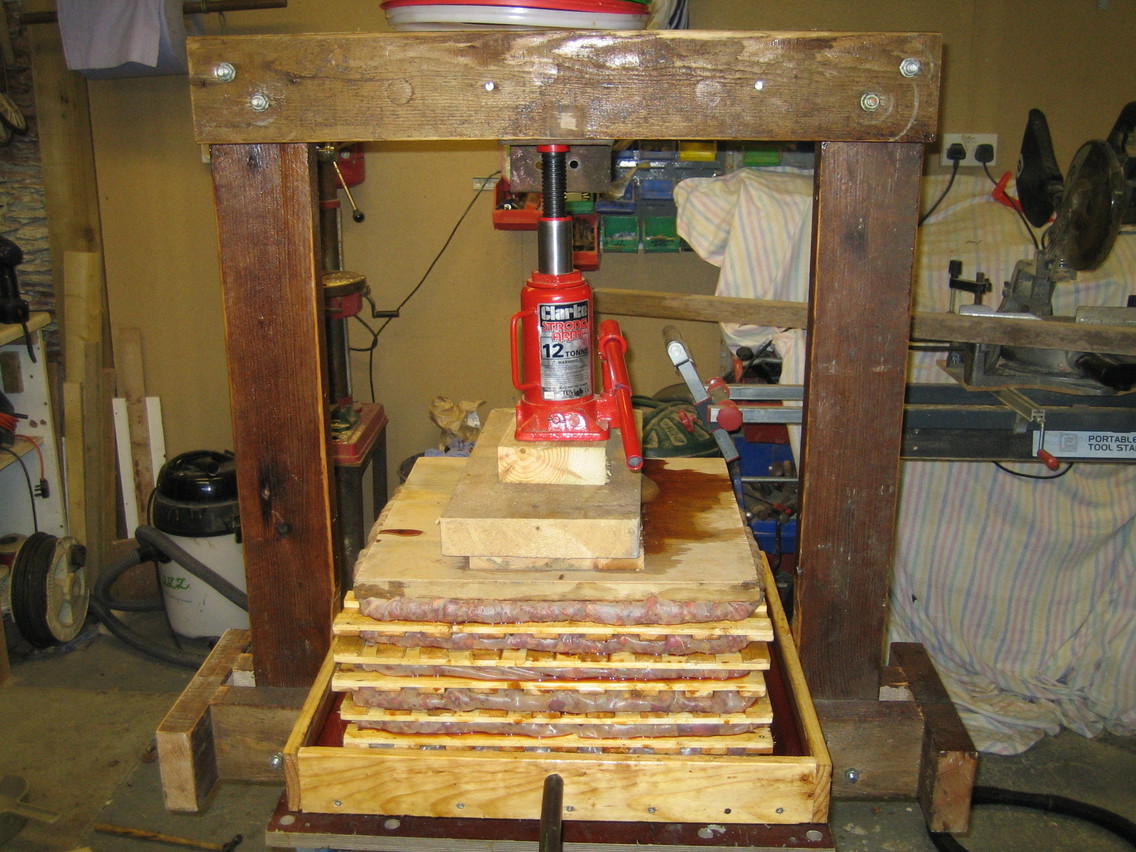
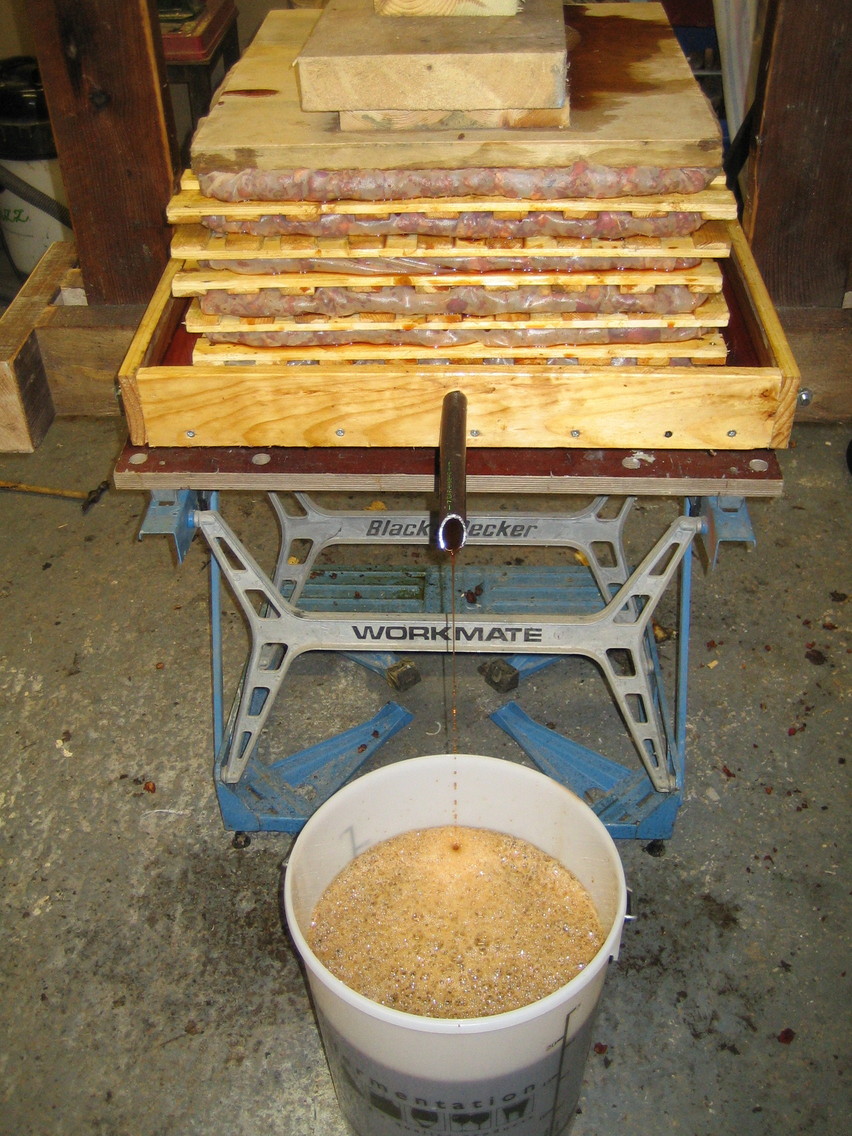
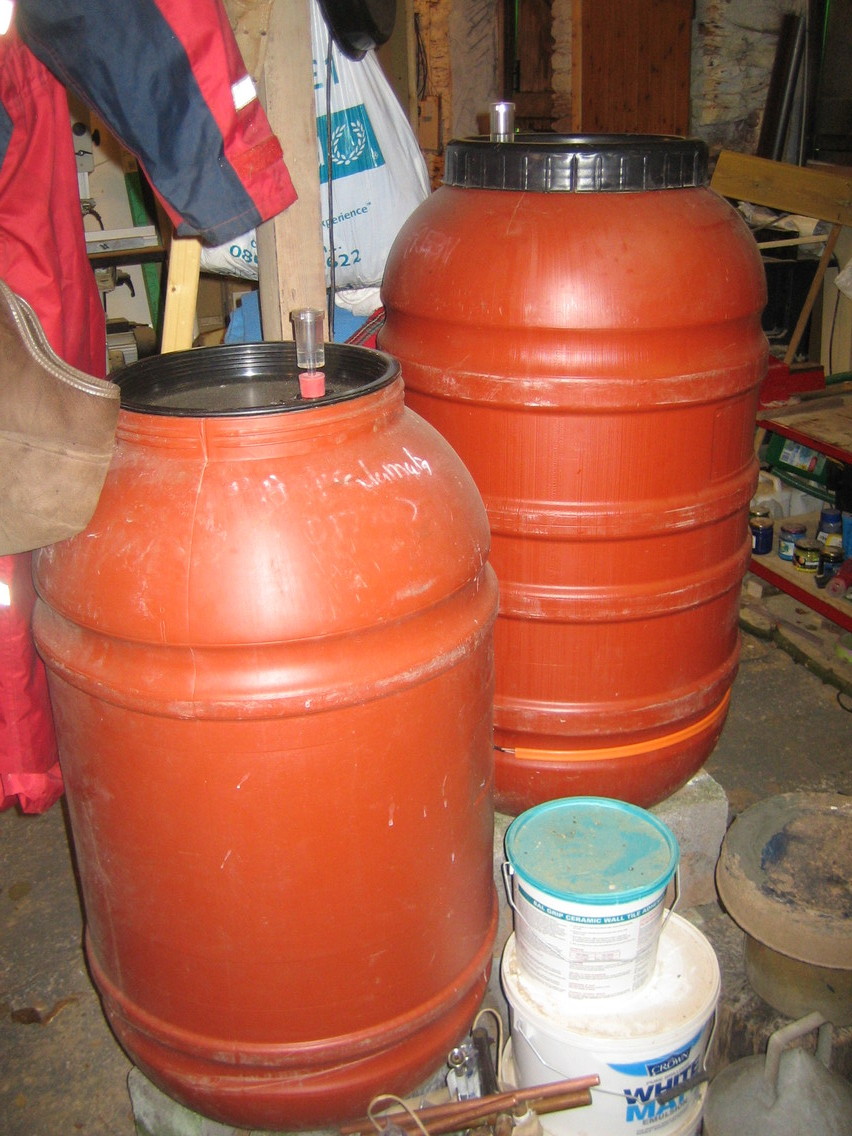
The last couple of years there haven’t really been enough apples to be worth pressing, but this year I managed to collect around 40 sacks full. Pretty much all of these (which I estimate to be in the region of 700 to 800kg in weight) came from the Yarlington Mill and other Jersey type trees. At the start of November I got to work pressing them using my Vigo crusher and home-built bottle jack-driven press.

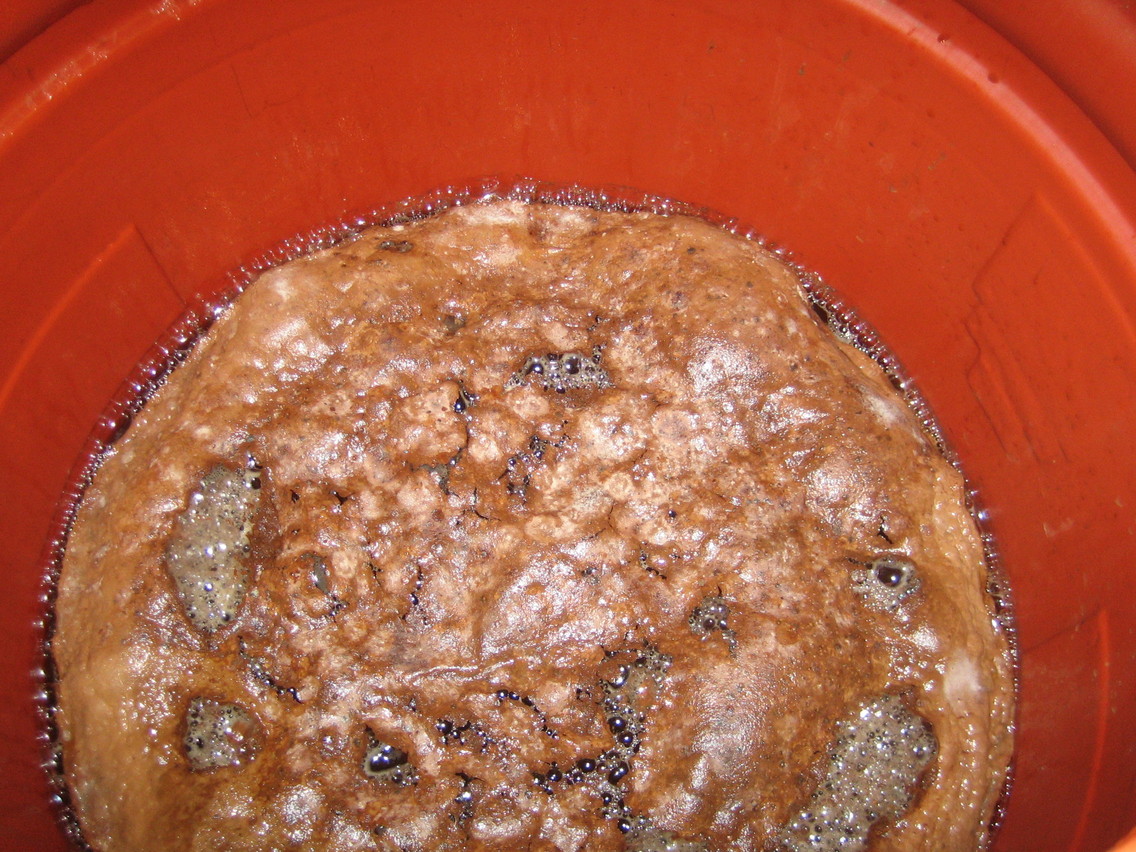
By the end of November I’d pressed around 600kg of apples to produce in the region of 300 litres of juice which I’ve split between two 220 litre barrels in the workshop. I also added a couple of dozen litres of juice from some Bramley apples to try to raise the acidity a little as all the others are bittersweets. To kick off the fermentation I also added some cider yeast. Unfortunately the remaining apples froze solid (the temperature did get down to -10C at some points) and by the time it was possible to press them they were little more than mush.

Due to the very cold weather throughout December (the coldest in 100 years, I’m sure it was announced on the news) the fermentation has been exceptionally slow. I’m hoping it will pick up again as the weather starts to warm up as we reach the end of winter.

Posted in Cider-making, Smallholding | 2 Comments

UK light pollution map

Someone pointed me at an excellent interactive UK light pollution map the other day, apparently done as an overlay on Google Earth. It’s quite shocking to think that all those bright areas represent wasted fuel, wasted energy and, especially in the current economic climate, wasted money.

I am lucky in that having spent a good fifteen years living in several of the red areas of the map I now live in one that doesn’t even show up on the map, although there appears to be someone a mile or so across the valley who’s doing his level best to change that.

Posted in Astronomy, Environment | Leave a comment

Observation Report 13/2/2011

Around 11pm the sky eventually cleared after a day of heavy cloud and rain to show a sky mostly washed out by the moon. This was my first chance to try out my new (to me) Startravel 102 though, so I wasn’t going to let the lack of things to look at put me off.

Given the brightness of the moon it seemed sensible to start there, so I spent a good hour or so finding the Apennines, Tycho, Clavius, Proclus and Mare Serenitatis. I tried to find a few other features towards the eastern limb, but being lit from overhead I wasn’t really able to get a good view. They will have to wait for another time. Those features near the terminator were stunning though, even at only 20x magnification. I did try 50x magnification, which made it tricky to identify whereabouts on the moon I was and it was tricky to get anything meaningful in focus beyond that.

On the point of packing up I noticed Saturn had crept around the corner of the house, though it was still fairly low on the horizon. Starting at 20x and working my way up to 125x magnification I ended up with a beautiful view of the planet and rings, closely accompanied by Titan. I look forward to seeing it higher in the sky over the next few months.

Posted in Astronomy | Tagged , , | Leave a comment

Observation Report 7/2/2011

Another night with fairly poor seeing and some cloud, but I wanted to catch up on some of the things I’d missed a few days earlier.

Again I had to give up on M77 and M79, but this time I found M31 fairly easily in the scope and spent some time observing it. Yet another thing I’m amazed I’ve never picked out with the naked eye.

Given the poor seeing and the barely lit moon I spent some time familiarising myself with it, but could really only pick out Mare Crisium. The lunar surface was dancing about all in the scope making it very difficult to view anything in detail, so at that point I decided to call it a night.

Posted in Astronomy | Tagged | Leave a comment

Observation Report 2/2/2011

Not the clearest of skies this evening, with some bubbles of cloud drifting across the sky, but you have to take what opportunities you’re given.

I thought I’d do a bit more Messier Object hunting this evening. First on my list of targets were M77 and M79, but I think they’d got too low in the sky to pick out with either binoculars or scope, so after half an hour’s fruitless searching I moved on.

M78 took some finding, but I eventually got there by using Stellarium and star-hopping. I’ve looked for it previously without success. Now I’m a little more used to what to look for it was easier, but still quite hard to find in the scope.

Following that I stayed in the Canis Major/Monoceros/Cancer area and found M50, M35, M46, M47, M93, M44, M67 and M48 in relatively quick succession. I was surprised to discover how bright and easy to find M44 (the Beehive cluster) was. It’s hard to believe I’ve never picked it up with the naked eye.

Moving around to the East and North I then completely failed to find any of M65, M66, M95, M96, M105, M81, M82 or M51. Possibly that’s just because they’re not particularly bright and the seeing was far from good.

Not wanting to end on a disappointment I had a scan across the western horizon with the binoculars in time to see M31 just before it disappeared into the murk. There wasn’t time to find it in the scope, so that’ll be something I save for another day.

Posted in Astronomy | Tagged | Leave a comment

The Tree House Project

(Apologies in advance if you’re confused by the feet-and-inches measurements. I was brought up with metric at school and imperial at home and tend to use whichever comes to mind first. 6′ is near enough 1.8m and 8′ is 2.4m)

For Christmas my wife suggested that I build a tree house for the children. I didn’t have one when I was a child and I thought it was something they’d get enjoyment out of for many years, so it seemed like a great idea.

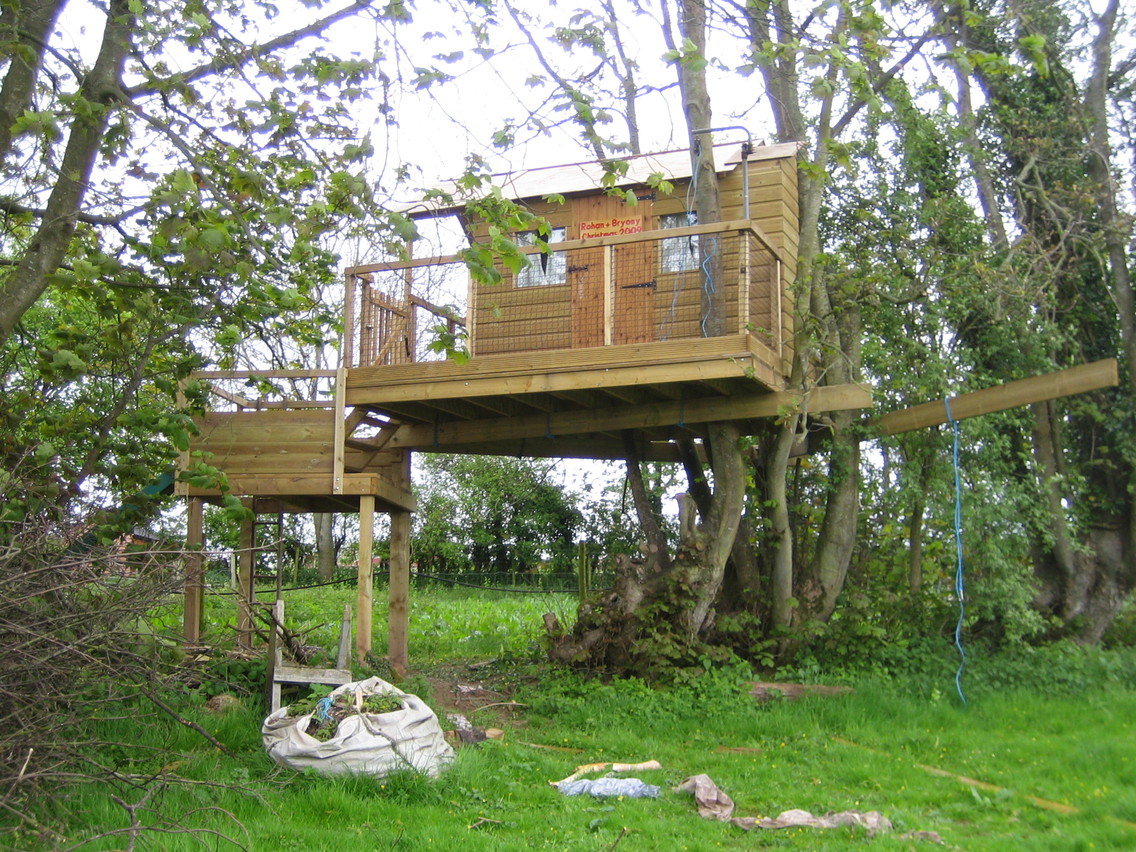
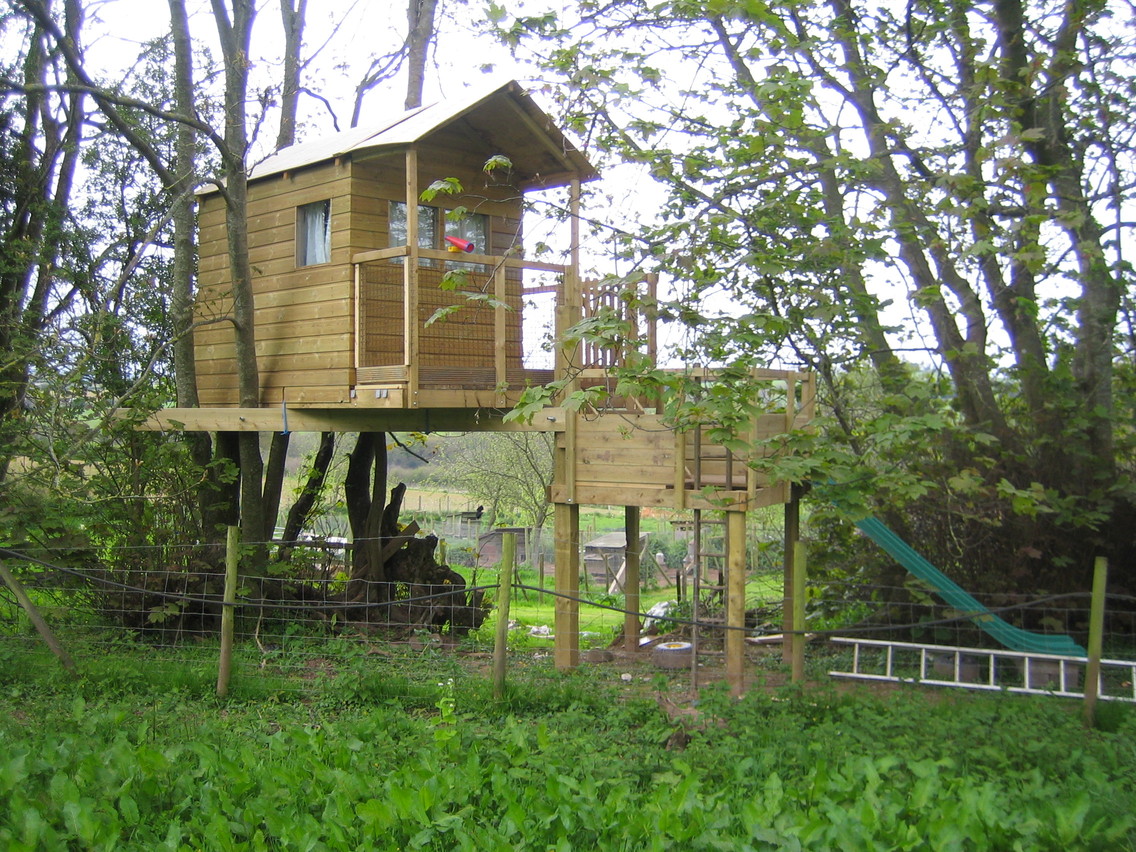
We have a number of fairly mature trees, but unfortunately the ones where I wanted to put the house are all in a line, so I picked trunks I could use to support one end and concreted a 6″ square post about three feet into the ground outside the line of the trees. With the post firmly in place I drilled holes through the trunks and post and fixed 8″x2″ timbers between them at a height of around seven feet using 22mm threaded steel rod. The timbers actually form a “kite” shape with the “bottom” of the kite supported by the post and the three other corners fixed to tree trunks.

The 8″x2″ timbers formed a frame on top of which I built the platform for the house from 6″x2″ timbers forming a rectangle approximately 11’x8′. This isn’t fixed rigidly to the supporting timbers, just tied down with rope. It means that as the tree flexes there’s no load on the house and platform so there’s no risk of it being pulled apart.

I planned to have the 8’x6′ “house” in the trees aligned with one corner and a platform around the other two sides with a ladder up to it. The area occupied by the house I floored with standard flooring chipboard and then “stick-built” the walls and roof from 3″x2″, incorporating spaces for windows (double-glazed, no less) scavenged from the remains of the ones we’d replaced in our house. The remainder of the platform I covered with grooved decking leaving a gap around one trunk I thought would be fun to leave growing up through the decking.

The outside of the house is covered with ship-lap and at the moment the roof is a couple of sheets of light-weight construction ply. Because I constructed the house in the late autumn and early winter it was hard to tell how dark it would be when the trees were in full leaf. I think I’ll probably end up replacing at least some of the roof with clear plastic sheeting to let in more light.

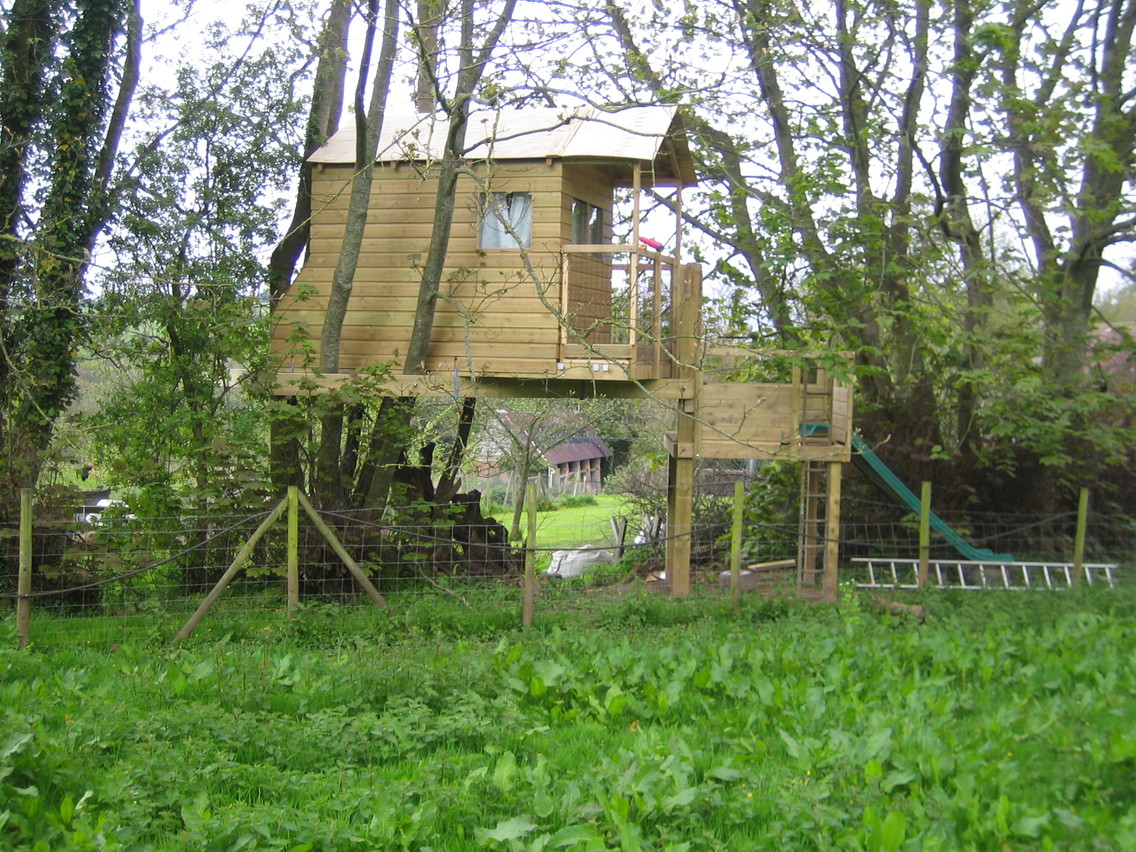
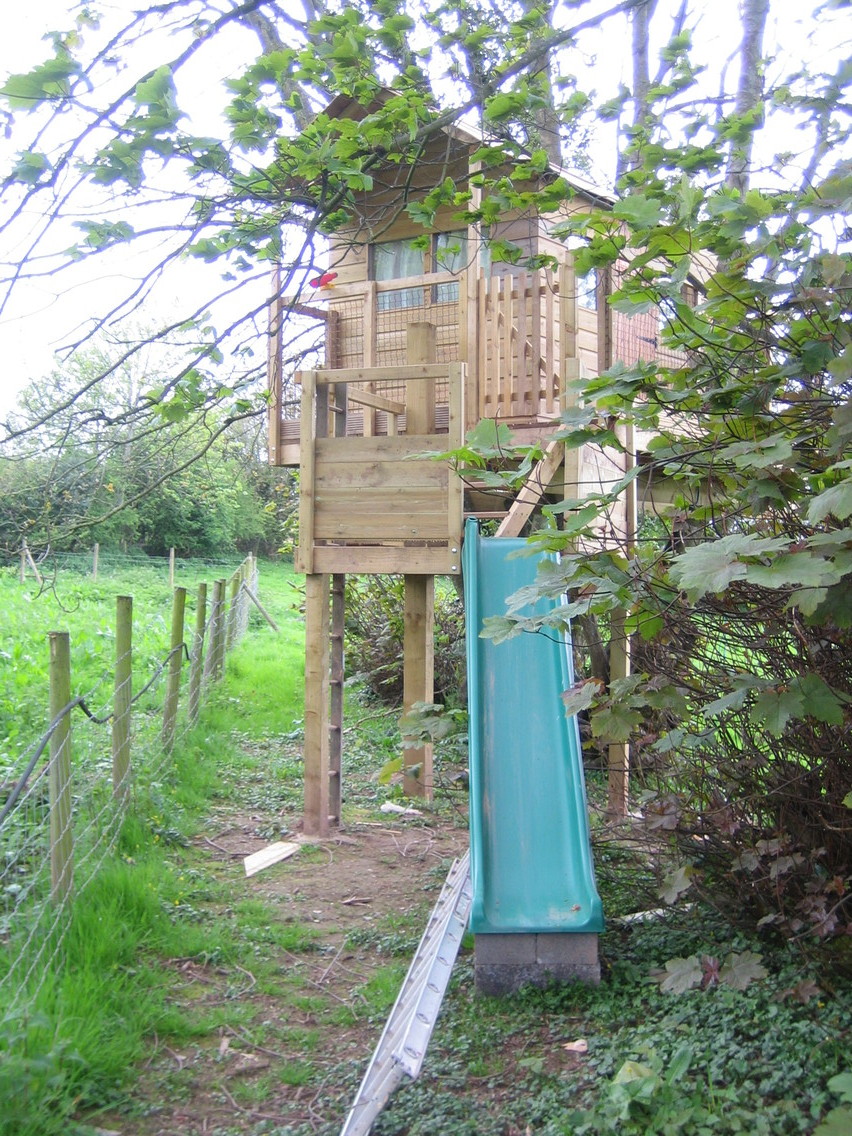
At this point it occurred to me that we had a spare slide body stashed away somewhere, so I dug that out and found that it wasn’t really tall enough to reach the main platform so I decided to build a second lower platform with steps up to the main one. This holds the top of the slide and has a trap door reached via the ladder.

The last stage of construction was to add rails to both platforms with boarding or fencing to stop over-inquisitive children falling out, and a gate at the top of the steps between the platforms.

My son was desperate to have a pulley to lift things up to the house, so an old television aerial mast, some bits of steel bracketing and a pulley from a dead ride-on mower deck were pressed into service and do a fine job.
The house has survived some high winds unscathed and gets played in regularly, so I’m very pleased with it. In fact, sometimes I’m almost tempted to take the laptop out there and work…

Finally, a couple more photos. If there’s interest in additional details of the construction I’ll be happy to take some more.

Posted in Projects | Leave a comment

Observation Report 30/01/2011

It’s been a beautifully clear day here, so I put the scope outside as the sun was going down on the off-chance of getting some clear sky despite the signs of cloud coming in. At 8pm there was still some cloud hanging around to the north, but it was clear to the south and I could make out at least some of the Milky Way so I decided to go out and pick off a few Messier objects.

I quickly found M42/M43 just to get my eye in and then went hunting M36, M37 and M38 which I was determined to find tonight having miserably failed on Friday. Switching between the bins and finder scope I finally located one and hopped to the next, but whilst I decided I could see all three in the bins I just couldn’t find the last one in the scope. It took quite a while for me to realise I’d found M36 and M37 when I thought I’d found M38 and then M36, so I was looking at the wrong end of the group for the last one. That problem sorted I found M38 fairly easily. Now I’m back inside and have had a chance to look at Stellarium I think that through the scope I’d mistaken the cluster of stars around Chi-Aurigae for those around 14-,18- and 19-Aurigae, so misidentified the first cluster I found. I’m not entirely surprised that should happen; I’m at a pretty dark site so there are a large number of stars visible in both the finder and scope. Inexperienced as I am, I find it far too easy to pick the wrong star as I’m star-hopping between objects.

From there I moved on to the Crab Nebula, which I’m fairly sure I found given that there doesn’t appear to be much else to mistake it for in that area of the sky, but in my scope it didn’t seem much more than a very small fuzzy patch.
To finish off for the evening I had a look for M41 which was pretty much jumping up and down shouting “Over here!” by comparison to the others.
That took me up to about midnight by which time I was starting to lose the feeling in my feet, so I had a brief look at Saturn before calling it a night.
Given practice and time to get more at home with what I can see through the scope I think I could find them all far faster than I did tonight, but we’ve only had three reasonably clear nights since I got the scope at Christmas, so I’m happy with what I achieved.

Posted in Astronomy | Tagged | Leave a comment

Observation Report 18/01/2011

I had two trips out with the scope today.

The first time was around 8am when the sky was clear and Venus was visible about 15° above the horizon before the sun had risen. The planet was a clear crescent shape, close to half-lit.

In the evening the sky was clear though much of it was washed out by the near full moon. It was possible to see Jupiter and make out the northern equatorial band. The four Galilean moons were also visible. Close to Jupiter I found Uranus, but no detail was apparent other than being a fuzzy pale blue disc. Targets for the evening included a few Messier objects:
M45 (The Pleiades) was bright and many stars were visible in the scope.
I tried to find M36, M37 and M38 in Auriga, but it was too washed out by the moon.
In Orion, the Trapezium was clear, but M42 and M43 were again too washed out. The A/B, D & E stars were easy to pick out in Sigma Orionis, but there was no obvious difference in colour.
Alpha Geminorum was clearly elongated, but I wasn’t able to split the stars.
All my other targets in Canis Major, Monoceros and Gemini were too washed out by moonlight to find.

Posted in Astronomy | Tagged | Leave a comment